Monte-Carlo Masters 2026 Draw and Results: Seeds, Key Matches and Tournament Review
Sinner claimed his first Monte-Carlo title after an event shaped by Vacherot's home run, surprising early results and a final against Alcaraz. Revisit the completed draw and decisive matches.

Monte-Carlo Masters 2026 results at a glance
Jannik Sinner won the 2026 Monte-Carlo Masters, beating defending champion Carlos Alcaraz 7-6(5), 6-3 in the final on Sunday, 12 April. Kevin Krawietz and Tim Puetz took the doubles title. This review covers the completed 2026 tournament, rather than an upcoming draw or a live order of play.
| Competition | Champions | Runners-up | Final score |
|---|---|---|---|
| Men's singles | Jannik Sinner [2] | Carlos Alcaraz [1] | 7-6(5), 6-3 |
| Men's doubles | Kevin Krawietz / Tim Puetz [6] | Marcelo Arevalo / Mate Pavic [5] | 4-6, 6-2, [10-8] |
The main draw ran from 5 to 12 April on outdoor clay. As the first clay-court ATP Masters 1000 of the season, Monte-Carlo offered a particularly revealing transition: players who had just spent weeks on hard courts had to establish their depth, movement and tolerance for another demanding ball. The final placed the top two seeds opposite each other, but several matches before Sunday made the week much less predictable than that ending suggests.
The quickest route to an individual score is the Monte-Carlo 2026 results archive. For the original bracket, consult the completed ATP singles draw. Here, the emphasis is on reading that bracket: which seeded paths survived, where the draw opened up and why Sinner's victory carried more significance than one additional trophy.
A useful review should preserve two different scales. A title belongs to the player who solves five successive matches after a bye; a breakthrough run can belong to someone who loses before the final. Valentin Vacherot's home semi-final and Joao Fonseca's quarter-final therefore deserve attention alongside the champion. Matteo Berrettini's extraordinary second-round score deserves a different kind of attention: it was a striking isolated performance, rather than evidence that he controlled the tournament.
The table also keeps singles and doubles separate. The bracketed 10-8 in the doubles final records a deciding match tie-break, not a conventional third set. Confusing those formats makes a close doubles finish sound like a much longer match than it actually was.
How the draw and seeds shaped the tournament
The singles draw contained 56 players, with first-round byes for the top eight seeds. That distinction matters when tracing a title run: Sinner and Alcaraz each needed five played victories to win the trophy, while a player without a bye would have needed six. The first number beside a player's name below is the tournament seed, rather than a claim about his ranking later in the season.
| Seed | Player | 2026 finish |
|---|---|---|
| 1 | Carlos Alcaraz | Runner-up |
| 2 | Jannik Sinner | Champion |
| 3 | Alexander Zverev | Semi-final |
| 4 | Lorenzo Musetti | Second round |
| 5 | Alex de Minaur | Quarter-final |
| 6 | Felix Auger-Aliassime | Quarter-final |
| 7 | Daniil Medvedev | Second round |
| 8 | Alexander Bublik | Quarter-final |
The top half: Alcaraz and Vacherot
Alcaraz occupied the top line, with Bublik his projected quarter-final opponent. Those two seeds did meet, and Alcaraz won 6-3, 6-0. The adjacent quarter was less orderly. Fourth seed Musetti and fifth seed De Minaur had been the obvious names to mark, but Vacherot beat both of them on his way to the semi-final.
That is the principal difference between reading a draw on release day and reading it after completion. A projected Alcaraz-Musetti semi-final was a seeding exercise. Alcaraz-Vacherot was the actual match, earned through results. For Vacherot, winning against Musetti in his first match after a bye also demonstrated that an early seeded opponent can be an opportunity rather than simply an obstacle.
The bottom half: Sinner and Zverev
The bottom half contained two projected quarters: Medvedev against Zverev, and Auger-Aliassime against Sinner. The second pairing materialised; the first did not. Medvedev's departure left space, but Fonseca still had to beat opponents to claim that space, eventually facing Zverev in the last eight.
Sinner ultimately defeated both Auger-Aliassime and Zverev in straight sets. In that part of the bracket the leading seeds supplied the expected late opposition, making his route a useful contrast with Vacherot's sequence of disruptions above. The 2026 Monte-Carlo player page helps put names to the field; the completed draw establishes who actually met.
One final caution concerns pre-tournament previews. An initial opponent can change through a withdrawal or a qualifying placement. Treat the completed draw as the record of the event, and the original draw ceremony report as a snapshot of expectations. Mixing those two stages can produce a perfectly plausible route that never happened.
Sinner's route to his first Monte-Carlo title
Sinner lost only one set across five matches. His path began with Ugo Humbert and ended with the top seed, with a demanding third-round interruption before increasingly assured wins over two leading seeds. The completed score sequence captures that progression better than a general description of dominance.
| Round | Opponent | Sinner's winning score |
|---|---|---|
| Second round | Ugo Humbert | 6-3, 6-0 |
| Third round | Tomas Machac | 6-1, 6-7(3), 6-3 |
| Quarter-final | Felix Auger-Aliassime [6] | 6-3, 6-4 |
| Semi-final | Alexander Zverev [3] | 6-1, 6-4 |
| Final | Carlos Alcaraz [1] | 7-6(5), 6-3 |
The Machac match was the exception
Machac's second-set tie-break ended Sinner's run of 37 consecutive sets won at Masters 1000 level. The tournament's account of the match described a period in which Machac's forehand applied sustained pressure and Sinner acknowledged fatigue. Winning the opening set 6-1 therefore gave a misleading impression of how straightforward the afternoon would become.
The important distinction is between losing control for a spell and losing the capacity to respond. Sinner recovered to win the deciding set 6-3, then returned the following day to eliminate Auger-Aliassime in two sets. That sequence is stronger evidence of his adaptability than the opening score against Humbert alone. It shows him having to solve an uncomfortable match during the transition to clay.
Against Zverev, the pattern changed again. Sinner won 6-1, 6-4 in 82 minutes, establishing a large first-set advantage and maintaining his service games when the second set tightened. Zverev stayed level through 4-4, but could not force a decider. The score reflects a player sustaining pressure rather than relying on one exceptional burst.
There is a useful lesson for replay selection here. Watch Machac for the resistance and the recovery; watch Zverev for Sinner's ability to hold a clear tactical advantage against a leading opponent. Neither match alone tells the whole story. Together with the final, they explain why this campaign was more than a smooth continuation of the hard-court season. The archived results keep the rounds and scorelines in their proper order.
Three matches that changed the story
The top two seeds reached the final, but that does not make the earlier rounds disposable. Three matches explain different things about the tournament: how dramatically a favourite can fall, how a young challenger can extend an established contender, and how a home player can sustain a run under growing attention.
Berrettini's 6-0, 6-0 win over Medvedev
Berrettini defeated seventh seed Medvedev without losing a game in the second round. The official match report recorded 49 minutes and 58 seconds, with Medvedev producing 27 unforced errors and three winners. Berrettini had to save two break points at the beginning, a useful reminder that even this extraordinary final score did not mean every service game began comfortably.
The result mattered to the bracket because it removed a leading seed from Zverev's quarter. Its limits matter just as much: Berrettini then lost 6-3, 6-2 to Fonseca. A spectacular performance against one opponent did not carry forward automatically. For fans assessing form, those two results belong together. Selecting only the double bagel exaggerates the strength of the overall campaign.
Fonseca pushes Zverev to three sets
Zverev beat Fonseca 7-5, 6-7(3), 6-3 in the quarter-final. Fonseca recovered from a second-set deficit and won the tie-break, forcing the third seed to establish control again. The final set then supplied the distinction between threatening an upset and completing one: Zverev went ahead and preserved the advantage.
Fonseca's value to the tournament was not a hypothetical future title. It was the concrete resistance he offered here, after earning his place with earlier victories. The match also left Zverev with a very different preparation for the semi-final from Sinner's straight-set quarter-final. That contrast is relevant context, although it cannot by itself explain the following day's result.
Vacherot turns home support into a semi-final
Vacherot's 6-4, 3-6, 6-3 win over De Minaur extended a sequence that already included beating Musetti. He had to reset after losing the second set, survive early danger in the decider and take the lead again. The tournament's quarter-final account describes that sequence alongside the increasingly vocal local support.
The analytical point is consistency across different tests. Beating a seeded player once can transform a week; following it with another demanding win makes the run more substantial. Alcaraz eventually ended it 6-4, 6-4 in the semi-final, but that defeat did not erase what Vacherot had achieved. He reached the last four of his home Masters alongside the top three seeds, giving the event a story that a list of expected favourites would have missed.
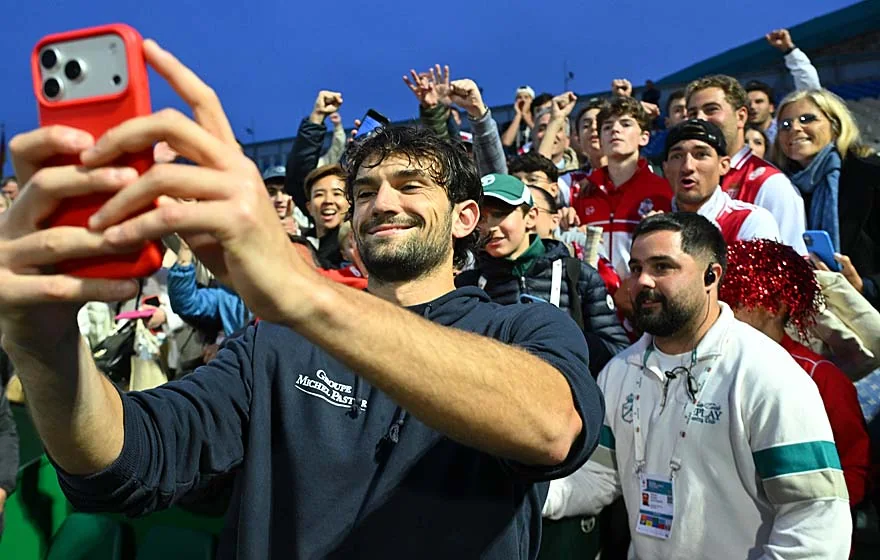
The Monte-Carlo event archive places these matches back within the full tournament, rather than treating each result as an isolated headline.
Why Sinner won the final
Sinner won by recovering from early breaks in both sets and executing more reliably at the moments when the final turned. The 7-6(5), 6-3 score describes the outcome accurately, but it leaves out how often Alcaraz initially occupied the stronger position. Alcaraz led 2-0 in the first set and 3-1 in the second; neither advantage survived.
In the first set, Sinner restored parity and carried the contest into a tie-break. That was a crucial change in the type of problem each player faced. Rather than needing to recover a whole service game, the outcome now depended on a short run of individual points. Sinner reached two set points and took the second when Alcaraz double-faulted. The error settled the set, but the preceding work that kept Sinner in it was equally important.
The second set offered an even clearer momentum shift. From 1-3, Sinner won five consecutive games. The tournament report counted 45 unforced errors from Alcaraz over the match. That figure supports a discussion of inconsistency, although it should not become an explanation that removes Sinner from the story. Pressure has to be sustained long enough for an opponent's missed chances to become decisive.
Conditions were part of the test. In his post-final interview, Sinner described a windy, cool match with a lower bounce, and highlighted his serving at important first-set moments and his precision in the tie-break. Those are the player's explanations, rather than a measured court-speed rating. They also caution against assuming this final represented every clay-court environment.
Our reading is that Sinner's greatest advantage was the stability of his response. He could lose an early exchange of breaks without abandoning the match plan, and he remained available to exploit the next opening. Alcaraz's early leads showed that he could create those openings too; the difference was preserving them.
For a fan watching the replay, the most revealing passages are the recovery after 0-2, the first-set tie-break and the sequence after 1-3 in the second. Watching only the final few games makes the match look more one-sided than it was. Watching those three passages shows how Sinner turned a contested final into a straight-set title.
Krawietz and Puetz win the doubles title
Sixth seeds Kevin Krawietz and Tim Puetz beat fifth seeds Marcelo Arevalo and Mate Pavic 4-6, 6-2, [10-8] to claim the doubles title. Their victory required a recovery after losing the opening set and another response when an 8-5 advantage in the deciding match tie-break disappeared.
The tournament's doubles final report records a finish at 8-8 before the German pair won the last two points. That is the central scoring fact: the final did not extend into a full third set. A deciding match tie-break concentrates the closing pressure into a short sequence, so a three-point cushion can vanish before either side has time to settle again.
Krawietz and Puetz had already experienced a comparable test in the semi-final. They defeated Hugo Nys and Edouard Roger-Vasselin 7-6, 4-6, [10-8]. Arevalo and Pavic arrived through a straight-set semi-final win over Guido Andreozzi and Manuel Guinard, 6-3, 7-5. The finalists therefore brought different immediate paths into Sunday, even though their title match eventually became close at the same decisive point.
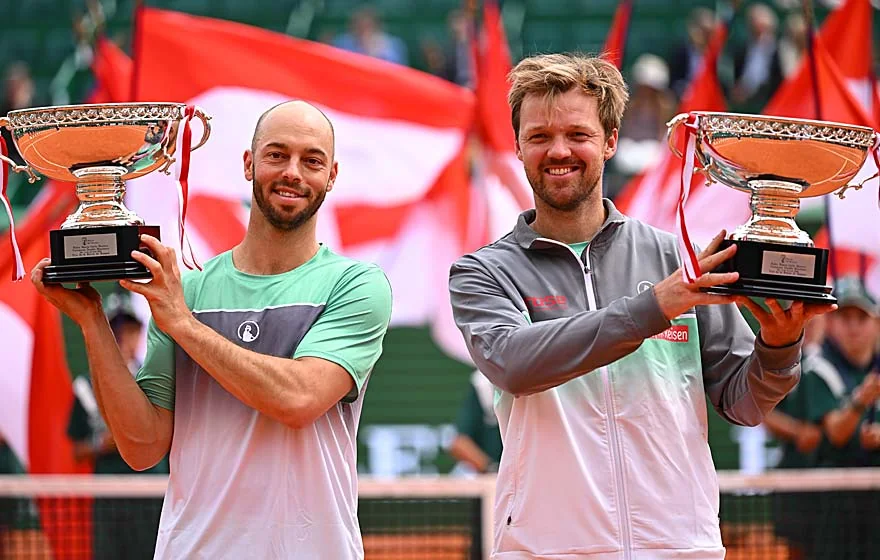
For a doubles replay, follow the return and the first exchange after serve, together with which team can establish a useful position at net. Those are viewing questions rather than claims about unreported statistical totals. The verified shift was that Krawietz and Puetz found two breaks in the second set after dropping the first, before surviving the compressed finish.
Their campaign also illustrates why an event review should give established doubles teams their own space. The singles final was the headline attraction, but the doubles championship was decided through a different format and a separate sequence of opponents. Winning two close deciding tie-breaks demonstrates the pair's ability to navigate pressure here; it does not justify describing every round as comfortable.
What the tournament changed
Monte-Carlo gave Sinner his first clay-court Masters 1000 title and returned him to world No. 1 immediately after the event. It was not his first clay title of any kind: he had already won Umag in 2022. Keeping that distinction clear gives the achievement its proper scale without rewriting his earlier career.
The victory also connected the start of the clay swing to his wins at Indian Wells and Miami. Those three 2026 Masters titles followed Paris in 2025, making a sequence across different settings rather than a run confined to one surface. For opponents, the significance was the ability to carry a winning level into a different set of problems. For Sinner himself, the post-final explanation still centred on learning and small adjustments.
Ranking points and the limits of one clay week
The tournament reported that the ranking list immediately after the final would place Sinner on 13,400 points and Alcaraz on 13,240: a gap of 160. Those are the historical post-Monte-Carlo figures for April 2026, not a current ranking update. The event awarded 1,000 singles points to the champion, 650 to the finalist, 400 to a semi-finalist and 200 to a quarter-finalist.
An event award should not be confused with a player's net ranking gain. Rolling totals also involve earlier results dropping away, which is why subtracting the two final-round awards does not explain the whole ranking change. The site's ATP rankings guide explains that distinction in more detail.
There is a similar limit to the sporting conclusion. Winning this final established that Sinner could beat Alcaraz for a major clay title under these conditions. It did not settle every possible clay match-up, nor determine the outcome of a longer tournament played in another environment. The difficult Machac match and Alcaraz's early final leads remain part of the evidence.
The most useful lasting picture is therefore specific: Sinner adapted successfully, Alcaraz remained the final obstacle, Vacherot sustained a home breakthrough and the doubles champions survived successive close finishes. Use the 2026 Masters 1000 guide to place Monte-Carlo within the wider calendar, while preserving this event as its own completed story.
About the author
ATP Schedule Editorial Team
The ATP Schedule editorial team turns match times, scores, tournament information and verified tennis news into clear answers fans can use quickly.
View all articles by this author →Fan discussion
Comments
Sign in with Google to comment. Keep the discussion helpful and tennis-focused. New comments are reviewed before they appear.
Loading comments…