Australian Open Men's Singles Winners by Year (2000–2026)
Look up every Australian Open men's singles champion from 2000 through 2026, with the last ten finalists and scores plus context on Djokovic's record and recent turning-point finals.
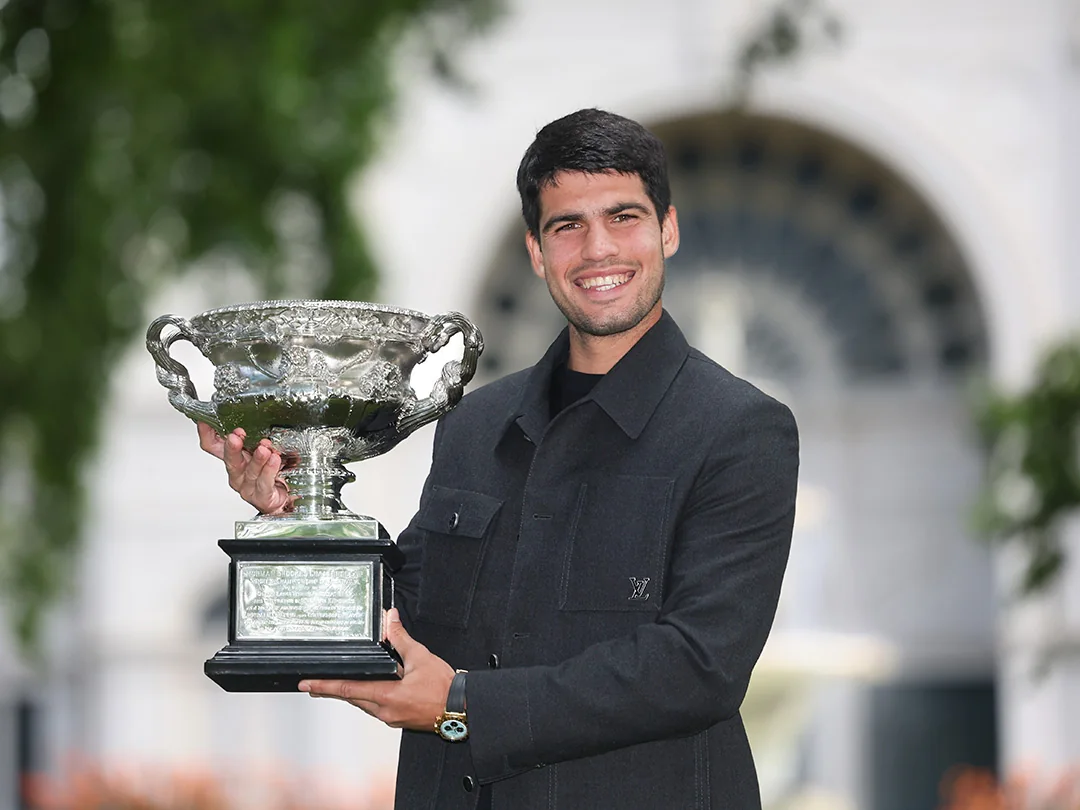
Carlos Alcaraz won the 2026 Australian Open men's singles title, beating Novak Djokovic in four sets. The tables below list every men's singles champion from 2000 through 2026, identify the ten most recent winners and show how Djokovic's ten titles compare with Federer, Nadal, Sinner and other champions. All year-by-year results were checked against the Australian Open's official honour roll.
Cover photo: Fiona Hamilton / Tennis Australia, via the AO 2026 champions gallery.
Who won the Australian Open men's singles title in 2026, and who won the last 10?
Carlos Alcaraz is the 2026 Australian Open men's singles champion. He beat Novak Djokovic 2-6, 6-2, 6-3, 7-5 at Rod Laver Arena, claiming his first Melbourne title and completing the set of all four major singles championships. That result belongs in the history books for two reasons: Alcaraz became the youngest man to complete a career Grand Slam, and Djokovic lost an Australian Open final for the first time after winning his first ten. The tournament's final report confirms both milestones.
“Last 10 years” below means the ten most recent completed editions, 2017 through 2026 inclusive. That is a precise window: it does not count the future 2027 tournament. Every winner, runner-up and score comes from the Australian Open's official men's singles honour roll. Scores are written from the champion's perspective.
| Year | Champion | Runner-up | Final score |
|---|---|---|---|
| 2026 | Carlos Alcaraz | Novak Djokovic | 2-6, 6-2, 6-3, 7-5 |
| 2025 | Jannik Sinner | Alexander Zverev | 6-3, 7-6(4), 6-3 |
| 2024 | Jannik Sinner | Daniil Medvedev | 3-6, 3-6, 6-4, 6-4, 6-3 |
| 2023 | Novak Djokovic | Stefanos Tsitsipas | 6-3, 7-6(4), 7-6(5) |
| 2022 | Rafael Nadal | Daniil Medvedev | 2-6, 6-7(5), 6-4, 6-4, 7-5 |
| 2021 | Novak Djokovic | Daniil Medvedev | 7-5, 6-2, 6-2 |
| 2020 | Novak Djokovic | Dominic Thiem | 6-4, 4-6, 2-6, 6-3, 6-4 |
| 2019 | Novak Djokovic | Rafael Nadal | 6-3, 6-2, 6-3 |
| 2018 | Roger Federer | Marin Cilic | 6-2, 6-7(5), 6-3, 3-6, 6-1 |
| 2017 | Roger Federer | Rafael Nadal | 6-4, 3-6, 6-1, 3-6, 6-3 |
The sequence captures three different moments in men's tennis. Federer won consecutive titles in 2017 and 2018; Djokovic then took three in a row from 2019 through 2021 and added another in 2023. Nadal's 2022 title interrupted that sequence. Sinner's back-to-back victories in 2024 and 2025 preceded Alcaraz's breakthrough in 2026. Across these ten editions, Djokovic won four, Federer and Sinner two each, and Nadal and Alcaraz one each.
A finalist is not necessarily a repeat champion: Medvedev appeared as runner-up in 2021, 2022 and 2024, with three very different scorelines. For current men's match outcomes, see our results page; for the next Melbourne dates, use the 2027 men's schedule guide. The list here remains a record of completed championships, not a prediction for January 2027.
Australian Open men's singles winners by year, 2000–2016
The tables below complete the 2000–2026 sequence that began with the ten recent champions above. They follow the Australian Open's official men's honour roll, and list the opponent who reached each final. Splitting the earlier seventeen editions into two stretches makes the changes in leadership easier to see while preserving a quick year lookup.
2010–2016: Djokovic takes control
| Year | Champion | Runner-up |
|---|---|---|
| 2016 | Novak Djokovic | Andy Murray |
| 2015 | Novak Djokovic | Andy Murray |
| 2014 | Stan Wawrinka | Rafael Nadal |
| 2013 | Novak Djokovic | Andy Murray |
| 2012 | Novak Djokovic | Rafael Nadal |
| 2011 | Novak Djokovic | Andy Murray |
| 2010 | Roger Federer | Andy Murray |
Djokovic won five of these seven Australian Opens: a three-title run in 2011–13 and another pair in 2015–16. Murray reached five finals in this slice but won none, a reminder that repeated deep runs do not automatically become titles. Wawrinka's 2014 defeat of Nadal is the lone non-Djokovic champion between 2011 and 2016. The 2012 final deserves special attention: Djokovic beat Nadal in five sets after five hours and 53 minutes, finishing at 1:37 a.m. Melbourne time. A simple winner column cannot convey how close Nadal came to altering that year's record.
2000–2009: Agassi, Federer and new challengers
| Year | Champion | Runner-up |
|---|---|---|
| 2009 | Rafael Nadal | Roger Federer |
| 2008 | Novak Djokovic | Jo-Wilfried Tsonga |
| 2007 | Roger Federer | Fernando Gonzalez |
| 2006 | Roger Federer | Marcos Baghdatis |
| 2005 | Marat Safin | Lleyton Hewitt |
| 2004 | Roger Federer | Marat Safin |
| 2003 | Andre Agassi | Rainer Schuettler |
| 2002 | Thomas Johansson | Marat Safin |
| 2001 | Andre Agassi | Arnaud Clement |
| 2000 | Andre Agassi | Yevgeny Kafelnikov |
Agassi's three titles in 2000, 2001 and 2003 gave way to Federer's wins in 2004, 2006 and 2007. Yet there was no clean handoff between two champions: Johansson beat Safin in 2002, and Safin returned to beat home favorite Hewitt in 2005. Djokovic's first major championship came in 2008 after he stopped Federer's run in the semifinal and then defeated Tsonga. Nadal followed in 2009 by beating Federer in the final. Those two years foreshadowed the Melbourne rivalries of the next decade, but the table shows how many different finalists shaped the route there.
How many Australian Open titles has Novak Djokovic won?
Novak Djokovic has won the Australian Open men's singles title ten times, more than any other man in the tournament's history. His championship years are 2008, 2011, 2012, 2013, 2015, 2016, 2019, 2020, 2021 and 2023. The Australian Open's official honour roll places him four titles ahead of the next men on its all-time list, Roger Federer and Roy Emerson, with six each. That record is specifically for Australian Open men's singles; it is not a count of every major Djokovic has won.
The pattern matters more than the bare total. Djokovic won once in 2008, returned for three consecutive titles from 2011 to 2013, added two in 2015 and 2016, then took another three in a row from 2019 to 2021 before winning again in 2023. Other champions filled the gaps, but his repeated returns to the trophy show a durable advantage at Melbourne Park across changing opponents. His 33-match unbeaten run at Rod Laver Arena, which ended against Jannik Sinner in the 2024 semifinal, gives another measure of how difficult he was to dislodge at the event's center court.
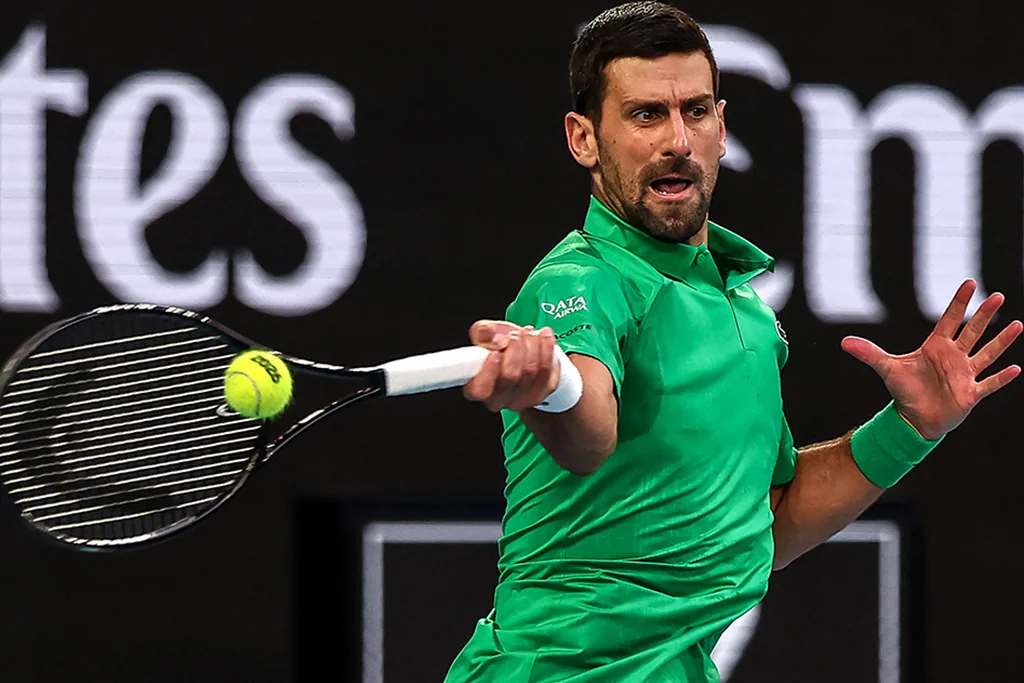
He won his first ten Australian Open finals. The 2026 championship match changed the second part of that statistic: Alcaraz beat him in four sets, leaving Djokovic with ten titles from eleven AO finals through the 2026 edition. The AO's post-final account identifies it as his first defeat in a Melbourne final. A runner-up finish is evidence of another deep run, but it does not raise a champion's title count.
There is a useful distinction when comparing eras. Roy Emerson's six tournament crowns include championships before professionals were admitted to the majors; Federer and Djokovic won all of theirs in the Open Era. The AO's all-time roll groups all editions in one title list, while an Open-Era-only comparison looks at a narrower period. Either way, Djokovic's ten stand alone among the men. His exhausting 2012 win over Nadal, recorded by the AO as a five-hour, 53-minute final, also shows that the record was built through very different kinds of victories, not only comfortable straight-set matches.
Which other men have shaped the 2000–2026 winners list?
Djokovic dominates the title count, but the Melbourne story since 2000 has more than one center of gravity. Roger Federer won six Australian Opens; Rafael Nadal and Jannik Sinner won two each; Carlos Alcaraz won his first in 2026. Andre Agassi captured three titles within this article's 2000–2026 window, even though his full career total at the tournament is four because he also won in 1995. The AO honour roll is the clean way to distinguish those two time spans.
Federer's six Melbourne titles
Federer won in 2004, 2006, 2007 and 2010, then returned to the top in 2017 and 2018. His total of six is tied with Roy Emerson for second on the tournament's all-time men's list, behind Djokovic's ten. The six-title figure also means that a fan who searches only the “last ten years” table sees just Federer's last two: four of his Melbourne victories occurred before 2017. That is why a recent-decade list should sit beside a wider year-by-year record.
The two late titles had different opponents but shared five-set finals. In 2017 Federer beat Nadal 6-4, 3-6, 6-1, 3-6, 6-3, a result the AO's champions feature treats as a defining comeback after his time away from the game. In 2018 he beat Marin Cilic 6-2, 6-7(5), 6-3, 3-6, 6-1. His 2007 title offers a different kind of achievement: the tournament's records feature notes that he went through that campaign without dropping a set. One champion's six wins therefore represent several types of dominance, not a uniform run of easy finals.
Nadal, Sinner, Alcaraz and the one-time winners
Nadal won his first Melbourne title over Federer in 2009 and his second over Daniil Medvedev in 2022. The AO's 2022 event review confirms he came back from two sets down in that final. The thirteen-year interval between those championships is unusually long for one man's two victories at the same major, and it makes a single decade slice a poor summary of his Australian Open career.
Sinner's two titles arrived consecutively, in 2024 and 2025. He came from two sets behind against Medvedev for the first, then beat Alexander Zverev in straight sets for the second. The AO's 2025 report calls him the youngest man to defend a Melbourne title since Jim Courier in 1993. Alcaraz followed in 2026, beating the ten-time champion Djokovic for his first AO title. The last three editions thus went to two players, although that is a record of completed events rather than a forecast of the next one.
Thomas Johansson in 2002, Marat Safin in 2005 and Stan Wawrinka in 2014 each won once within 2000–2026; Alcaraz also appears once so far. Their presence matters. A list that mentions only Federer, Nadal and Djokovic would erase championships that broke the expected pattern, including Wawrinka's 2014 interruption of Djokovic's two title streaks.
Which finals best explain the changes in this era?
Three championship matches show why a year and a champion's name are only the start of the story. Rafael Nadal in 2022 and Jannik Sinner in 2024 both recovered from two sets down against Daniil Medvedev. Carlos Alcaraz in 2026 needed four sets to beat Djokovic, but that match broke a ten-final unbeaten record and completed a career Grand Slam. Each result changed how fans read the surrounding years in the winners table.
Comebacks from two sets down in 2022 and 2024
Nadal was two sets behind Medvedev in the 2022 final and faced three break points at 0-40 during the third set. He survived and won 2-6, 6-7(5), 6-4, 6-4, 7-5 after five hours and 24 minutes. That was his second Australian Open title, thirteen years after his first. The scoreline makes the comeback visible; the break-point moment reveals how close it came to never happening. It also helps explain why Medvedev, who appeared in multiple Melbourne finals, has no winner entry in the table.
Two years later, Sinner followed a different path to the same five-set shape, defeating Medvedev 3-6, 3-6, 6-4, 6-4, 6-3 for his first major title. The AO's tactical review found that Medvedev attacked unusually early, stepping in on returns and taking the first set without facing a break point. His first-serve rate and shot speed later fell as Sinner began to extend rallies and strike his forehand harder. The same report notes that Medvedev had spent more than 20 hours on court before the final, compared with less than 15 for Sinner. That difference may have mattered, but it is not the entire explanation: Sinner also changed the direction and weight of the points he played.
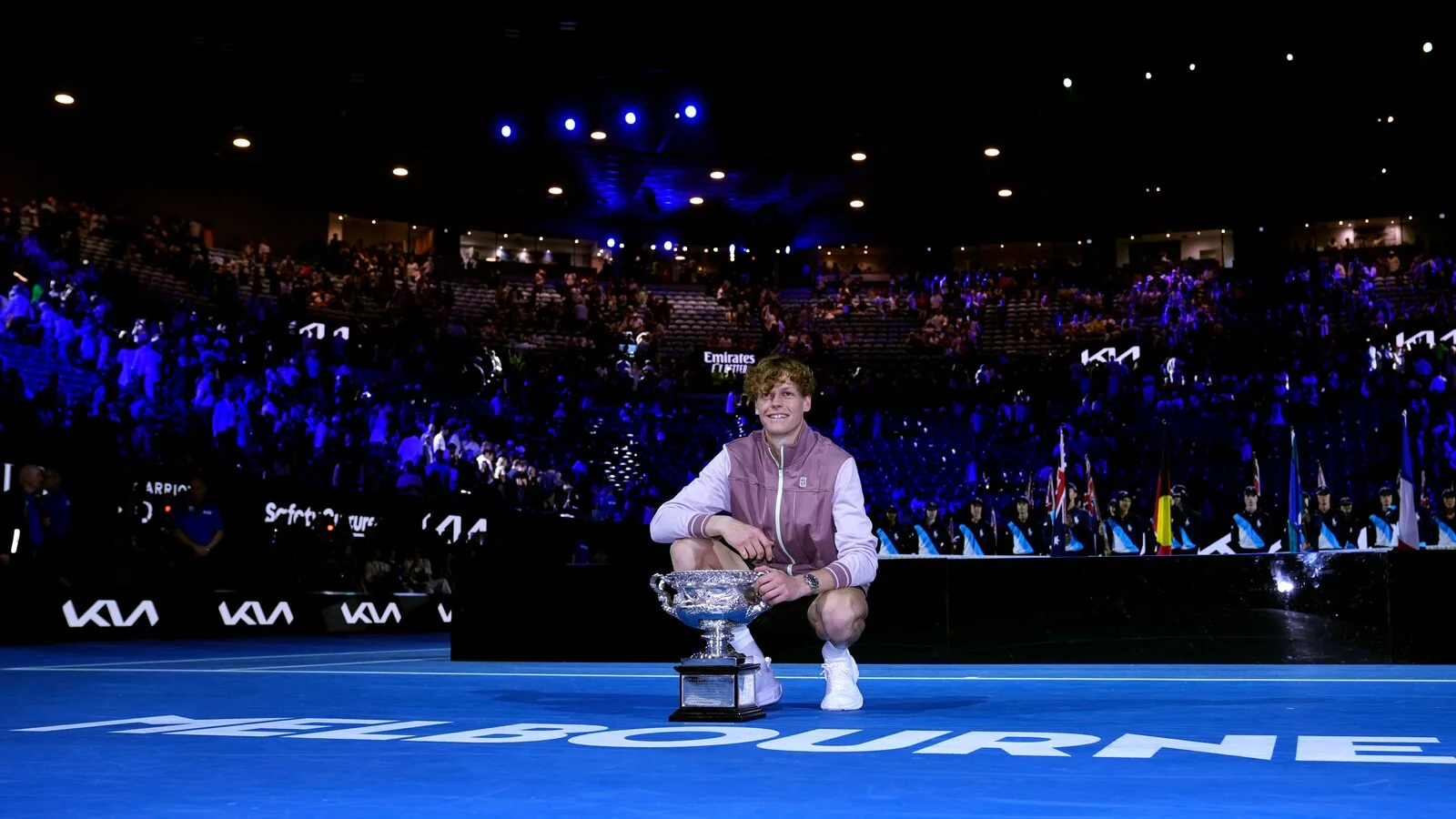
These two comebacks should not be flattened into a claim that Medvedev simply collapsed. In 2022 Nadal had to escape a near-fatal third-set service game; in 2024 Medvedev's aggressive opening was a clear tactical choice, while Sinner improved as the contest lengthened. The 2024 final report records a three-hour, 44-minute match. The different durations and match patterns matter when comparing what “from two sets down” really involved.
What the 2026 final changed
The 2026 score, Alcaraz over Djokovic 2-6, 6-2, 6-3, 7-5, was not another two-set comeback. Djokovic took the opener, and Alcaraz won the next three. The AO's match analysis shows how the pattern changed: Alcaraz won 14 long rallies to Djokovic's nine across the final three sets, and won all six points behind his second serve in the second set after taking just one of eight in the first. Those details support a more precise reading than “younger player outlasted older player.” Alcaraz adjusted his point construction and reduced the pressure on his second serve.
The historical consequence was immediate. Djokovic's AO final record moved from 10-0 to 10-1, while Alcaraz joined the Melbourne champions for the first time and completed the career set of major titles. The winners list therefore records two related events: a new name on the Norman Brookes trophy and the end of a previously perfect final streak. For the completed scores themselves, use our men's results page alongside the official AO record.
How should fans read this winners list before AO 2027?
This list ends with Alcaraz's 2026 title because 2027 has not been played yet. The Australian Open's official men's singles honour roll currently ends at the 2026 final, and that is the record to check after the next champion is crowned. A future event date, a draw announcement or a bookmaker's favorite should not be added to a list of winners.
There is a sensible sequence for following the next edition. The tournament has confirmed Australian Open 2027 for 11–31 January at Melbourne Park, with the main draw beginning on 17 January. Its August 2026 provisional schedule places the men's singles final on Sunday 31 January, while warning that match dates and schedules can change. Those are planning facts, not the identity of the next finalist. The draw will establish each man's potential route; the daily order of play will establish his court and session closer to a match; completed scores will establish who actually advanced.
- Before the draw: use the 2027 men's schedule guide for the event window and round context. Do not turn the 2026 champion into an automatic 2027 finalist.
- During the tournament: check the AO's official match schedule for the daily court order, and use our today page to follow men's matches. A player's presence in the main draw is not a result.
- After the final: verify the winner, opponent and score against the AO honour roll and our results page. Then the year-by-year table can add one completed row.
Recent form gives fans a question to follow, not an answer to print in advance. Sinner defended his crown in 2025, Alcaraz won in 2026, and Djokovic remains the ten-title record holder. Whether one of them or another player wins next is decided by the 2027 draw and matches. The older tables are useful precisely because they record outcomes after the tennis, including years when the expected favorite did not lift the trophy.
For an answer by year, start with the tables; for the meaning of a final, look at the score and the match story around it. The next entry belongs to the man who wins the 2027 championship match, after the result is official.
About the author
ATP Schedule Editorial Team
The ATP Schedule editorial team turns match times, scores, tournament information and verified tennis news into clear answers fans can use quickly.
View all articles by this author →Fan discussion
Comments
Sign in with Google to comment. Keep the discussion helpful and tennis-focused. New comments are reviewed before they appear.
Loading comments…