Australian Open 2027 Dates and Men's Schedule: Draw to Final
Plan the 2027 Australian Open men's draw with confirmed dates, round windows, session context and the steps to find a player's exact daily court assignment.
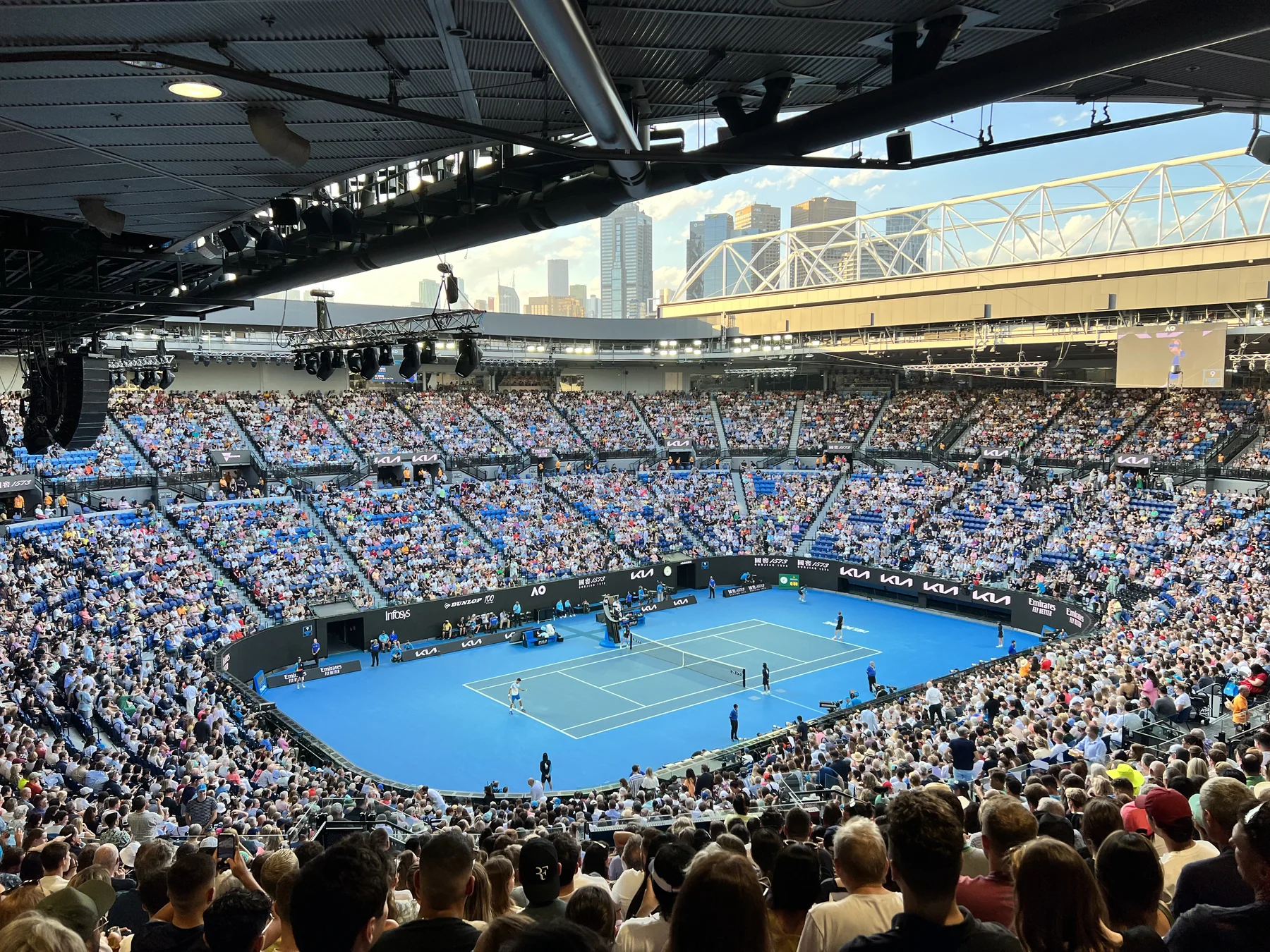
The 2027 Australian Open main draw runs from 17 to 31 January in Melbourne, with the men's singles final scheduled for Sunday, 31 January. Opening Week begins on 11 January. This guide follows the men's route from qualifying and the draw to the final, explains what remains provisional, and shows when to check the daily court order for a specific player.
Cover photo: Gracchus250 / Wikimedia Commons, CC BY-SA 4.0; resized and converted to WebP.

When is the 2027 Australian Open?
The 2027 Australian Open runs from 11 to 31 January at Melbourne Park, but those 21 days do not all belong to the men's main draw. The tournament's confirmed date announcement separates Opening Week, 11–16 January, from the main draw, 17–31 January. The men's singles final is scheduled for Sunday, 31 January. That is the date to circle if you want the championship match; 17 January is the date to circle if you want the first main-draw matches.
Opening Week and men's qualifying
Opening Week starts on Monday, 11 January and ends on Saturday, 16 January. Men's qualifying is part of that window, alongside player practice and other public events. The Australian Open's event program does not mean that every day contains the same qualifying round or that a particular main-draw player will practice in front of spectators at a known hour. It gives fans an early look at Melbourne Park before the main draw begins.
For followers of a lower-ranked player, this distinction is useful. Qualifying decides which players claim the remaining main-draw places; a qualifying win is meaningful, but it is not a first-round win in the championship draw. For visitors, an Opening Week visit also answers a different question from a ticket for a first-round Rod Laver Arena session. Decide which type of tennis you want to see before choosing a date.

Main draw and the men's final
Main-draw play begins on Sunday, 17 January and continues through Sunday, 31 January. The AO says this will be its fourth straight Sunday start. A longer first-round opening gives the organizers more sessions in which to place a large field; it does not tell us which man will play on the first Sunday, Monday or Tuesday. Those names come later, when the draw and daily order of play are released.
The men's final on 31 January is the end point, not a guaranteed appearance for any current star. Carlos Alcaraz and Novak Djokovic reached the 2026 final, for example, but their 2027 paths depend on entry, health and results still to come. To see how Melbourne fits among the men's lead-in tournaments and the rest of the season, use our 2027 ATP Tour calendar. The next sections turn these confirmed bookends into a practical round-by-round plan.
What is the men's singles round-by-round calendar?
The men's singles draw is planned to move from a three-day first round to two-day blocks for most later rounds, with the semifinal on Friday, 29 January and the final on Sunday, 31 January. The round windows below follow the Australian Open's official provisional schedule, current as of August 2026. The tournament warns that match dates may change. Treat the table as a way to plan a week, not as a promise that a particular player will take the court on one of these days.
| Stage | Planned dates, Melbourne | What it means |
|---|---|---|
| Qualifying | 11–16 January | Players compete for main-draw places during Opening Week. |
| First round | 17–19 January | The largest spread of men's singles matches. |
| Second round | 20–21 January | First-round winners return. |
| Third round | 22–23 January | The field narrows toward the second week. |
| Fourth round | 24–25 January | Round-of-16 winners reach the quarterfinals. |
| Quarterfinals | 26–27 January | Eight players become four semifinalists. |
| Semifinals | 29 January | The two finalists are decided. |
| Final | 31 January | The men's singles champion is crowned. |
The official event program calls 17–24 January Main Draw Week One and 25–31 January Week Two. That is a useful shortcut, but the fourth round crosses the boundary between those two calendar weeks. If your purpose is to see an early-round player rather than simply attend during “week one,” use the round dates above, then check the player's actual order of play later.
The changing size of the field explains why these windows feel different. The first round offers the most simultaneous matches and the widest mix of seeded players, qualifiers and local entrants. By the quarterfinals, every remaining singles match determines a semifinalist. That makes the late sessions easier to follow but also leaves less flexibility if your favorite has already lost. Men's doubles, mixed doubles and other draws have their own schedules; the table here is only for men's singles.
Once play begins, a stage label alone cannot tell you who won. Our completed 2026 Australian Open tournament page illustrates the difference: it holds actual men's match results, player links and set scores, whereas this 2027 calendar tells you when rounds are expected to happen. Check the corresponding 2027 event page when that edition is available.
When will the draw and daily order of play be known?
The round calendar cannot yet tell you when Carlos Alcaraz, Jannik Sinner or any other named player will compete in 2027. Three separate pieces of information arrive at different times: the provisional tournament schedule, the singles draw and the daily order of play. As of 28 September 2026, the official Australian Open pages checked for this guide had announced the event dates and round plan, but had not announced a 2027 men's singles draw ceremony or a player-by-player daily schedule.
The draw is different from the daily schedule
The draw places entrants into a bracket and shows a player's first opponent and possible later route. It does not assign a court, day session or exact time to every match. For a useful historical comparison, AO announced its 2026 singles draw for Thursday, 15 January, three days before the first main-draw Sunday. Seeds were placed in the bracket; successful qualifiers were incorporated after their qualifying matches. That sequence explains why a provisional 2027 round calendar can exist long before the final set of first-round names is settled.
Do not turn the 2026 ceremony date into a guessed 2027 date. The start of the 2027 main draw is confirmed for 17 January, but the draw announcement needs its own official notice. A bracket can also suggest a potential clash between two stars that never occurs if either loses first. Read those pathways as possibilities, not booked matches.
How to track one player after the order of play appears
The daily order of play is the document that converts a bracket into a plan: it lists the match, court, session and start instruction. In 2026, AO's Day 1 schedule announcement named Alcaraz against Adam Walton as the second Rod Laver Arena night match, while Alexander Zverev faced Gabriel Diallo in the day session. Both men were in the first round, but a first-round date range alone could never reveal those different viewing slots.
For 2027, open the AO's official draw page once it switches to the new event, then its match-schedule page as the relevant day approaches. Check the player's name, opponent, court, session and local time together. A label such as “not before” is a lower bound, not a promise that the match will start at that minute.
Our 2026 Australian Open players page and completed schedule page show how player and match views connect on ATP Schedule. They are historical examples; use the 2027 edition only when it is published. On match day, recheck the official order after any withdrawal or long preceding match.
How do day and night sessions shape the men's schedule?
A round can run across several days, and each day can be divided into separate court sessions. That is why “Australian Open first round, 17 January” is still too broad to locate one match. The daily order of play assigns a man to a court and a session; only then can a visitor judge which seat or admission type makes sense, or a viewer set a reliable reminder. Even after publication, the lineup can move if earlier matches run long or a player withdraws.
Rod Laver Arena, show courts and outside courts
Rod Laver Arena is the event's main show court, but the men's draw is distributed around Melbourne Park. The AO27 official ticket guide distinguishes reserved seats at Rod Laver Arena, Margaret Court Arena and John Cain Arena from Ground Pass access to outdoor courts and some unreserved areas. It also warns that outdoor access depends on scheduling and capacity. A ticket for one arena does not create a reserved seat in another. The precise access rules belong in the ticket guide; the scheduling point is that a player may be assigned to any suitable court during the early rounds.
AO 2026's opening day makes the distinction concrete. Carlos Alcaraz played Adam Walton as the second Rod Laver Arena night match. Alexander Zverev's match with Gabriel Diallo was placed in the same arena's day session. Francisco Cerundolo appeared on Margaret Court Arena, while Frances Tiafoe was scheduled at John Cain Arena. All four were part of the first-round program, yet no single “first-round start time” could describe their matches. Those assignments are historical examples from the 2026 official order of play, not a model for where they will play in 2027.


For a fan at home, court assignment can also determine which feed to open. For someone on site, it affects whether a reserved arena ticket is needed or an outside-court seat is available subject to capacity. The schedule and ticket are linked decisions, but neither guarantees a particular star will survive long enough to reach a planned date. Our Melbourne Park venue guide helps put the courts in physical context once the official lineup appears.
The useful habit is to start with the player's name, then read across the official order: opponent, court, day or night session, and “not before” time if one is listed. Do not start with a purchased session and assume the player must be in it. The first approach follows the competition; the second relies on a guess the tournament has not promised to fulfill.
What time is the 2027 men's final?
The date is confirmed: Sunday, 31 January 2027. The exact match start time is not yet fixed in the Australian Open's publicly available 2027 date announcement or its August 2026 provisional schedule. A search result that gives a precise 2027 hour may be using a past final or a provisional ticket-session listing. Fans should wait for the AO's official finals-week program and daily order of play before treating an hour as settled.
Confirmed final date and provisional session time
The Australian Open places its two singles finals on 30 and 31 January, with the men's championship match on the Sunday. Its provisional round schedule also reaches the men's final on 31 January. These are stronger planning anchors than a clock time: they come directly from the tournament's date announcement and provisional schedule.
For context, the 2026 final-day program listed Alcaraz against Djokovic at 7:30 p.m. Melbourne time in Rod Laver Arena. That is evidence of how the previous final was staged, not a 2027 start-time confirmation. Even a published session start can shift when ceremonies, weather decisions or earlier tennis alter the day's running order. The safest plan is to leave room around the final rather than assume first ball will land at the top of a published hour.

Converting Melbourne time for overseas fans
Melbourne will be on Australian Eastern Daylight Time, UTC+11, during the 2027 event. Victoria's published daylight-saving dates run from October 2026 through April 2027, so a January schedule marked AEDT is eleven hours ahead of UTC. The AO schedule has also used the label “AEDT – GMT +11” for its Melbourne-local display.
Use the confirmed Melbourne date first, then convert the eventual official hour. As a purely illustrative calculation, a hypothetical 7:30 p.m. AEDT start would be 8:30 a.m. UTC on the same day. That example mirrors the 2026 listing; it is not a forecast for 2027. A fan in North America may be watching in the very early morning, while an Asian viewer could see the match later in the afternoon. Local broadcast schedules may show pre-match coverage before first ball, so distinguish a channel's program time from the tennis start.
When the official 2027 order appears, check both the local date and the time-zone label on the source page, then recheck shortly before play. After the trophy is awarded, our men's results page is the place to follow the recorded score and final match status.
What can change the schedule, and where should fans check?
The 2027 Australian Open calendar is useful for choosing a day, but it cannot promise a particular player's first-ball time. The tournament labels its August 2026 provisional schedule as subject to change. Once play begins, the daily order of play, official event updates and live scores become more useful than a months-old round chart. That distinction matters especially if you are buying a session ticket or setting an alarm in another time zone.
Heat, rain and long matches
Melbourne's summer can force operational changes. Ahead of a hot day in January 2026, the AO moved its Rod Laver Arena start and postponed the wheelchair championships by 24 hours; it also said outside-court play and roof decisions would follow its heat protocols. During a separate 2026 men's match, the Rod Laver Arena roof closed for heat during Jannik Sinner's third-round win over Eliot Spizzirri, interrupting play for ten minutes. These are examples of what happened in 2026, not predictions for January 2027.
Rain can interrupt an uncovered court, and a long earlier match can push everything that follows it later. The AO's 2026 Day 11 announcement placed Novak Djokovic against Lorenzo Musetti “not before 2.30pm” after two other quarterfinals. That phrase sets the earliest possible start; it does not guarantee the players walk on court at 2:30. A preceding five-set men's match or extended women's match can move the actual start substantially. A withdrawal or walkover can have the opposite effect by removing a planned match. Court location can change too, so an old screenshot should never be your final check.
A simple match-day checking routine
- The evening before: open the AO's official match schedule and confirm the player, opponent, court, session and “not before” wording. If the page still shows an earlier tournament or an incomplete order, return after the tournament publishes the relevant day.
- Before leaving or tuning in: reopen the same AO order and its news updates. Check for heat, weather or court changes, then compare the progress of earlier matches on that court. For a ticketed fan, check the session and entry information tied to the ticket as well.
- During play: follow live scores and the court order together. ATP Schedule's today page can help find current men's matches, while results can confirm what has finished. The AO's official order remains the authority for court assignment and tournament notices.
For the men's final, keep Sunday 31 January 2027 on the calendar, but wait for the AO to publish the exact session and match start. For earlier rounds, think in two stages: use the provisional chart to choose a date, then use the daily order and real-time court progress to decide when to arrive or watch. That two-stage habit is the simplest way to avoid treating a provisional schedule as a guarantee.
For a date on the calendar, use the official 2027 tournament program. For a particular man's match, use the AO's daily order of play when it is published and check it again on match day. That is the difference between knowing the round window and knowing when a player will actually step onto court.
About the author
ATP Schedule Editorial Team
The ATP Schedule editorial team turns match times, scores, tournament information and verified tennis news into clear answers fans can use quickly.
View all articles by this author →Fan discussion
Comments
Sign in with Google to comment. Keep the discussion helpful and tennis-focused. New comments are reviewed before they appear.
Loading comments…