Paris Masters 2026: Draw, Schedule, Players and How to Watch
The draw and qualifying weekend begin the final Masters 1000 of 2026. Plan the Paris week with clear session dates, field updates and viewing choices.
When is the Paris Masters draw, and what is confirmed?
The 2026 Paris Masters draw ceremony is scheduled for Friday, October 30 at 18:30 in Paris. Qualifying follows on October 31 and November 1, before the singles main draw runs November 2–8. This guide was checked on the morning of October 30, before the ceremony; possible opponents should therefore be treated as unresolved until the official bracket appears.
The draw time in Paris and abroad
The time comes from the organiser’s October 29 programme, supported by its separate broadcast announcement. That is the most useful reference if another preview gives a different hour. Paris is on Central European Time, UTC+1, so 18:30 is 17:30 UTC and 13:30 in New York on October 30. In Beijing, it is already 01:30 on October 31.
American viewers should pay attention to the date as well as the hour. Europe has already changed its clocks, while New York changes on November 1. The transatlantic difference on draw day is therefore different from the difference during the main draw. A reminder copied from last year, or converted using one fixed offset for the entire week, can send you to the stream late.
What the draw will tell you
The bracket establishes a player’s starting position and potential route through the tournament. It does not establish that every projected opponent will advance, or that a particular player will occupy Tuesday’s evening session. Even an attractive projected quarterfinal remains conditional on several earlier results.
Three pieces of information answer three different questions. The tournament programme tells you which rounds are planned for each date. The draw tells you who can meet whom. The daily order of play tells you the court and sequence for the next matches. Use each for its own purpose when comparing tickets, setting alarms or arranging a replay.
After the ceremony, start with the official draws page, then consult ATP matches today when the daily order is available. For one favourite, note the first opponent and the relevant section of the bracket before worrying about the final. That keeps the next competitive task visible and makes later changes easier to understand.
The 2026 Paris Masters schedule from qualifying to finals
Qualifying occupies the opening weekend; the main tournament then fits into one Monday-to-Sunday week. The official provisional programme is the starting point for planning, while the daily order of play supplies the actual names, courts and match sequence.
| Date | Planned singles stage | Planning point |
|---|---|---|
| October 31–November 1 | Qualifying | Main-draw places still at stake |
| November 2 | First round | Main draw begins |
| November 3 | First and second rounds | Two rounds share the date |
| November 4 | Second round | Field moves toward the last 16 |
| November 5 | Round of 16 | Eight quarterfinal places |
| November 6 | Quarterfinals | Centre Court starts later |
| November 7 | Semifinals | Check each match’s start label |
| November 8 | Final | Singles planned for 15:00 Paris |
Qualifying and the early rounds
Qualifying is competitive tennis with entry into the main event as its immediate reward. It is particularly useful viewing if you enjoy discovering players before they encounter the established names. A familiar player in qualifying has a different job from a seed waiting for a later start: he first has to earn a place in the bracket.
Monday through Thursday have an overall start from 11:00 Paris time, with Centre Court evening sessions from 19:00. Those numbers describe the session framework. They cannot tell you when the third match on a court will begin, because its start depends on the contests before it.
Tuesday’s mixture of first- and second-round singles is also easy to misread. It describes different parts of the bracket advancing on the same day, rather than an instruction that an individual must complete two rounds that afternoon. Follow the relevant player’s line and the published order, rather than assigning every entrant the same schedule.
Quarterfinals and finals weekend
Friday rewards a closer look at the court column. The wider programme begins at noon, but the Centre Court quarterfinal sessions are listed from 14:00 and 19:00. Arriving for an arena-wide start does not mean that your chosen singles quarterfinal starts at that hour.
Sunday offers separate championship matches: the doubles final is planned for 12:30 and the singles final for 15:00 on Centre Court. The wheelchair singles final is a different contest on Court 2, scheduled for noon. Choose deliberately if you hope to follow more than one competition, since their programmes can overlap.
The ATP event guide describes the singles final as not before 15:00. Keep that qualification in your own plan: an earliest start is not a guaranteed finish for the preceding match. Our ATP schedule for this week can help you narrow the programme once the daily details arrive.
How the 56-player singles draw changes the week
Paris has a 56-player singles field placed on a bracket with 64 positions. The difference creates eight first-round byes. Under the 2026 ATP competition rules, those byes go to the top eight seeds; a 56-player draw has 16 seeds overall. Being seeded and receiving a bye are therefore different advantages.
The arithmetic explains the early schedule. Forty-eight players contest 24 first-round matches, producing 24 winners. Add the eight players with byes and the second round has 32 competitors. A player starting in the first round needs six main-draw victories to become champion; one with a bye needs five. Those totals assume a fully contested route, rather than additional walkovers.
Why a first-round bye matters
A bye removes a match from the route, which matters in a tournament completed over seven main-draw days. It can spare the player a serving workload, a difficult return matchup and the possibility of an extended three-set opening battle. It does not award the next match or prove that the player arrives healthier than his opponent.
The opponent may have a competitive advantage of a different kind: actual experience of that week’s court, ball and arena. A qualifier can arrive in the main draw with confidence from meaningful wins, while also having spent more energy than a direct entrant. Neither description settles the contest. Watch the player’s movement, first-serve quality and ability to repeat an attacking pattern late in a set before deciding which factor matters more.
A useful bracket reading therefore begins with three details: whether your player has a bye, who emerges from the adjacent first-round match, and when each player last competed. Simply counting famous names in a quarter does not capture those differences. Nor should the absence of a top seed from Monday’s order immediately be described as a withdrawal; his first match may belong to a later round.
The compact Paris week also differs from the expanded 96-player Masters events discussed in our guide to the longer Masters format. More calendar days and more draw places change the experience of following a tournament. Paris brings the bracket toward its decisive rounds quickly, so a viewer who waits until the weekend will miss most of the field.
For daily viewing, the best response is selective attention. Follow one section through the opening rounds, then widen your focus as the quarterfinal lineup forms. The format gives those early results immediate consequences: one unexpected winner can alter the next opponent without changing the published date of the round.
Which players are expected, and who is missing?
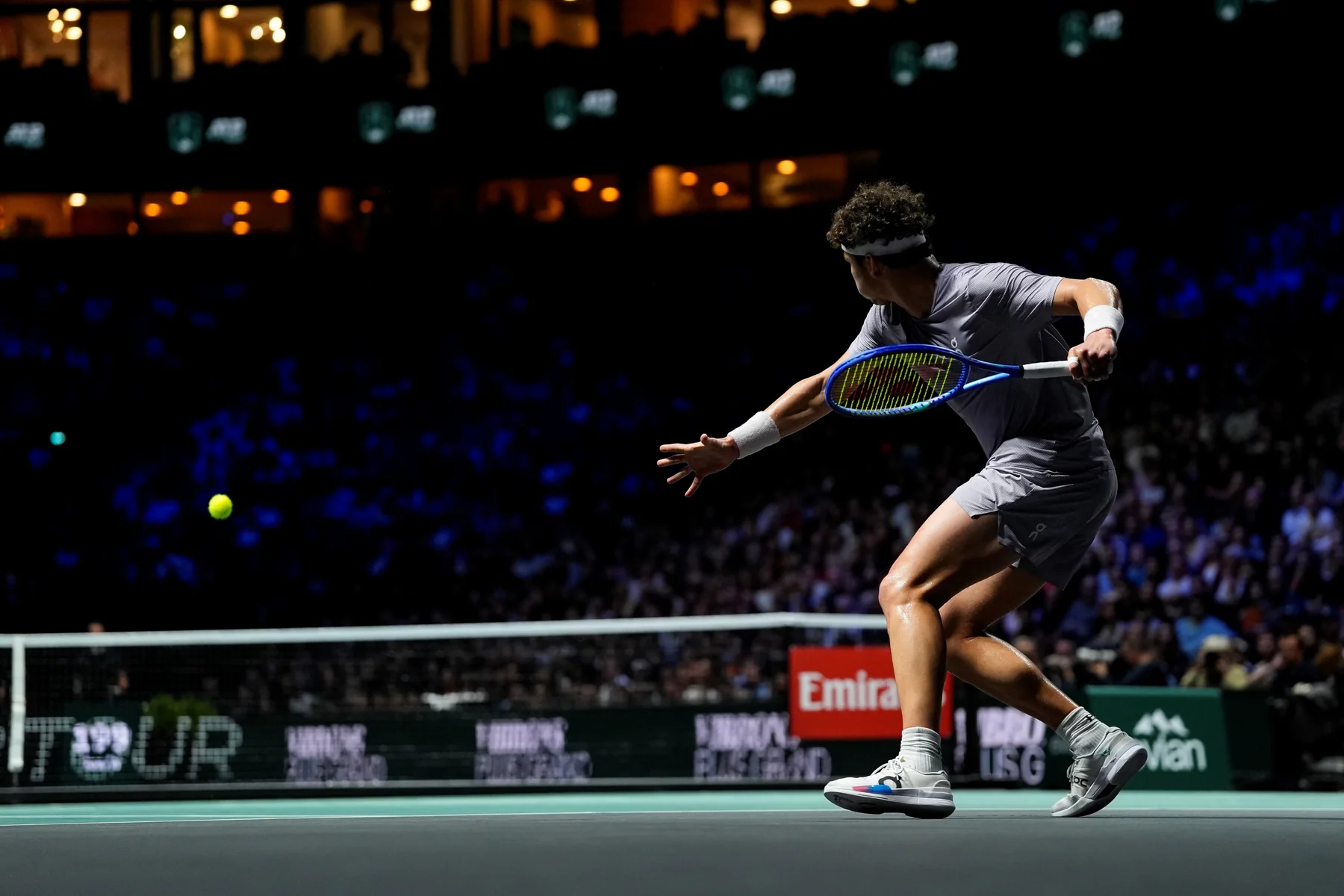
Alexander Zverev, Carlos Alcaraz, Novak Djokovic and Ben Shelton headline the expected field. The central absence is defending champion Jannik Sinner: the organiser’s updated entry preview confirms that he will miss Paris after ending his ATP season with a knee problem. His status as the 2025 winner should not be mistaken for an intention to defend the title.
Djokovic brings the most substantial Paris title history, with seven victories. Zverev won the 2024 edition, beating Ugo Humbert in that final. These records explain the attention around them, but history cannot provide their 2026 opponents before the draw or guarantee that either reaches the later rounds. Recent performance and the actual route will matter more than a familiar name alone.

The French contingent provides a reason to watch beyond the highest seeds. In its October 27 wild-card announcement, the FFT named Titouan Droguet, Arthur Géa, Quentin Halys and Kyrian Jacquet as main-draw invitees. They join home players including Arthur Fils, Humbert and Arthur Rinderknech. A wild card supplies entry; it does not supply an easier first opponent.
That announcement also lists qualifying wild cards separately. A player invited into qualifying must still progress through that competition to earn a main-draw place, unless another valid route becomes available. The distinction matters if you are buying a main-draw ticket principally to see a French prospect whose name appeared in a general “wild cards announced” headline.
For a more useful preview, separate three questions: who has been entered, who is present in the final draw, and who appears in the next order of play. A preview can answer the first while later withdrawals change the second. Neither automatically answers the third. Check the ATP player directory for identity and background, then use the current tournament order for the practical appointment.
Once the bracket is published, watch for contrasts rather than assuming a list of stars creates one obvious favourite. An attacking first server can face a different test against a compact returner than against another player seeking short points. Those are matchup questions to investigate after the opponents are known, with the players’ current condition kept in view.
What the indoor arena changes for players and spectators
The Paris Masters is played on indoor hard courts at the Plenitude Arena in Nanterre, the venue also known as Paris La Défense Arena. It is a different setting from the outdoor clay of Roland-Garros and from the tournament’s former Bercy home. The move occurred in 2025, making this the second edition at the new arena.
For a visitor, that identity matters before any tactical discussion. An old photograph, a search result using “Bercy,” or the general description “tennis in Paris” can point you toward the wrong building. Use the organiser’s practical information for the current venue and transport plan, and compare it with the name on your ticket.
For a viewer, indoor tennis offers a more controlled environment than an exposed outdoor court, particularly in relation to wind and rain. That does not establish a measured court speed for the 2026 tournament. Nor does it mean every match will be dominated by aces. Return quality, the height of the bounce and the ability to play the next shot after the serve still shape the contest.
A revealing passage often comes on second serve. Can the returner step forward without giving away errors? Can the server use placement and the first groundstroke to regain control? Those observations explain an apparent service advantage better than simply counting untouched first serves. On a close score, pay attention to whether the returner is creating pressure repeatedly or surviving on one spectacular point.
The arena also contains different viewing experiences. Centre Court is the major stage, while another court may offer a closer view of a doubles partnership’s movement or a developing singles contest. The official 2026 ticket conditions distinguish access by ticket type; a Court 1 ticket does not include Centre Court. Check the product and session you actually select before assuming that every visible match is accessible.
That is especially relevant when a favourite’s schedule is still unknown. A ticket buys the stated admission rights for a session and court, while the player must first be assigned there and remain in the tournament. Decide whether your priority is a particular competitor, a round, or simply a full day watching tennis. Each priority can lead to a different choice.
Our ATP tournament directory provides the broader event context. For this visit, keep the organiser’s current venue and ticket information alongside the order of play: one tells you how to arrive and enter, while the other tells you what tennis you can expect to follow.
How to watch Paris without choosing the wrong coverage
Choose coverage for the country where you will actually watch. A French broadcast announcement does not establish access in the United States, and a British sports subscription does not create worldwide rights. After identifying the territory, check that the service carries the competition and court you want, then whether your package includes live play, replays or both.
France and the United Kingdom
The organiser’s French coverage announcement names Eurosport, principally Eurosport 1, and its HBO Max digital platform for comprehensive coverage in France. France Télévisions has a selected programme: a match each day through the quarterfinals on France TV Sport or France 4, one semifinal on France 4 and the final on France 3.
That distinction is useful if your intention is to follow one player through every round. A daily selected match is not a promise that the same player will be chosen each time. Check the broadcaster’s actual listing instead of assuming that a free-to-air option includes every court or that every stage has identical access.
For the United Kingdom, the LTA’s Paris preview identifies Sky Sports Tennis and NOW. Confirm the sports entitlement on your account and the device you plan to use before the desired match begins. A channel appearing in a guide and a subscription being able to open it are separate practical checks.
Other territories and the official YouTube programme
Elsewhere, begin with the ATP’s current television listings and the provider’s local schedule. The ATP event guide also links to Tennis TV, which is a useful starting point for checking streaming availability in your location. Our ATP viewing guide helps organise that search by territory; avoid treating any one national broadcaster as the answer for every reader.
The tournament’s official YouTube Social Club has a specific programme: the draw, four Centre Court qualifying matches and the wheelchair singles final. Qualifying coverage is announced from noon on October 31 and 11:00 on November 1; the wheelchair final is scheduled from noon on November 8. This announcement does not offer the entire ATP main-draw singles competition on YouTube.
Build a viewing plan around one live priority and a realistic catch-up option. If you want to avoid discovering the winner first, open the provider’s replay area before browsing the latest ATP results. If you prefer a quick overview, do the reverse: check the completed scores, then choose the match whose score or matchup deserves a longer look. The programme gives you the framework; your territory, access and available time determine the useful version of the week.
About the author
ATP Schedule Editorial Team
The ATP Schedule editorial team turns match times, scores, tournament information and verified tennis news into clear answers fans can use quickly.
View all articles by this author →Fan discussion
Comments
Sign in with Google to comment. Keep the discussion helpful and tennis-focused. New comments are reviewed before they appear.
Loading comments…