Japan Open 2026 Draw: Alcaraz Opens Against Michelsen in Tokyo
Alcaraz begins his Tokyo title defense against Alex Michelsen. Read the confirmed Japan Open 2026 draw, his possible route and the key dates without confusing projections with fixtures.
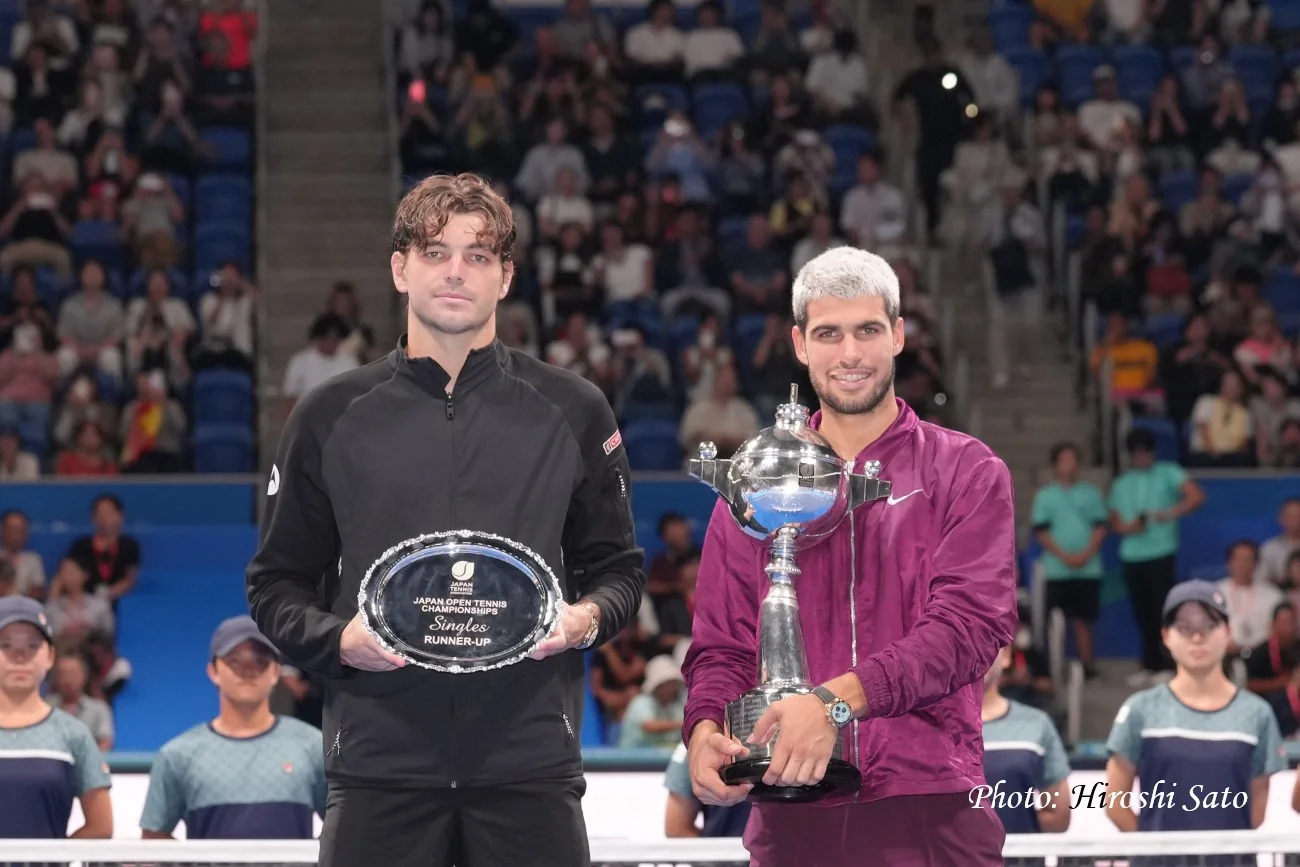
As of September 29, the 2026 Japan Open men's singles draw gives defending champion Carlos Alcaraz a confirmed first-round match against Alex Michelsen in Tokyo. The Spaniard's next-round branch is already visible, but names such as Tommy Paul, Taylor Fritz and Frances Tiafoe are potential opponents rather than booked fixtures. This guide reads the official 2026 draw sheet in order, explains why the opener deserves attention and shows how to follow changes when qualifying and the daily order of play are finalized.
What is Alcaraz's confirmed Japan Open 2026 draw?
Carlos Alcaraz is the No. 1 seed and will face Alex Michelsen in the first round of the 2026 Japan Open. That pairing is fixed in the tournament's official men's singles draw, released on September 28. As checked on September 29, the 32-player main draw has yet to begin, and neither man has a Tokyo 2026 singles result. Everything beyond their meeting is a route through the bracket, not a scheduled encounter.
| Round | Alcaraz's position in the draw | Status on September 29 |
|---|---|---|
| First round | Alex Michelsen | Confirmed pairing |
| Round of 16 | Winner of Matteo Arnaldi vs Rei Sakamoto | Conditional on Alcaraz winning |
| Quarterfinal | Could be No. 7 Tommy Paul; three other players occupy that quarter | Seed projection only |
| Semifinal | Could be No. 3 Taylor Fritz or No. 6 Casper Ruud, among others | Draw-half projection only |
| Final | An opponent from the opposite half, headed by No. 2 Frances Tiafoe | No finalist determined |
The distinction matters. The first two slots sit together on the draw sheet, so Alcaraz and Michelsen must meet unless a withdrawal or other draw change intervenes. The adjacent Arnaldi–Sakamoto tie determines the next opponent only if Alcaraz advances. Paul's seed sits in the other eighth of the same quarter; he also needs two wins for the projected last-eight match to happen. Fritz and Ruud are in the next quarter and cannot meet Alcaraz before the semifinals. Tiafoe is on the far side of the 32-player field, so a meeting with him would require both players to reach the final.
This is the strongest way to read a preview without treating a neat seeded path as a prediction of results. An upset, retirement or replacement can rewrite one branch immediately. Several qualifying places were still labeled “Qualifier” in the released sheet, which is another reason to use the tournament's current draw hub for late changes. Our Tokyo tournament tracker follows listed matches and scores in the reader's time zone, while the event's PDF remains the authority for the bracket. It is an appealing draw for a defending champion, but the only opponent Alcaraz can prepare to play next is Michelsen.
Why is Alex Michelsen a demanding first-round opponent?
Michelsen arrives with proof that his unseeded place understates his recent level. The 22-year-old American reached his first Grand Slam quarterfinal at the US Open earlier this month. According to the US Open's match preview, he did not drop a set in his first four rounds and beat seeded Brandon Nakashima and Tomás Martín Etcheverry along the way. That is more meaningful preparation for a top seed than a generic claim that a young player is “dangerous.” He has already handled a difficult hard-court draw recently, and he did it with enough consistency to reach the last eight.
The quarterfinal ended in defeat, but it shows both his ceiling and the limits of reading a result alone. Michelsen won the first two sets against Frances Tiafoe and served for the match at 5–4 in the third. Tiafoe recovered to win 5–7, 3–6, 7–5, 6–3, 7–6(6) in four hours and 38 minutes. The USTA's match report notes that Michelsen broke Tiafoe six times in the first 12 Tiafoe service games and timed forward moves on second-serve points. Those are concrete reasons Alcaraz cannot assume an easy opening hold every time he serves. The same match also showed that finishing a high-pressure contest is a separate challenge from getting ahead in it.
The first-strike matchup on Tokyo hard courts
The useful tactical question is who takes control of the first exchange. Michelsen is a 6-foot-4 right-hander with the reach and serve to keep an opponent from settling immediately, according to the USTA player profile. His US Open run shows he is also willing to attack a second serve and close at the net. For Alcaraz, the response is not merely to hit harder: reliable first serves, enough depth on the second ball and good passing choices can prevent Michelsen from taking the court away. For Michelsen, free points on serve and committed first returns would shorten the amount of time he spends defending against Alcaraz's variety. These are matchup questions to watch, not claims that either player will execute them successfully.
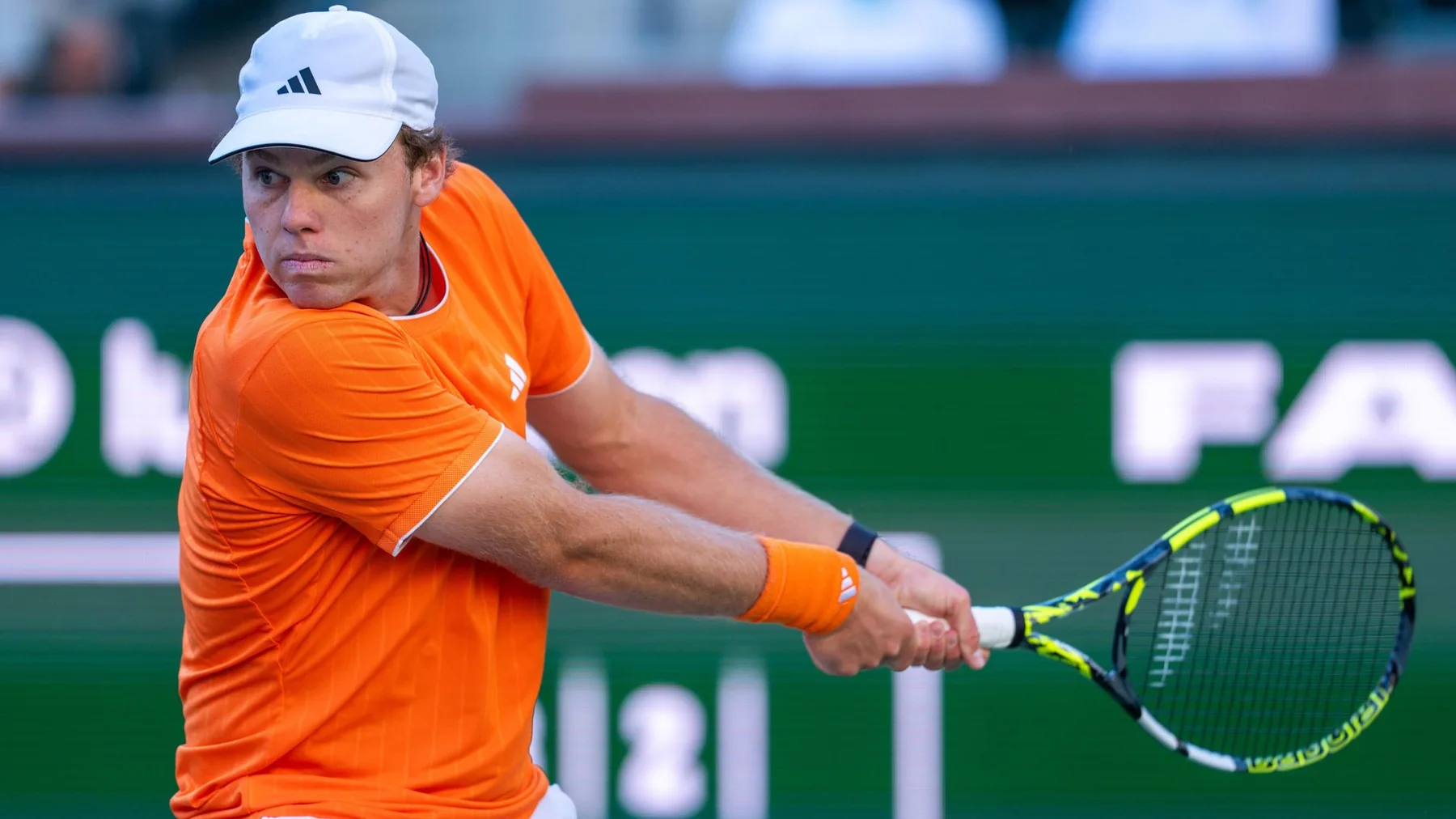
Tokyo's official fact sheet specifies a hard-court event and best-of-three tiebreak sets. That is a different contest from a five-set New York quarterfinal: a slow first set can be more expensive, but one long US Open match cannot tell us how quickly this particular Tokyo court plays. There is no singles head-to-head to lean on either. The upcoming-match listing shows Alcaraz ranked No. 3 and Michelsen No. 34 at the time of checking; those numbers explain the favorite's status without making the first round a formality. Alcaraz also comes straight from London's Laver Cup, a scheduling choice covered in our calendar analysis. Whether the short turnaround affects his first match is something the play itself must establish.
Who could stand in Alcaraz's way after Michelsen?
The official 2026 draw identifies a sequence of possible opponents, not a fixed itinerary. If Alcaraz gets past Michelsen, he plays the winner of Matteo Arnaldi against Japanese wildcard Rei Sakamoto. If he reaches the quarterfinals, Tommy Paul is the highest seed he could meet in that part of the bracket. Taylor Fritz and Casper Ruud occupy the adjacent quarter of the top half, which makes either man a possible semifinal opponent. The structure is simple once read round by round, but it prevents a tempting error: announcing an Alcaraz–Fritz rematch before both players have won three separate matches.
Arnaldi or Sakamoto: the immediate gate
Arnaldi and Sakamoto play each other in the first round, so this is the one later branch where the draw already supplies both names. Sakamoto carries a wildcard, meaning he enters the main draw directly rather than through the qualifying section; the crowd would have a local player to support if he advances. Arnaldi's presence creates a different potential second-round test for Alcaraz. Neither opponent should be treated as booked until that first-round result and the Alcaraz–Michelsen result are final. The correct short version is “winner of Arnaldi–Sakamoto,” not “Alcaraz will play Arnaldi.”
What lies beyond them makes the path less linear. In the other eighth of the same quarter, Denis Shapovalov meets another Japanese wildcard, Sho Shimabukuro, while No. 7 seed Paul opens against Alejandro Tabilo. Paul must win that match and then a second-round tie against the Shapovalov–Shimabukuro winner to make the projected quarterfinal. Alcaraz must do the equivalent in his eighth. The two wildcard entrants also make this section unusually interesting for Tokyo fans: home support may shape the atmosphere, but it does not alter who has to win on court. Our Tokyo results page is the practical place to check how those branches develop once play starts.
Paul, Fritz and Ruud are conditional paths
A Paul quarterfinal would carry a recent reference point. Alcaraz defeated the American 6–4, 6–3, 6–4 in the US Open fourth round on September 6. It is evidence that Alcaraz recently handled Paul's baseline pace on a hard court; it is not evidence that a different match in Tokyo would have the same score. Paul's first task remains Tabilo, and any analysis of a Paul–Alcaraz rematch depends on the outcome of that opening tie.
Fritz heads the next quarter as the No. 3 seed and starts against a qualifier. Lorenzo Musetti faces Arthur Fery on the same side of his eighth. In the other eighth, Holger Rune faces special exempt Kyrian Jacquet while Ruud opens against Luciano Darderi. The winner of that quarter, whether Fritz, Ruud or someone else, would be Alcaraz's semifinal opponent only if the Spaniard wins his quarter. That is why “projected Fritz semifinal” is useful shorthand but “Alcaraz versus Fritz semifinal” is premature.
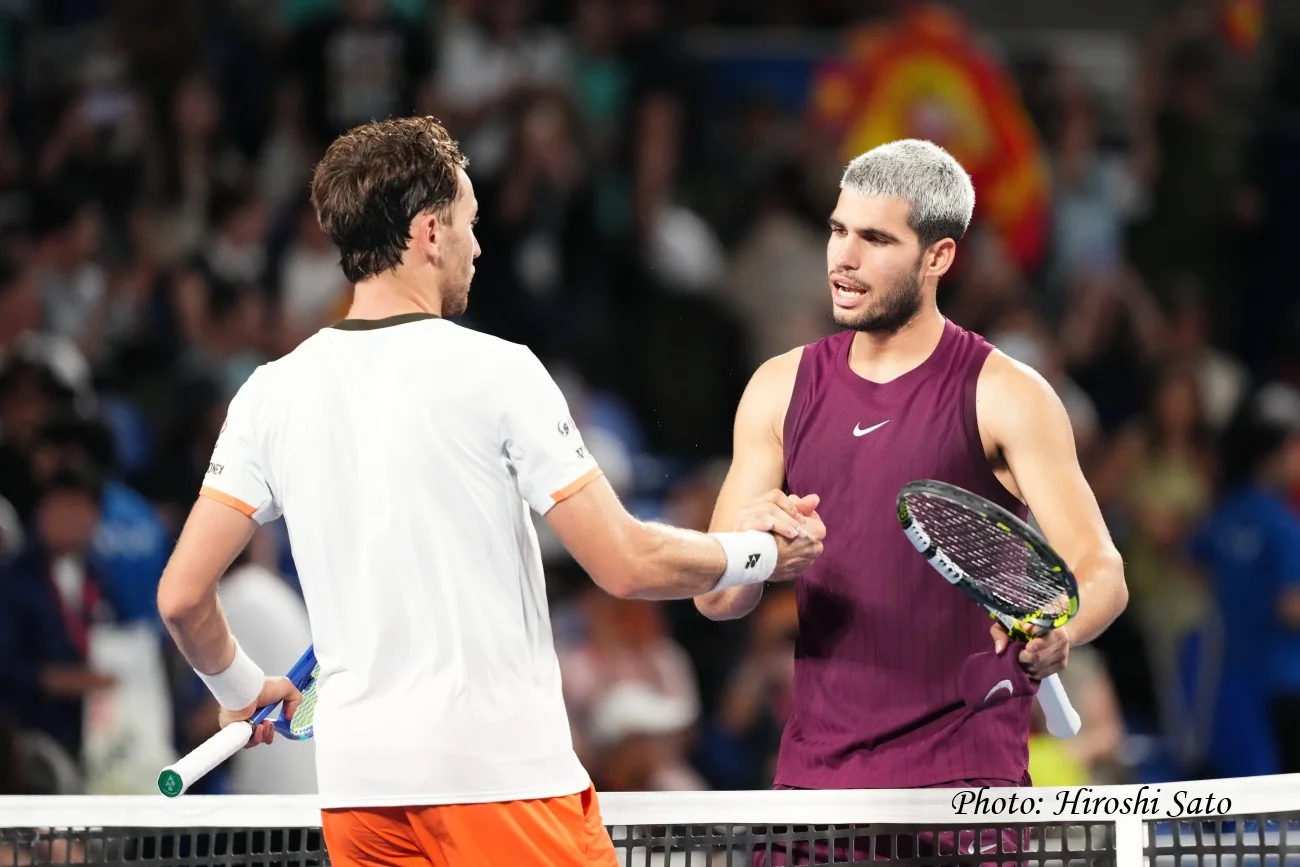
The history still enriches the preview. Alcaraz recovered from a set down to beat Ruud 3–6, 6–3, 6–4 in last year's Tokyo semifinal, then defeated Fritz 6–4, 6–4 for the title. A rematch with either man would test what has changed since those contests, especially return position and the ability to win short points. It would be compelling precisely because the previous meetings were real; the 2026 versions remain hypothetical.
What makes the bottom half worth watching?
The opposite half has its own confirmed first-round headline: No. 2 seed Frances Tiafoe against Japanese wildcard Kei Nishikori. An Alcaraz–Tiafoe final is possible because they sit at opposite ends of the draw, but it is only one of many outcomes. The official bracket also places No. 4 Rafael Jódar and No. 5 Brandon Nakashima in the lower half. Those seedings make them natural preview names; the first-round pairings explain why none can be penciled into the final. Looking beyond Alcaraz is useful for the same reason that reading his own quarter carefully is useful: the other finalist must survive three rounds before the title match exists.
Tiafoe–Nishikori is a first-round headline
The Tiafoe–Nishikori matchup is already on the official draw sheet. Its appeal is not just ranking or the possibility of a favorite being tested. The tournament announced that this is set to be Nishikori's final Japan Open appearance before his planned retirement at the end of 2026. He won the Tokyo title in 2012 and 2014 and received a singles wildcard this year. Seeing a two-time home champion across the net from the second seed gives the opening round an occasion of its own, whatever the result.
Tiafoe cannot look ahead to Alcaraz or even to a seeded quarterfinal. He must first handle that emotionally charged match; then he would meet the winner of a nearby tie whose names were not both filled in when the September 28 PDF was issued. No. 8 seed Valentin Vacherot starts against Alexander Blockx elsewhere in the bottom quarter. A seeded Tiafoe–Vacherot quarterfinal is a possible bracket outcome, not an appointment. Tiafoe's own recent US Open comeback against Michelsen gives the first round another thread: one of the men from that New York quarterfinal is in Alcaraz's opener, the other in Nishikori's. Their Tokyo matches remain completely separate.
Jódar, Nakashima and the qualification wildcard
The lower half's upper quarter is less settled at the first-round level. Jódar, the No. 4 seed, is paired with a qualifier; Nakashima, seeded fifth, has a named opponent in Ugo Humbert. Alejandro Davidovich Fokina meets Matteo Berrettini, while Jiří Lehečka faces Zizou Bergs. This concentration means a quarterfinal projected by seed may disappear quickly. If Jódar advances, the Davidovich Fokina–Berrettini winner is his immediate second-round branch. If Nakashima advances, Lehečka or Bergs waits next. Those are specific dependencies rather than a vague claim that the field is “stacked.”
The qualifier label is meaningful, not a blank to fill with a guess. The tournament's entry list notes that Arthur Fils is playing qualifying because of an entry-process issue, but that does not put him in Jódar's slot or guarantee him a place in the main draw. Qualifying finishes on September 29, and its winners must be assigned to the four open singles slots. Fans should revisit the draw after those names appear, then judge Jódar's actual opener. The entry page also labels its ranking column as an August 31 snapshot; it is useful for field composition, while the later official draw sheet gives the operative seeds. Our Japan Open page can help readers follow the resulting match listings as the field settles.
When does Tokyo start, and how should fans track changes?
The 2026 Japan Open men's main draw runs from Wednesday, September 30 to Tuesday, October 6 in Tokyo. Qualifying takes place on September 28 and 29. Those are the dates on the organizer's 2026 fact sheet, which also locates the tournament at Ariake Coliseum and Ariake Tennis Forest Park. Singles is a 32-player, hard-court ATP 500 draw, with matches decided over the best of three tiebreak sets. The first day of main-draw play is a tournament date, however, not proof that Alcaraz will play his opener at a particular hour on that day.
At the September 29 check, the organizer's schedule page still says it is being prepared, while our Tokyo order-of-play page lists Alcaraz–Michelsen with “Time TBA.” That is the accurate distinction between a draw and a daily schedule. The bracket answers whom he is drawn to face. A published order of play answers when and on which court the match is assigned. Match start times can also slide as earlier contests run long. A generic date shown by a fixture card should not be treated as a confirmed first-serve time, particularly by readers converting Tokyo time to North American or European clocks.
Three checks before the first ball
- Use the official draw hub to see whether the September 28 PDF has been replaced, whether the four qualifier names are filled, and whether withdrawals have changed any branch.
- Use the daily order of play when published to verify Alcaraz–Michelsen's court, session and local start listing. Our Tokyo schedule displays listed match times in the reader's time zone when they become available.
- After each result, read the winner of the adjacent pairing rather than carrying a pre-tournament seed prediction forward. The bracket changes from possible opponents to an actual next opponent one round at a time.
Alcaraz is defending a real Tokyo title, which gives the tournament a stronger story than a routine stop on the Asian swing. In the 2025 final he beat Fritz 6–4, 6–4, taking the key first-set break at 4–4 before closing out his debut Japan Open campaign. The 2026 singles draw sheet assigns 500 ranking points to the champion. That does not mean those points are automatically added to a player's existing total, because ranking calculations depend on the tournament being replaced and the wider points ledger. For a bracket reader, the simpler and safer point is that the champion is back and has to win five matches to repeat.
Tokyo is also coming immediately after the Laver Cup in London for Alcaraz, a different competitive format and a substantial change of time zone. It is reasonable to watch how promptly he finds his return timing and movement against Michelsen, but no schedule alone establishes fatigue or injury. The first Tokyo match will supply the evidence. For now, the dependable guide is the official draw, the organizer's dates and a daily order of play when it is issued. If you are planning to watch live, check that order again close to the session; if you are following afterward, the tournament's listed results will replace each conditional branch with a name and score.
The useful starting point is simple: Alcaraz–Michelsen is real, while the rest of the attractive path depends on results. Tokyo's main draw runs September 30–October 6, and the official draw and daily order of play should settle any late changes or start-time questions. Follow the first-round matches before turning a seeded forecast into a later-round matchup; that is where the 2026 Japan Open story will actually be decided.
About the author
ATP Schedule Editorial Team
The ATP Schedule editorial team turns match times, scores, tournament information and verified tennis news into clear answers fans can use quickly.
View all articles by this author →Fan discussion
Comments
Sign in with Google to comment. Keep the discussion helpful and tennis-focused. New comments are reviewed before they appear.
Loading comments…