Why Did Alcaraz Play Laver Cup 2026 Amid Calendar Complaints?
Alcaraz said the Laver Cup restored his joy in tennis. His two London matches and exact scheduling complaints show what the apparent contradiction does and does not mean.

Carlos Alcaraz has questioned tennis's crowded calendar and its late-night Grand Slam matches, yet he spent September 25–27, 2026 with Team Europe at the Laver Cup. The apparent contradiction prompted a fair question: why spend a possible rest week competing? His answer was that a rare team experience helps him enjoy tennis and prepare for the weeks ahead. This guide checks his exact comments against the official London results, separates two different scheduling complaints and weighs the real cost of his voluntary choice.
What did Alcaraz say about choosing Laver Cup 2026?
Carlos Alcaraz said he chose the Laver Cup because team tennis helps him enjoy playing again. Asked in London why he would give up a free week when he has criticized the long tennis season, he said that spending time with teammates and sharing the court with players he normally faces across the net restores something he misses on the individual tour. In Tennis Majors' September 24 press-conference report, his central phrase was that these weeks help him “bring my joy back on the court.” An independent Ubitennis account reported the same explanation. It was an answer about how he experiences a particular event, not a declaration that the travel and matches require no energy.
He acknowledged the alternative: he could have trained or rested instead. That acknowledgment makes the choice more informative. He weighed those uses of the week against a short competition in which the players sit together, coach each other and pursue a shared score. He did not say every optional tournament is helpful, or that playing more weeks is always the best route to recovery. The Laver Cup rules make participation an invitation a player may decline, with ranked places and captains' selections making up the teams. The three-day format is different from a two-week major or a sequence of individual tour stops, although it remains real competitive tennis.
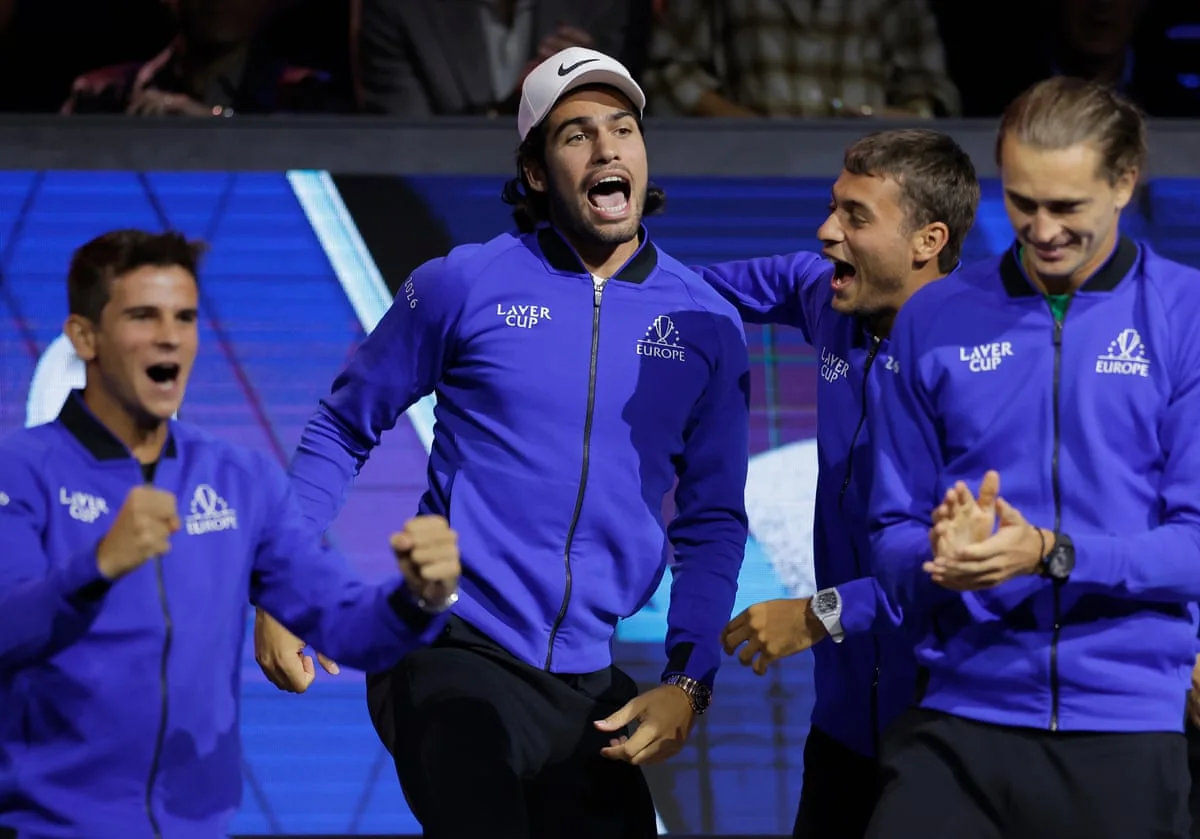
The Guardian's opening-day report offered a concrete glimpse of the appeal. Alcaraz was energetic on the Team Europe bench, encouraging Casper Ruud and discussing tactics during Ruud's match with Francisco Cerundolo. For a player whose ordinary job involves solitary preparation and ranking pressure, the ability to be a teammate and occasional sideline adviser could plausibly feel different. That observation supports the meaning of his words; it cannot prove a measurable psychological benefit weeks later.
This was not his first Laver Cup. He had appeared in the previous two editions and returned for a third in London. Familiar teammates and a familiar event likely made the invitation attractive, but we should not replace the player's stated reason with our own speculation about loyalty, money or publicity. The tournament pays appearance fees and a prize to winning-team members, and those incentives are part of its structure. Alcaraz specifically highlighted the team setting and enjoyment when asked to defend the choice. Team Europe ultimately won 13–5; our London results and scoring guide shows how his on-court contribution fitted the weekend.
Which calendar complaints are being compared with that choice?
The apparent contradiction becomes easier to assess when the complaints are dated and stated precisely. Alcaraz has questioned the number of weeks elite players are pushed to compete and, separately, the scheduling of individual Grand Slam matches that run into the early morning. A voluntary Laver Cup appearance raises a reasonable question about his own choices. It does not directly answer either structural complaint. Treating all three as the same claim would miss what he actually asked organisers to change.
The crowded-season objection is about choice and recovery
At the 2026 US Open, Alcaraz said he expected to skip some tournaments in the future, perhaps taking breaks of one or two months, so he could prepare physically and mentally for major events. Tennis Majors' account of those remarks explains the context: the top-player commitment system creates ranking and money consequences for missing certain events, even though a player can decide to stay home. That is a complaint about the incentives attached to the official calendar and the lack of genuinely unpressured recovery blocks. It is not the claim that a player should never choose to compete in an optional week.
One nuance deserves special care. Asked about the wrist injury that had kept him out from April through August, Alcaraz expressly said he did not believe it came from playing too much. He did not need to prove that one injury was caused by overload to argue for better preparation time across a career. His stated priority was to arrive at Grand Slams and Masters events feeling ready, rather than move straight from tournament to tournament. An article that presents his wrist problem as evidence he personally blamed the calendar for it would distort the interview.
The 3:33 a.m. US Open finish is a different problem
On the eve of the London Laver Cup he also criticized late-night Grand Slam scheduling. His five-set US Open quarterfinal defeat to Ben Shelton had ended at 3:33 a.m. New York time after four hours and 28 minutes. AFP's report of his London comments says he was concerned about post-match treatment, sleep, next-match recovery and spectators who cannot stay awake or in the stadium. Front Office Sports traces the domino effect: unusually long day-session matches delayed the start of the night session, helping push the final match into the morning. That is a scheduling-design issue even if an athlete's annual event count stays exactly the same.
| Issue | What he objected to | How Laver Cup fits |
|---|---|---|
| Annual workload | Too few useful breaks between important events | A chosen, three-day team week adds load but carries different incentives |
| Late-night matches | Finishes that damage recovery and audience access | Playing in London does not endorse a 3:33 a.m. Slam finish |
| Personal choice | Ability to choose a week that feels worthwhile | He chose the team setting and can still be questioned about its cost |
The tournament calendar remains crowded around this period, with the Asian swing following the US Open and Laver Cup. The fair question is how to give players room to make meaningful choices inside that calendar while maintaining the events fans care about. A single London appearance neither disproves his earlier concern nor makes its physical cost disappear.
How much tennis did he actually play in London?
The official 2026 score sheet makes the workload question concrete. Alcaraz played two competitive rubbers, one doubles and one singles, and won both. He was due to face Alex de Minaur in Sunday's singles if Team World kept the contest alive, but Europe clinched before that match. Counting the event as an entire extra week of match play would exaggerate what happened on court. Treating his two matches as equivalent to a rest week would understate it.
Friday doubles and a Saturday test against Fritz
On Friday, Alcaraz and Jakub Mensik beat Alexander Bublik and Taylor Fritz 6–4, 6–4 in one hour and 27 minutes. The official opening-day report records Alcaraz talking about chemistry with Mensik and their ability to translate good energy off court into their partnership. That is a rare opportunity for an elite singles player: work with a peer on the same side of the net while still facing world-class opponents. It illustrates why “I enjoy team events” was more than a vague promotional answer.

Saturday's match was a much sharper individual test. Alcaraz defeated Fritz 6–3, 4–6, 13–11 in one hour and 50 minutes after saving two match points. The official match report documents a tense tiebreak and his use of a drop shot at the finish. It was a high-intensity contest, especially for someone back from a long absence. The decisive tiebreak format meant there was no full third set; it did not make the preceding effort imaginary. Adding the official match durations gives three hours and 17 minutes of competition across two days. This is a transparent, useful number, but it omits practice, warm-up, travel, media activity and every other part of event participation.
Why Sunday's singles did not happen
Europe entered Sunday ahead 7–5. Flavio Cobolli and Mensik won the opening doubles to move the score to 10–5, then Alexander Zverev beat Learner Tien to reach the 13-point winning threshold. The official clincher account says Alcaraz was waiting to play if Zverev failed. The score sheet labels the Alcaraz–de Minaur match “Not Played.” A preview or Sunday lineup can be mistaken for an actual match in a quick recap, but it did not add another result or another recorded match duration to his week.
That early finish shows why team competition does not map neatly onto an individual player's calendar. He had to be ready for a possible second singles appearance, but the team's success removed that obligation. The full 2026 Laver Cup score pathway explains how the one-, two- and three-point match weights led to the 13–5 final. For this debate, the relevant facts are simpler: he elected to travel to London, competed for 3:17, contributed directly on Friday and Saturday, and did not play on Sunday. Whether that was a wise use of his energy is a judgment for him and his team, informed by his recent wrist history but not settled by the box score alone.
Is playing a voluntary event still a fair target for criticism?
Yes. A flight to London, training sessions, two competitive matches and media duties are work. A player who argues for a lighter schedule should expect questions when he fills a free week with more tennis. The best criticism is concrete: how much energy did the trip cost, what recovery opportunity was forgone and could the same choice be sustainable repeatedly? It is weaker to claim the choice automatically cancels his position on mandatory events or 3:33 a.m. Grand Slam finishes. Those are different decisions made by different organisers.
There are also genuine financial and professional incentives. The Laver Cup's published rules say participants receive an appearance fee based on their ATP singles ranking, and each player on the winning team receives $250,000. The event is sanctioned and sits on the calendar, although it offers no ATP ranking points. Alcaraz said the team setting brought enjoyment, and there is no need to deny that the event may also be financially attractive. The public evidence does not tell us how he personally ranked those motives. An honest answer can mention the payment structure without asserting that money, rather than team spirit, drove his choice.
What Mouratoglou's mental-reset argument can and cannot prove
Patrick Mouratoglou offered a sharper defense after the event. In his public comments, reported by Tennis Majors, he argued that the risk for Alcaraz is mental saturation from repetitive individual competition, and a different kind of tennis can renew motivation. This interpretation fits Alcaraz's own comment about regaining joy. It also fits the Guardian's observation of him cheering, advising and celebrating with Team Europe rather than merely waiting for his own match. The details show why a team week may feel refreshing even while it uses physical energy.
But Mouratoglou's argument should be labeled for what it is: an informed commentator's reading, not a diagnosis, a measurement of fatigue or a statement from Alcaraz's medical staff. Nor does psychological variety erase possible physical consequences. The Guardian reported that Alcaraz had returned after roughly four and a half months away with a wrist problem. That recent history makes the cost of additional matches worth asking about, even though neither the score sheet nor the public interviews show that London harmed him. The plausible conclusion is limited: he knowingly selected a short, social event that he said helped his enjoyment, while accepting an extra workload. Fans may disagree about the wisdom of that trade-off without needing to call either side dishonest.
For a player with a demanding tour profile, the right comparison is not “work versus no work” in the abstract. It is this particular week against the alternatives he and his team actually had: rest, training, or a different competitive stop. Public records show what he played. They cannot reveal how recovered he felt afterward, how valuable the team experience was to him, or whether the same choice would suit another player. Those limits matter when an individual decision becomes a symbol for a tour-wide calendar dispute.
What would make the schedule debate more useful?
Start by naming the rule or practice at issue. A player objecting to an overnight Grand Slam finish is asking for a different way to schedule a day's matches. A player asking for longer breaks is questioning the incentives and obligations spread across many months. A player choosing a voluntary team week is making an individual decision within that existing system. Each deserves scrutiny, but none alone resolves the others. The evidence from London is specific: Alcaraz gave a reason for playing, completed two rubbers and did not play his scheduled Sunday singles. That is more informative than calling him consistent or inconsistent based only on a promotional poster.
For the annual calendar, useful questions include how many events count toward commitment rules, what a player loses by missing one, and whether the season provides stretches long enough for training and recovery. Alcaraz's September remarks pointed toward missing some events to arrive at major tournaments better prepared. That is a choice he can make, but the surrounding ranking and financial consequences help explain why players still ask for changes to the system. A useful future update would report both what the rules require and what athletes actually enter or skip. It should not assume that a proposed break has been taken before a confirmed withdrawal or schedule exists.
For late finishes, the question is more immediate. The AFP report documents Alcaraz's concern that a 3:33 a.m. result left too little time for sleep and excluded many spectators. Earlier starts, fewer matches on one show court, curfews or more contingency planning are possible topics for organisers to evaluate. Each has costs in tickets, broadcast windows or access to marquee matches. The debate should identify those trade-offs rather than pretend every late finish can be prevented by a player refusing an unrelated September invitation. Nor must reform automatically mean ending five-set Grand Slam tennis: in the same AFP report, Team World captain Andre Agassi defended that format while acknowledging overnight play is undesirable.
Fans can also hold players to a reasonable standard without demanding perfect austerity. If Alcaraz said every optional match was harmful, the Laver Cup would be a direct contradiction. He did not say that. He said that some team weeks make tennis more enjoyable and that he needs space to be physically and mentally ready for his priorities. If future appearances become frequent enough to erase the breaks he says he wants, the criticism would gain force. As of London 2026, the public record supports a narrower conclusion: a chosen, two-match team event can coexist with a call to change mandatory scheduling and night-session practices, while still adding work and travel.
After this completed weekend, any prediction about his next event should come from current entry lists and player announcements, not from an assumed path through the Asian swing. Follow this week's ATP matches and the tournament calendar for confirmed schedules. The question to return to is practical: will organisers adjust the pressures he described, and will his own later choices create the recovery space he says matters? Those future facts will give fans a better test of the argument than a single three-day team event.
Alcaraz chose Laver Cup 2026 because, in his own account, teammates and a shared goal restored some enjoyment that an individual season can drain. He played two matches and missed a planned third when Europe clinched early. The choice added work, so fans can question it. It also does not erase his separate objections to calendar incentives and a 3:33 a.m. US Open finish. Future entry decisions and any changes to those scheduling practices will offer a firmer test than a simple hypocrisy label.
About the author
ATP Schedule Editorial Team
The ATP Schedule editorial team turns match times, scores, tournament information and verified tennis news into clear answers fans can use quickly.
View all articles by this author →Fan discussion
Comments
Sign in with Google to comment. Keep the discussion helpful and tennis-focused. New comments are reviewed before they appear.
Loading comments…