Vienna Open Guide: Venues, Tickets and Watching the Erste Bank Open
Choose between Stadthalle and Marx Halle, understand ticket access and plan a useful tennis day. This fan guide separates the finished 2026 event from confirmed 2027 planning.
What is the Vienna Open, and when should you plan to visit?
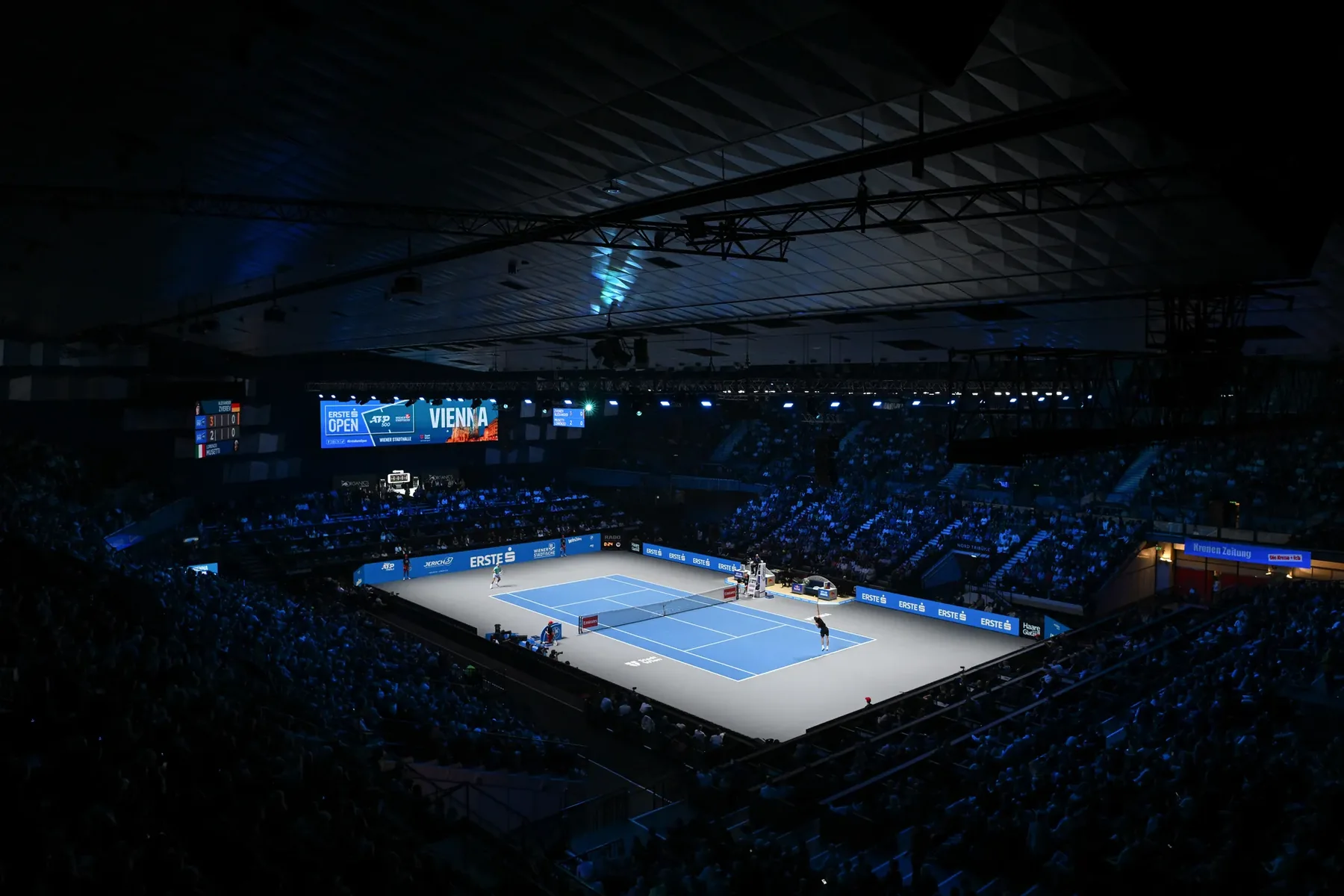
The Vienna Open is the Erste Bank Open, the Austrian capital's indoor ATP 500 tournament. Its appeal for a visiting fan is the choice of experiences: a seat for the main arena's program, additional matches at a separate venue, and opportunities to see players preparing between competitive appearances. Choosing among those experiences matters as much as choosing a particular day.
As of November 12, 2026, the 2026 tournament has finished. For a future visit, the organizer has confirmed the 2027 main draw for October 25–31. Its official ticket page says general sales for 2027 will start in early December. It does not give an exact opening day or hour. Those are the useful facts to build around now, rather than an expired listing for last season.
There is a distinction between the general sale and renewal. Existing spectators had a separate opportunity to retain their seat for the same weekday in 2027; the organizer's renewal announcement gave a deadline of November 1, 2026. Finding that promotion in search does not mean its reservation window remains open. A date on a ticketing article can be as important as the headline.
Broader event listings can include days before the main draw. For example, ATP Experiences advertises an October 23–31, 2027 event window. That broader span should not be read as a promise that every day contains main-draw singles. Confirm the exact program attached to the product you are considering before arranging arrival or departure around it.
Our recommendation is to decide what would make the trip worthwhile before selecting accommodation: seeing many different players, following the closing rounds, watching doubles closely, or spending time around the practice courts. That preference will guide the venue and ticket decisions below. A named player's participation and match time are separate questions that may be settled much later. Use the 2027 ATP calendar to place Vienna within the wider season, then keep the tournament's own announcements as the final authority for your visit.
Stadthalle and Marx Halle offer different tennis days
Wiener Stadthalle and Marx Halle are separate destinations. A map pin for “Vienna tennis” is therefore not enough: first establish which venue hosts the match or activity you want, then check the admission conditions. Their different settings are part of the tournament's appeal, but they also require a choice about how you spend a limited day.
Centre Court at Wiener Stadthalle
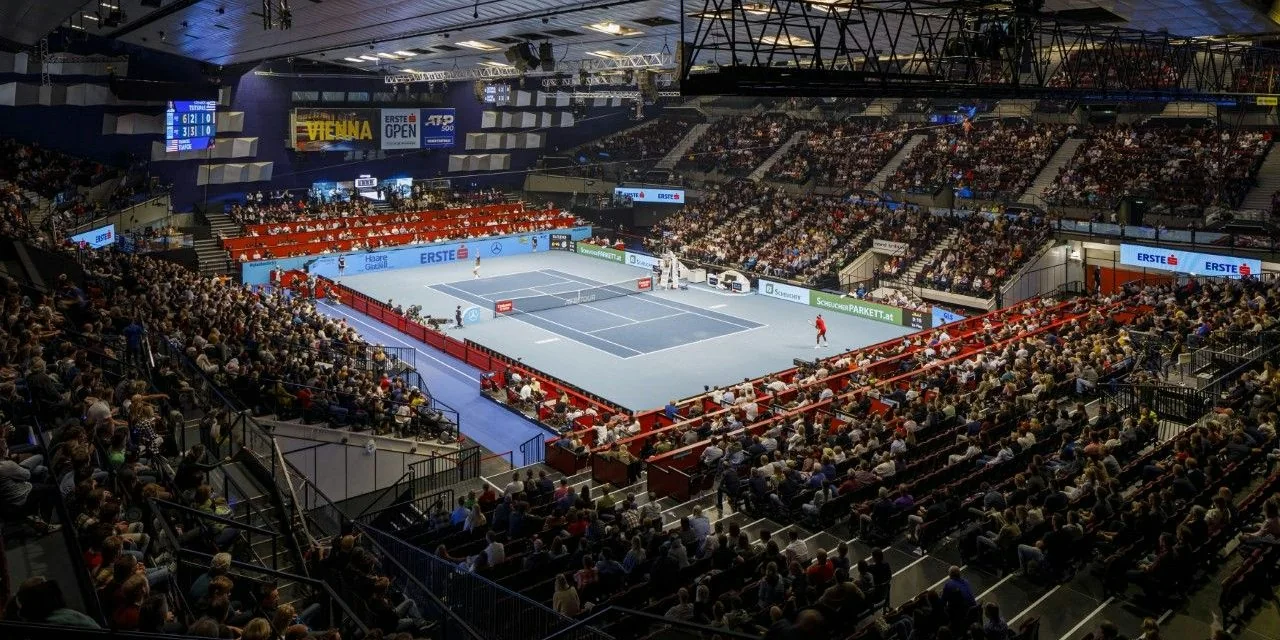
The main arena is Hall D at Wiener Stadthalle, identified in the venue's official event listing. For a fan who wants to settle into a seat and follow successive matches without moving between courts, this is the natural starting point. The arena setting also makes it easier to share the rise and fall of a match with a large crowd.
Consider what you like to watch when comparing available seats. A view from behind the baseline helps you follow changing angles and how far a player is pushed sideways. A side-on view makes the timing of contact and movement toward the net easier to appreciate. These are viewing preferences, rather than a guarantee that a particular price category offers an unobstructed angle; inspect the seating plan supplied with the actual sale.
The courts and practice sessions at Marx Halle
The organizer's 2026 Marx Halle visitor account describes two match courts, two practice courts and public training sessions. That combination suits a different kind of day: compare players' preparation, watch a less familiar pairing, or alternate competitive tennis with time around the wider fan activities.
Practice can be especially rewarding if you play tennis yourself. You can watch a player repeat a return, adjust a recovery step or discuss a pattern with a coach without treating every miss as a lost point. It is still a working environment. A photograph of a famous player at practice does not reserve you a similar encounter next year; the published practice schedule is the useful guide.
| Your priority | Start by checking |
|---|---|
| An uninterrupted main-arena program | Stadthalle date, seat and Centre Court schedule |
| Additional matches and practice | Marx Halle program and admission conditions |
| A particular player | Confirmed court assignment, then the appropriate ticket |
The completed 2026 Vienna tournament page provides an example of the competition behind those venue choices. Treat its results as an archive; 2027's layout and program must be checked when the organizer publishes them.
How to buy the right Vienna Open ticket
Start from the tournament's official ticket page, which identifies Wiener Stadthalle and Wien-Ticket as authorized partners. Compare the venue, date and admission description before comparing prices. A cheap listing is poor value if it covers a different court from the one you intend to watch.
What the ticket covers
The organizer's published ticket FAQ describes Stadthalle admission as covering that day's Centre Court matches, and says regular week passes are not offered. Check the terms attached to your chosen edition and product rather than assuming an evening match requires a separate session purchase.
Read the venue name literally. Do not treat a Marx Halle Ground Ticket as a reserved Centre Court seat. Equally, if a Stadthalle purchase advertises an additional venue benefit, read its capacity and date conditions before depending on it. An itinerary involving both locations should be based on the actual entitlement printed or linked with your booking, not a benefit remembered from a previous visit.
Prices and family tickets
The FAQ gives a €25 Marx Halle Ground Ticket as a 2026 example; that is not a 2027 price promise. It also explains that prices vary with the date, category and availability. Check the new tariff when sales open rather than using an old article as your budget.
For a family, compare the cost for the whole party. How many children need their own seat? Does the advertised concession apply to their ages? Does a family offer cover your exact group and the venue you want? Do not assume that an adult's admission automatically includes children or that two products with similar names have identical terms. Put the complete admission cost beside travel and meals before deciding which day offers the best value.
Our preference for a first family visit would be a program that leaves room for breaks. A long day may offer excellent tennis value to one spectator and be difficult for another. Agree on the match or activity everyone most wants to see, then build the ticket choice around that shared priority.
Resale and changes to your plans
The FAQ states that paid tickets cannot be returned or exchanged. It describes an official resale route for Stadthalle tickets bought through the e|motion shop: release them through its Ticket Management Portal, with reimbursement dependent on a new buyer. Do not assume this applies to Marx Halle tickets or guarantees a sale.
Keep the confirmation and seller details somewhere you can retrieve them. If plans change, identify the original sales channel first; a screenshot from an unrelated marketplace is not an explanation of your booking's options. Before committing to nonrefundable travel, consider whether you would still enjoy the day if your preferred player withdraws. That is a useful test of the visit you are buying.
Build your day around the order of play
Use the published order of play to connect your ticket with an actual match. Check the date, venue, court and the position of the match in the sequence. An event calendar tells you when the tournament takes place; it cannot tell you which player will occupy a particular court before the draw and daily schedule are settled.
Separate the opening time from the start of tennis. On the organizer's 2026 visitor timetable, for example, October 30 listed doors at 12:30 p.m. and play at 1:30 p.m. That hour was useful for entering and finding a seat; it was not an extra hour of scheduled match play. The example describes a completed day, not an announced 2027 timetable.
A match marked “not before” has an earliest start, rather than an appointment that overrides the preceding contest. The organizer used that wording for later Centre Court matches in its 2026 daily previews. A long three-setter earlier in the sequence can change your wait. Plan a break around the actual progress of play, and recheck the order if an earlier match ends unusually quickly.
Choose rounds before choosing players
When booking well ahead, choose the stage of the event that suits you. The 2026 program illustrates the progression: qualifying on October 24–25, quarter-finals on October 30, semi-finals on October 31 and singles and doubles finals on November 1. Treat this as a model of how a tennis week narrows, while waiting for the next edition's detailed program.
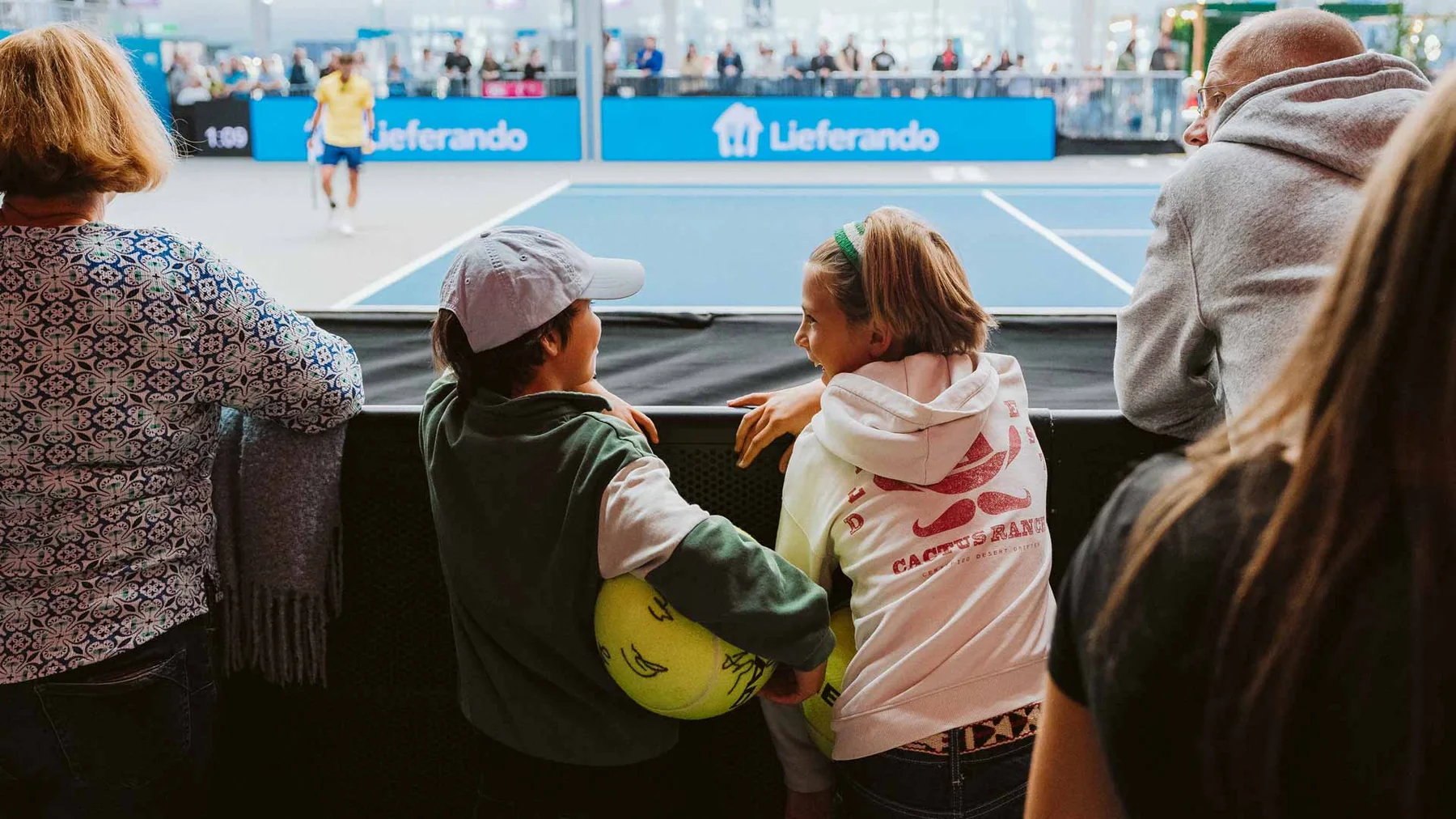
Early rounds suit a spectator who enjoys discovering different styles and following more names. The quarter-finals offer a concentrated view of players who have already found a way through the draw. Final day adds the trophy occasion, with fewer remaining opponents to watch. None of those choices guarantees a favorite player will survive to your day.
Once the schedule is available, identify one match or activity you would most regret missing. Make that the anchor for meals, travel and any second-venue visit. The 2026 Vienna schedule archive shows why court-level detail matters; an ambitious plan to see everything can leave you watching only the middle of several matches.
Getting to the venues and through the doors
Choose your destination from the ticket and program, then plan the journey to that address. The two venues sit in different districts. A convenient hotel route to one does not establish how easily you can reach the other, especially when you are trying to arrive between two matches.
| Venue | Address | Useful rail connection to check |
|---|---|---|
| Wiener Stadthalle | Roland-Rainer-Platz 1, 1150 Vienna | U6 to Burggasse-Stadthalle |
| Marx Halle | Karl-Farkas-Gasse 19, 1030 Vienna | U3 to Schlachthausgasse |
The Stadthalle arrival guide identifies the Urban-Loritz-Platz exit for the U6 connection and also lists U3 Schweglerstraße as an alternative. The organizer's Marx Halle visitor page provides its separate directions. Check current service information on the day rather than relying on a route saved many months before the event.
Build the trip backward from the first thing you want to watch. Include time to find the entrance, pass checks and reach your place, rather than counting only the minutes spent on a train. If you move between venues, add a second entry process to the journey. A plan that works only if every match ends on time is fragile; allow yourself the option to stay and finish a compelling contest.
Pack for admission, not just for the weather. The tournament's 2026 visitor instructions set a 30 × 21 × 21 cm maximum bag size. Recheck the next edition's restrictions before leaving accommodation. If you have a suitcase, arrange storage with your hotel or another suitable service and confirm any event-depot arrangements directly. Do not make the success of your tennis day depend on an assumption that the entrance will accept large luggage.
Keep travel benefits separate from tennis admission. Stadthalle explains that some tickets marked “Gilt auch als Fahrschein” include public transport under defined conditions. Read your actual ticket's area and time limits; do not extend a venue benefit into an airport journey or another day without confirmation.
If you need accessible seating, step-free access or space for a companion, contact the relevant venue before purchasing. Ask about the complete path from arrival to your viewing position. Those practical answers will help you enjoy the match more than a general assurance that a tournament welcomes everyone.
How to watch Vienna matches live or on replay
If you are following Vienna from home, choose coverage for the edition and match you actually want to see. In November 2026, a video of the completed tournament is a replay even if an old search headline still says “watch live.” This distinction is particularly useful while planning next season.
Live coverage depends on where you watch
The official 2026 event guide linked to Tennis TV for live viewing, and its Vienna tournament hub now contains that edition's replay collection. For 2027, check the provider's event listing and availability where you will physically watch before buying access. Use our ATP viewing guide by country as a starting point, then confirm the match with the broadcaster or streaming service.
A free registration and a live-match subscription are different products. Tennis TV's account guide lists free highlights, interviews and features, while Premium includes live matches and full replays. A free clip on the service is not evidence that a complete final is free too.
Before match day, test the device you intend to use and make sure you can sign in. If you are traveling, check the viewing arrangement for your destination rather than assuming your home television package settles the question. Also read the renewal terms: Tennis TV describes its subscriptions as recurring unless canceled. Choose a product that matches how long you intend to follow the tour.
Replays help you follow a complete match
The 2026 Vienna library includes both a full replay and a condensed version of Alex de Minaur against Carlos Alcaraz in the final. Tennis TV's replay help explains that you can search by player, tournament or year. Those options are useful when a local match time falls during work or sleep.
Choose the video length according to your question. Highlights are a good introduction to striking rallies and decisive points. A complete match helps you understand what happened between those moments: whether a player protected a vulnerable second serve, changed the return position, or found a repeatable way to win an ordinary service game. A condensed replay offers a compromise when you want more context without committing to the full running time.
What to watch once the tennis starts
Give yourself a simple question to follow for a few games. After a first serve, does the receiver get the ball deep enough to stop the server attacking the next shot? After a second serve, does the returner move forward or stay back? Watching the first two or three contacts reveals a pattern that is easy to lose if you follow only the final winner.
The 2026 singles final offers a useful lesson in looking beyond a set score. Alcaraz beat de Minaur 6-1, 6-4, but the ATP match report records that five of the opening set's seven games reached deuce. A 6-1 score therefore did not mean every game was brief or uncontested. At courtside, those repeated pressure points were part of the story.
The same report gives Alcaraz 29 of 36 points won behind his first serve, rounded to 81 percent. That measures success when his first serve landed; it is not his first-serve-in percentage. When comparing players, ask which question a statistic answers before drawing a conclusion. If a player wins many first-serve points but struggles behind the second delivery, the interesting tactical question is how the receiver changes position and ambition between them.
Doubles deserves its own attention. In the 2026 doubles final, Lucas Miedler and Neil Oberleitner defeated Ryan Seggerman and Learner Tien 6-1, 7-5. Rather than watching it as singles with extra people, follow the server's partner: where do they begin, when do they move, and which return seems to invite that movement? Then watch how the returning pair protect the middle or attempt to find the outside space.
Those are observation prompts, not a claim that one formation explains that final. The reward is learning to connect positioning with the next available shot. A close practice view, a main-arena seat and a full replay can each help you notice something different.
If an extended tie-break makes the scoreboard confusing, our explanation of Alcaraz's 13-11 Vienna tie-break separates points from games. Once you understand what the score represents, it becomes easier to enjoy the changing decisions behind it—and to choose the kind of Vienna tennis day you would like to experience next.
About the author
ATP Schedule Editorial Team
The ATP Schedule editorial team turns match times, scores, tournament information and verified tennis news into clear answers fans can use quickly.
View all articles by this author →Fan discussion
Comments
Sign in with Google to comment. Keep the discussion helpful and tennis-focused. New comments are reviewed before they appear.
Loading comments…