Why Alcaraz's Vienna Tie-Break Finished 13-11
Alcaraz won a 13-11 tie-break in Vienna's second set, despite the ordinary seven-point target. Decode the score and the distinction between set, match and Grand Slam deciding-set tie-breaks.
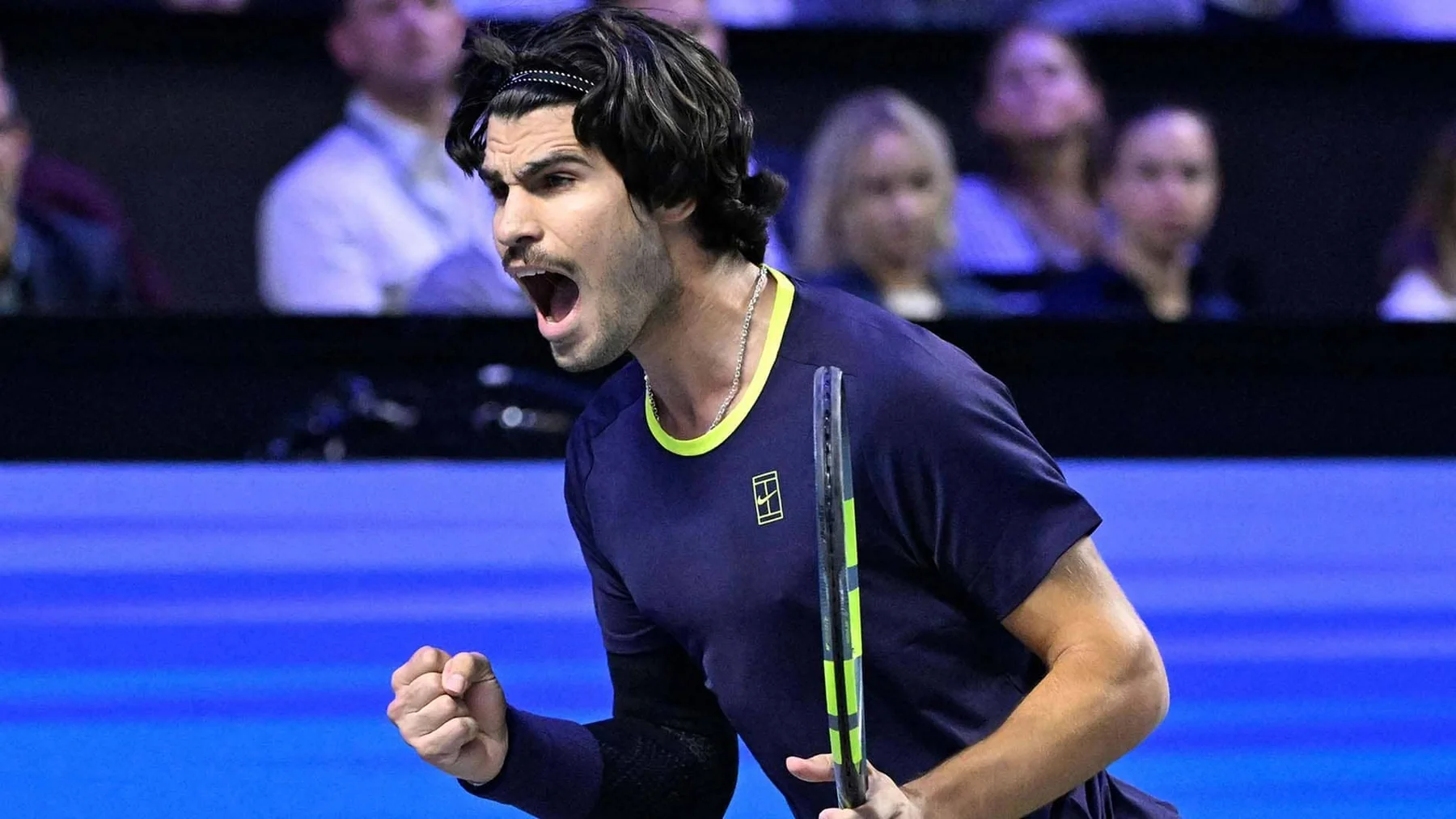
Alcaraz's 13-11 finish against Basilashvili in Vienna was still a seven-point tie-break: seven was the minimum, and a two-point lead remained compulsory. The 29 October 2026 result provides a clear way to separate tie-break points, set scores and different match formats.
What happened in Alcaraz's 13-11 Vienna tie-break
Carlos Alcaraz beat Nikoloz Basilashvili 6-1, 7-6(11) in the second round of the Erste Bank Open in Vienna on 29 October 2026. The second-set tie-break finished 13-11 in points. It was an ordinary set tie-break with a seven-point minimum and a two-point winning margin, extended well beyond seven because neither player had secured that margin earlier.
The official tournament report records Alcaraz saving four set points before converting his fourth match point. Those chances had different meanings. A set point for Basilashvili would have taken the match into a third set; a match point for Alcaraz could finish the contest because he had already won the opener.
The match had changed shape before the tie-break. Alcaraz established clear control in the first set, then lost a break advantage in the second as Basilashvili recovered. The final score therefore contains a comfortable opening set and a much tighter second one. Calling the whole match straightforward would lose the uncertainty of its closing passage.
A 13-11 tie-break contains 24 points: 13 won by Alcaraz and 11 by Basilashvili. Those are points within one deciding game of the second set, not 24 separate games and not another set added to the match. The second set still appears as 7-6 in games, because the tie-break supplies the final game that settles it.
It also matters that the tie-break ended the match without replacing a set. Alcaraz and Basilashvili had already played the second set to six games each. Winning the ensuing tie-break gave Alcaraz that set and, with it, a two-set victory. A match-ending tie-break is not automatically the alternative scoring format called a match tie-break.
If you encounter different presentations in ATP results or a broadcast graphic, establish whether the numbers show games or tie-break points. The official 7-6(11) notation and the expanded 13-11 account describe the same second-set finish. The reason that finish was possible lies in the two conditions required to win the tie-break.
Why a seven-point tie-break can finish 13-11
The ordinary rule has two simultaneous conditions: win at least seven points and lead by at least two. Reaching seven alone does not finish a close tie-break. That is why a competition described as a seven-point tie-break can continue to 13-11, 15-13 or beyond without changing its format.
Seven is a minimum target, not a points cap
The USTA's scoring guide explains the same principle with high-scoring examples. At 7-5, the leading player satisfies both conditions and wins. At 7-6, he has reached the minimum but leads by only one, so play continues. The next point can produce either a winning 8-6 or a renewed tie at 7-7.
The number seven also does not describe the total number of points played. A 7-5 result contains 12 points; a 13-11 result contains 24. The target concerns the winner's score, while the two-point margin determines how much longer a close contest lasts. Confusing the target with a fixed length is the source of much of the apparent mystery.
From 6-6 onward, a two-point gap decides it
Once the score reaches 6-6 in an ordinary tie-break, somebody must establish a two-point lead. One player wins a point to lead 7-6; if the opponent responds, it becomes 7-7. The same pattern can recur at 8-8, 9-9 or 11-11. These are illustrations of the rule, rather than an invented point-by-point account of the Vienna match.
| Illustrative point score | Finished? | Reason |
|---|---|---|
| 7-5 | Yes | At least seven, two clear |
| 7-6 | No | Only one clear |
| 8-6 | Yes | Two-point margin achieved |
| 12-11 | No | Still only one clear |
| 13-11 | Yes | Two-point margin achieved |
The final 13-11 score supports a limited deduction about the finish: after 11-11, Alcaraz won the last two points to reach 12-11 and then 13-11. A prior 12-10 lead would already have ended the ordinary tie-break. That arithmetic does not tell us the strokes played or every earlier chance.
A final score above ten also cannot identify the target by itself. Both a seven-point and a ten-point format can extend to 13-11. To know which was played, check where the tie-break occurred in the match and what the event's announced format required.
How to read 6-1, 7-6(11) without mixing games and points
Read the Vienna result on three levels. Alcaraz won the match in two sets. The first set ended 6-1 in games and the second 7-6 in games. In the notation used for this result, the number in parentheses records the losing player's tie-break points: Basilashvili won 11, while Alcaraz won 13.
The second set does not become 13-11 in games simply because the tie-break was lengthy. At 6-6 in games, the tie-break is the special scoring game that settles the set. Its winner is credited with the set's seventh game. The internal point score explains how that game unfolded, while the set score remains 7-6.
| Ordinary set result | Tie-break points | Interpretation |
|---|---|---|
| 7-6(4) | 7-4 | Winner reaches the minimum with a sufficient margin |
| 7-6(6) | 8-6 | Play continues beyond seven to achieve two clear |
| 7-6(11) | 13-11 | Extended finish, the Vienna example |
These illustrative scores also show why adding two to every losing total is not a reliable shortcut. If the loser has four points, the winner needs seven, not six. Once the losing score is high enough to have forced an extension, the two-point margin determines the finishing total. Apply both the minimum target and the winning margin.
Broadcasters and results services can present the information differently. Some show a small superscript, some place the losing total in parentheses, and some print both tie-break point totals in full. A live graphic may temporarily emphasize the current point score while retaining the set games beside it. Different layouts do not necessarily mean different results.
On today's ATP scoreboard, identify which number belongs to the current game, which to completed games and which to completed sets. After the match, the compact result preserves the outcome rather than the entire sequence. The parenthetical 11 tells you the second-set finish was extended and close; it does not identify who served each point, how many rallies were long or which shot decided every missed opportunity. Those details require the match itself or reliable reporting.
Who serves and when players change ends
A tie-break uses a serving sequence that continues regardless of who wins the points. Changing the lead does not change whose turn it is to serve, and reaching seven does not restart the rotation. Keeping the service order separate from the score makes a long finish much easier to follow.
One opening serve, then two points each
The player next due to serve begins with one point from the right, or deuce, side. His opponent then serves points two and three, starting from the left, or advantage, side and then the right. The opening server returns for points four and five, again left then right. After the opening single point, the players alternate blocks of two.
| Point numbers | Illustrative server | Service side |
|---|---|---|
| 1 | Player A | Right |
| 2 and 3 | Player B | Left, then right |
| 4 and 5 | Player A | Left, then right |
| 6 and 7 | Player B | Left, then right |
Player A and Player B here are explanatory labels, not a claim about who served first in the Vienna tie-break. A point won against serve is often called a mini-break because it changes the balance within this short contest. It is still one point, not a full service game. The final 13-11 score cannot tell you the number of mini-breaks without the service sequence and point record.
Count all points to know when ends change
Under the standard procedure, players change ends after every six points in total. A score of 4-2 has six points, as does 3-3. A continuing tie-break at 6-6 has reached 12 points, and one at 9-9 has reached 18. The count does not mean six points won by each player.
The 2026 ITF rules also specify continuous play during a tie-break change of ends, without the ordinary seated changeover rest. Approved alternative procedures exist, so a recreational competition using a different announced end-change method should not be used to rewrite the standard explanation for this match.
If another set follows an ordinary tie-break set, the player who served first in the tie-break receives in the next set's opening game. In Vienna this conditional rule did not need to be used after the second set because Alcaraz had finished the match. Understanding it nevertheless helps distinguish the tie-break's service rotation from the ordinary alternation between full service games.
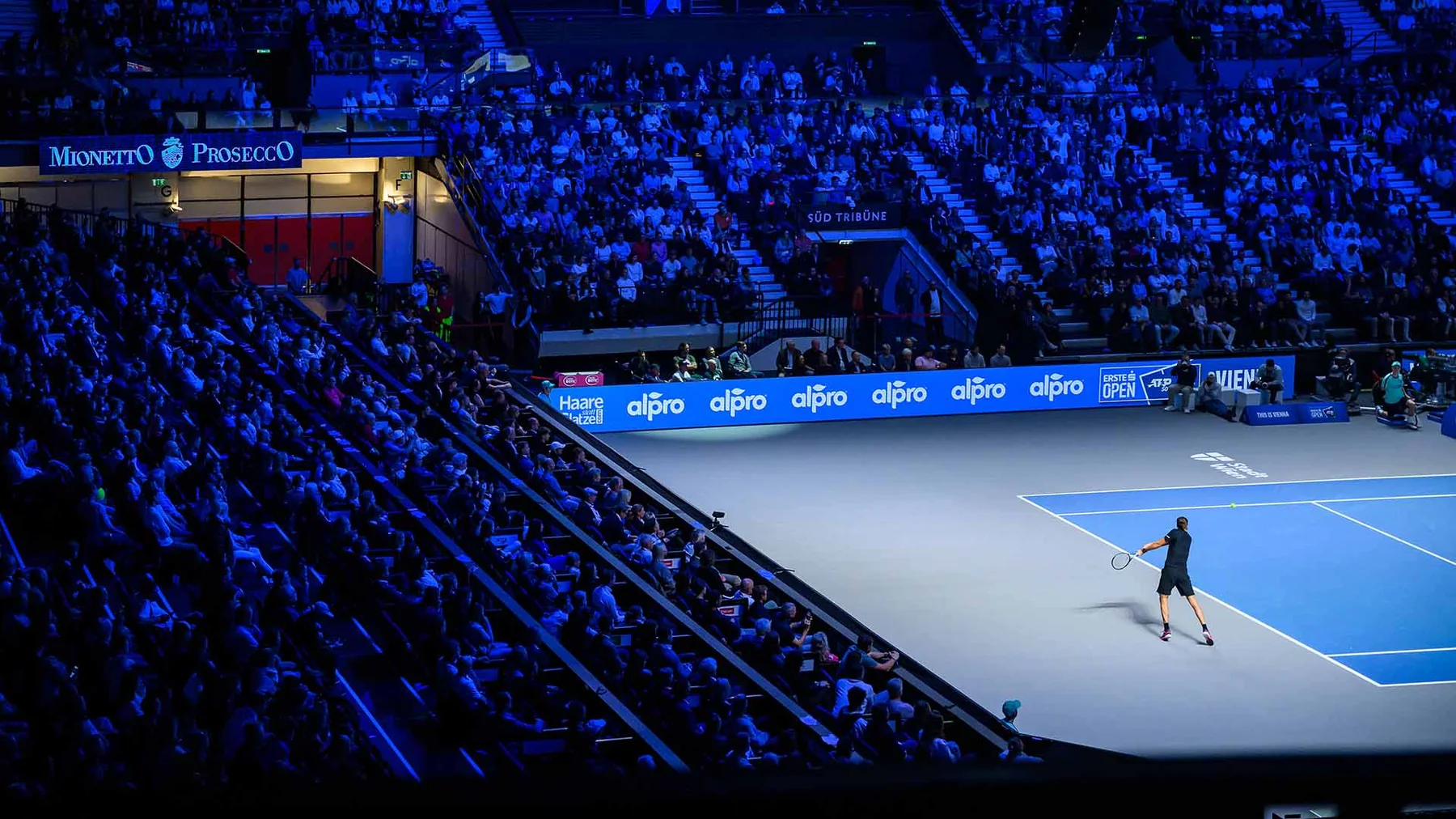
Ordinary tie-break, match tie-break and Grand Slam decider compared
Two questions identify the format: what score triggers the tie-break, and what does winning it replace or complete? The target number alone is insufficient. The 2026 ITF rules explicitly distinguish a tie-break that ends a played set from a match tie-break that replaces the deciding set.
The ordinary set tie-break played in Vienna
In Alcaraz-Basilashvili, the second set reached 6-6 in games before the ordinary seven-point tie-break. Its winner needed at least seven points and two clear. Alcaraz's victory completed that set at 7-6 and gave him the match because he already held the first set. Nothing about the second set had been replaced.
This distinction remains true when commentators say a tie-break decided the match. They may simply mean it provided the final winning points. The phrase does not necessarily name an alternative competition format.
A match tie-break replaces the final set
A replacement match tie-break begins when the match is level in sets and the announced format substitutes it for the deciding set. In a ten-point version, the players or teams seek at least ten points with a two-point margin. They do not first play the omitted set to 6-6 in games.
For doubles using this format, a score such as a split pair of sets followed by a ten-point match tie-break describes a different match structure from a singles deciding set that has been played out. The ITF also approves a seven-point replacement match tie-break in Appendix VI, so the word match does not universally guarantee a ten-point target. Check the competition's chosen procedure.
A Grand Slam deciding-set tie-break comes after 6-6
Under the 2026 Grand Slam main-draw singles framework, a deciding set is played in games and a ten-point tie-break is used if it reaches 6-6. In men's singles that deciding set is the fifth; in women's singles it is the third. The winner still needs two clear points. This is a final-set tie-break, rather than a replacement for the entire set.
| Format | Trigger | Minimum winning target |
|---|---|---|
| Ordinary set tie-break | A played set reaches 6-6 | 7, with two clear |
| Ten-point replacement match tie-break | Sets level; deciding set replaced | 10, with two clear |
| Grand Slam singles deciding-set tie-break | Played deciding set reaches 6-6 | 10, with two clear |
A 13-11 ending is possible under either a seven-point or ten-point target. Establish the event and discipline on the tournament listing, then read the announced format. Vienna's second-set context answers the question here: ordinary set tie-break, extended by the two-point margin.
What the finish tells us about the match, and what it cannot
The score establishes that Alcaraz won in straight sets and that the second-set ending remained unresolved through an extended tie-break. It does not establish that every phase was equally close or that the entire match was comfortable. The contrast between 6-1 and 7-6(11) is the central sporting feature of the result.
Alcaraz's own account helps explain the turn. In the official report, he described making mistakes while serving at 3-2 in the second set and said Basilashvili raised his level. That is a more specific explanation than simply announcing a mysterious change in momentum. A break advantage was lost, and the challenger became competitive enough to threaten a deciding set.
Saving four set points is meaningful evidence of Alcaraz surviving immediate pressure. Converting his fourth match point also shows that his own chances were not all taken at the first opportunity. Both facts belong in the account. They support a description of a difficult closing passage, rather than a claim that one player alone felt nerves or that every missed chance had the same technical cause.
Basilashvili's preceding run adds context without supplying a complete explanation. The tournament's player feature documented his Almaty final and the qualifying matches that preceded it. Recent wins and substantial workload can coexist. Neither the entry history nor the 13-11 finish proves exactly how fresh he felt during a particular rally.
If you watch the replay, examine the serve and return before assigning a label such as missed opportunity. Was the player attacking from a favorable position, defending under pressure or responding to a well-placed shot? The score tells you the consequence of the point; the footage supplies the action. Without reliable statistics, do not turn the final numbers into invented totals for errors, winners, second-serve success or return quality.
The same restraint helps with scheduling. Twenty-four tie-break points do not translate into a fixed number of minutes: rallies and the intervals between them vary. The official report's match duration describes the whole contest, not the tie-break alone. A later match on the same court can be delayed by a long preceding contest, so a close-looking schedule should be checked near play.
Use this week's ATP schedule for the continuing event and the viewing guide for coverage in your country. The reusable lesson from Vienna is precise: seven was the minimum, two clear was the finishing condition, and 13-11 completed an ordinary second-set tie-break. Once those layers are separated, the dramatic result becomes easy to read without losing what made it tense.

About the author
ATP Schedule Editorial Team
The ATP Schedule editorial team turns match times, scores, tournament information and verified tennis news into clear answers fans can use quickly.
View all articles by this author →Fan discussion
Comments
Sign in with Google to comment. Keep the discussion helpful and tennis-focused. New comments are reviewed before they appear.
Loading comments…