Paris Masters 2026 Prize Money and ATP Ranking Points by Round
Carlos Alcaraz and Ben Shelton finished one match apart. See what the 2026 Paris singles and doubles draws paid and how qualifying and byes changed the points.
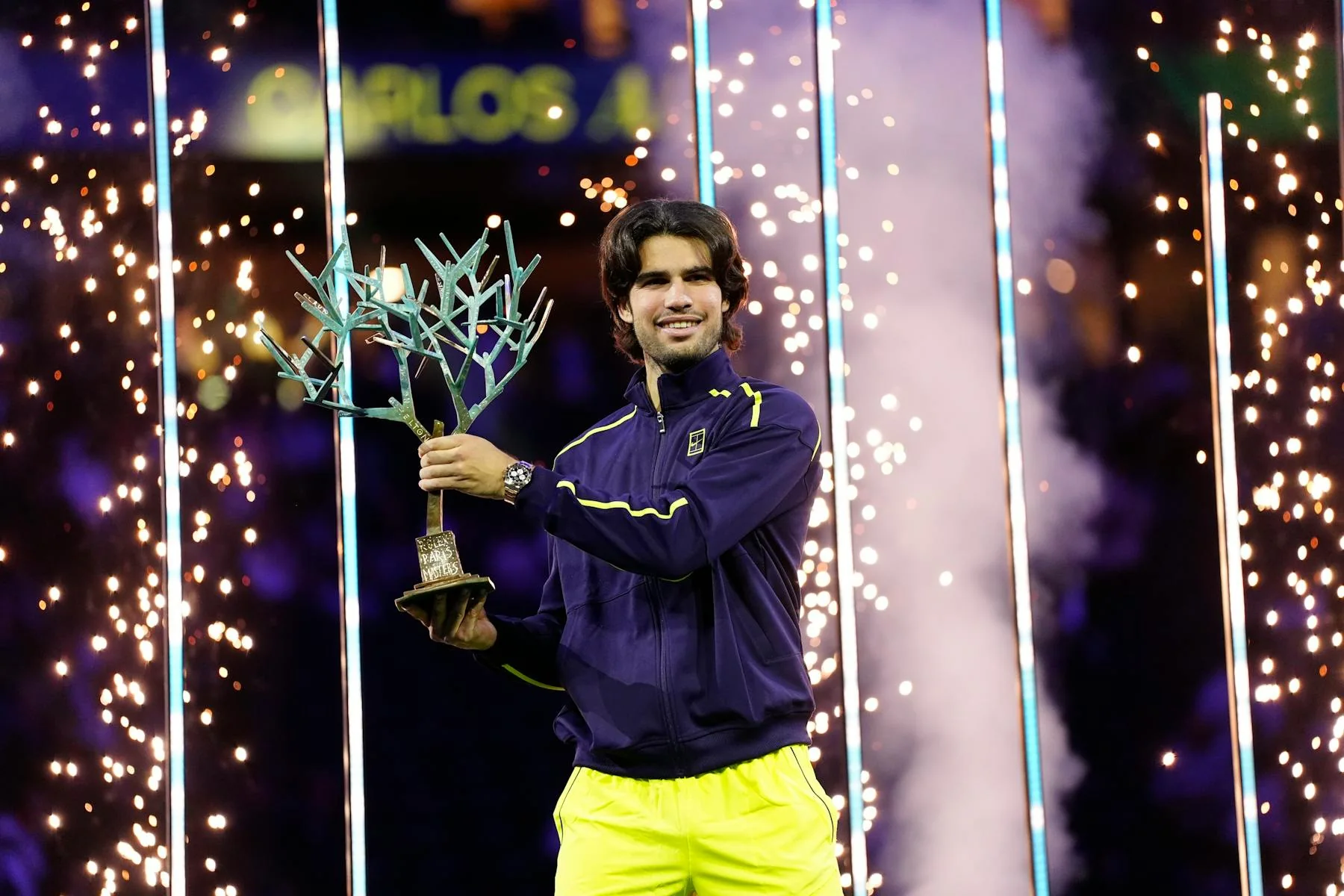
What Alcaraz and Shelton earned in the Paris final
Carlos Alcaraz earned €974,370 and 1,000 ATP ranking points for winning the 2026 Rolex Paris Masters. Ben Shelton earned €532,120 and 650 points as runner-up. Alcaraz won the November 8 final at Plenitude Arena 7–6(5), 7–5. The official 2026 singles draw puts both awards in the context of a €6,309,095 tournament purse, the figure for the ATP event as a whole.
The difference between the winner’s and runner-up’s lines was €442,250 and 350 points. That gap was fixed before the final. The tennis was far closer than the money suggests. Shelton created six break chances in the opening set, including four in one game. Alcaraz saved them all and edged the tiebreak after more than an hour on court. Shelton did break in the second set, but Alcaraz recovered and finished the match by breaking again in the twelfth game. The players came within a few points of a second tiebreak even though the draw ended with a straight-sets score.
Those two figures answer separate questions about the same match. The prize schedule gives the gross amount assigned to each player’s finishing round. The ranking schedule gives the value of the result on the ATP points scale. On finals day the result moved Alcaraz from the finalist’s line to the champion’s line. A third set or a longer tiebreak would have changed the match story without changing either line of the payout schedule. The organizer’s final report gives the sequence of the match, and the draw supplies the awards.
This was Alcaraz’s first Paris Masters title and his ninth Masters 1000 trophy. Both finalists had entered the Paris draw with first-round byes, so their path starts in the round of 32. To locate a different player’s prize line, open the Paris Masters results, find his last round and check the entry mark next to his name on the draw. The last round gives you the starting row. Winning through qualifying or entering the main draw after a bye can change how a player’s points should be read.
Singles prize money and points by round
Every singles player has one finishing position in the main draw. The winner’s award already reflects every round needed to get to the title. The same principle applies lower down. If a player reaches the semifinal and loses there, read the semifinal line once. Advancing from the quarterfinal payout to the semifinal payout was worth an extra €132,260 and 200 points in Paris. Adding both rows would give an inflated estimate of what the player earned for the week.
| Finish | Prize money | Standard ATP points |
|---|---|---|
| Champion | €974,370 | 1,000 |
| Runner-up | €532,120 | 650 |
| Semifinal loss | €290,960 | 400 |
| Quarterfinal loss | €158,700 | 200 |
| Round of 16 loss | €84,890 | 100 |
| Round of 32 loss | €45,520 | 50 |
| First-round loss (round of 64) | €25,220 | 10 |
The first round is labeled the round of 64 because the bracket has 64 positions. There were 56 entrants, with eight empty positions creating the eight seeded byes. Unsure which round a match belongs to? Find the relevant column on the draw before counting how many rounds the player had played. The Paris Masters draw guide explains those bracket positions and how they affect the order of play. The points column shows the standard scale. The ATP ranking rules give main-draw wild cards points starting in the second round at Masters 1000 events, so a wild card losing in the first round can have the first-round prize with zero ranking points.
How the first-round bye changes the points
Alexander Zverev had a bye and lost 7–6(5), 6–2 to Lorenzo Musetti in the second round, his first played match of the week. Apply two rules to that exit. The ATP financial rules give a player losing in that spot the second-round prize, €45,520. The ranking rule credits first-round loser’s points, 10 in Zverev’s case. Looking only at the round printed above the match would give him 40 too many points.
Musetti had already beaten Hubert Hurkacz in the first round. He came through two tiebreaks that day, and the next win earned him a place in the last sixteen. That route makes a useful comparison with a top seed who wins his first played match. Both players reach the same round from different starting positions and use the same regular points line from there. The opening loss after a bye is the special case. The top seed’s earlier rest changes his workload, while his performance in the match still decides which part of the draw opens up.
How qualifying changes a player's Paris total
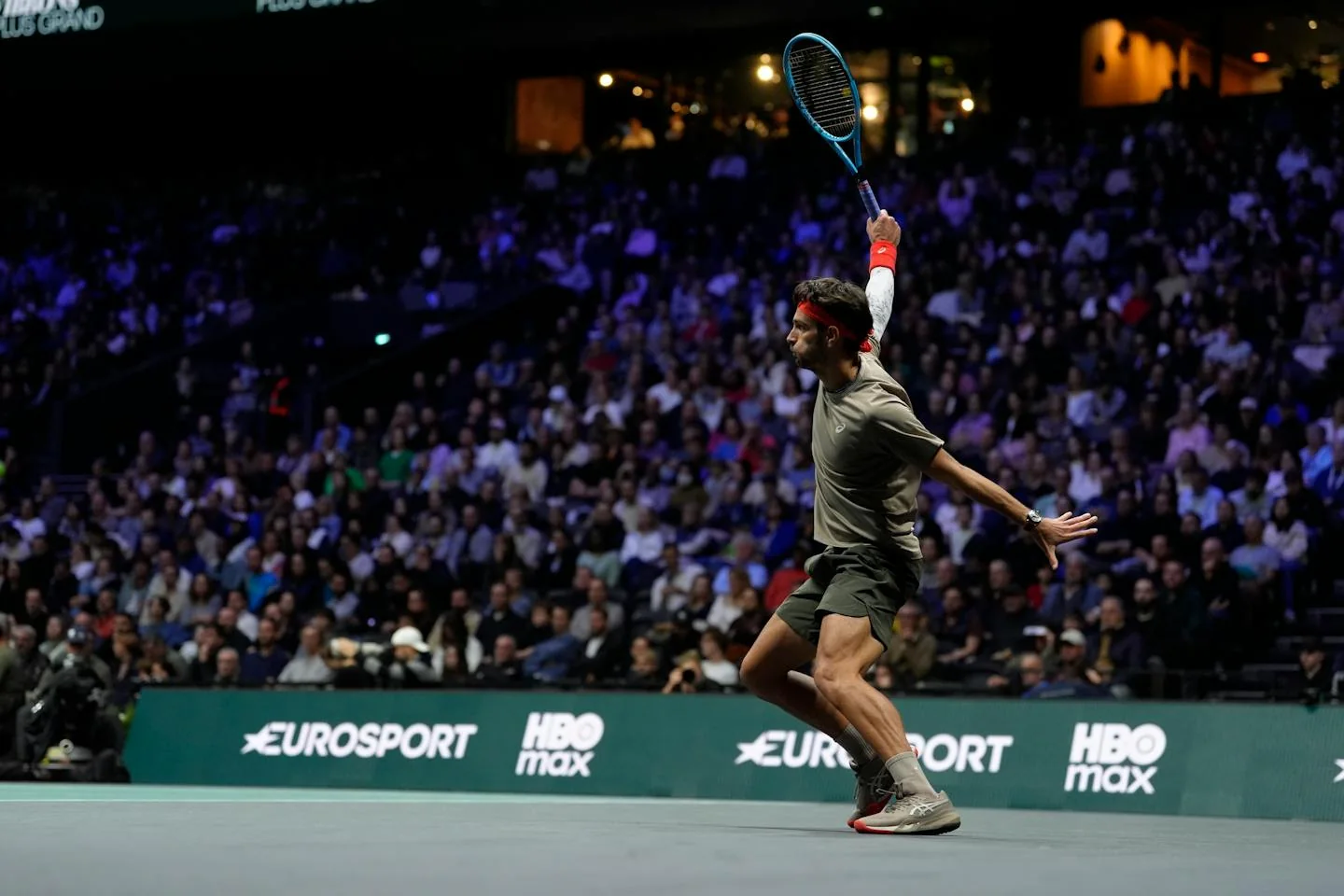
Qualifying had its own award schedule. A player eliminated on the first qualifying day earned €6,765 and zero points. A player who lost in the final qualifying round was on the €12,920 and 16-point line. A successful qualifier earned 30 points and advanced to the main draw, where his main-draw finish determined his prize money and earned its own points. The qualifying draw shows zero as the separate prize for a qualifying winner because his cash award moves to the main-draw schedule.
| Qualifying outcome | Qualifying prize | Qualifying points |
|---|---|---|
| Lost in round one | €6,765 | 0 |
| Lost in final round | €12,920 | 16 |
| Won a main-draw place | Main-draw line applies | 30, plus main-draw points earned |
Twenty-eight men were in the qualifying draw and seven won places. Rinky Hijikata earned one of the spots by beating Vít Kopřiva in the final qualifying round. In the main draw he beat Luciano Darderi, Novak Djokovic and Tomás Martín Etcheverry, then lost a three-set quarterfinal to Luca Van Assche. For Hijikata, the published qualifying schedule adds 30 points to the 200 he earned for the quarterfinal, giving him 230 for the tournament. His prize line came from the main draw, at €158,700 for a quarterfinal loss. The two extra qualifying matches were part of his route into the field and part of his point total.
A qualifying loss and a main-draw appearance
Nuno Borges arrived at the same main-draw round by a different route. Alex Molčan beat him in qualifying, then Borges received a main-draw place marked LL after a vacancy opened. Borges beat Moïse Kouamé, Karen Khachanov and Ignacio Buse before losing to Casper Ruud. Read the ATP lucky loser rules guide for how that replacement route works. A qualifying defeat and a later appearance in the main draw can both be true of the same player in the same week.
The replacement route matters when reading the money column. The ATP financial rules give different examples for lucky losers depending on when a place became available and whether the departing player received compensation. You can identify the published quarterfinal benchmark for Borges from the draw. His individual payout requires the replacement details, so adding the two prize rows on sight would be a guess. For a clean comparison, record the entry mark, who won the last qualifying match and where each player finished in the main draw. Those three things explain why Hijikata’s 30-point qualifying award cannot simply be copied into Borges’s result.
Paris Masters doubles prize money and points
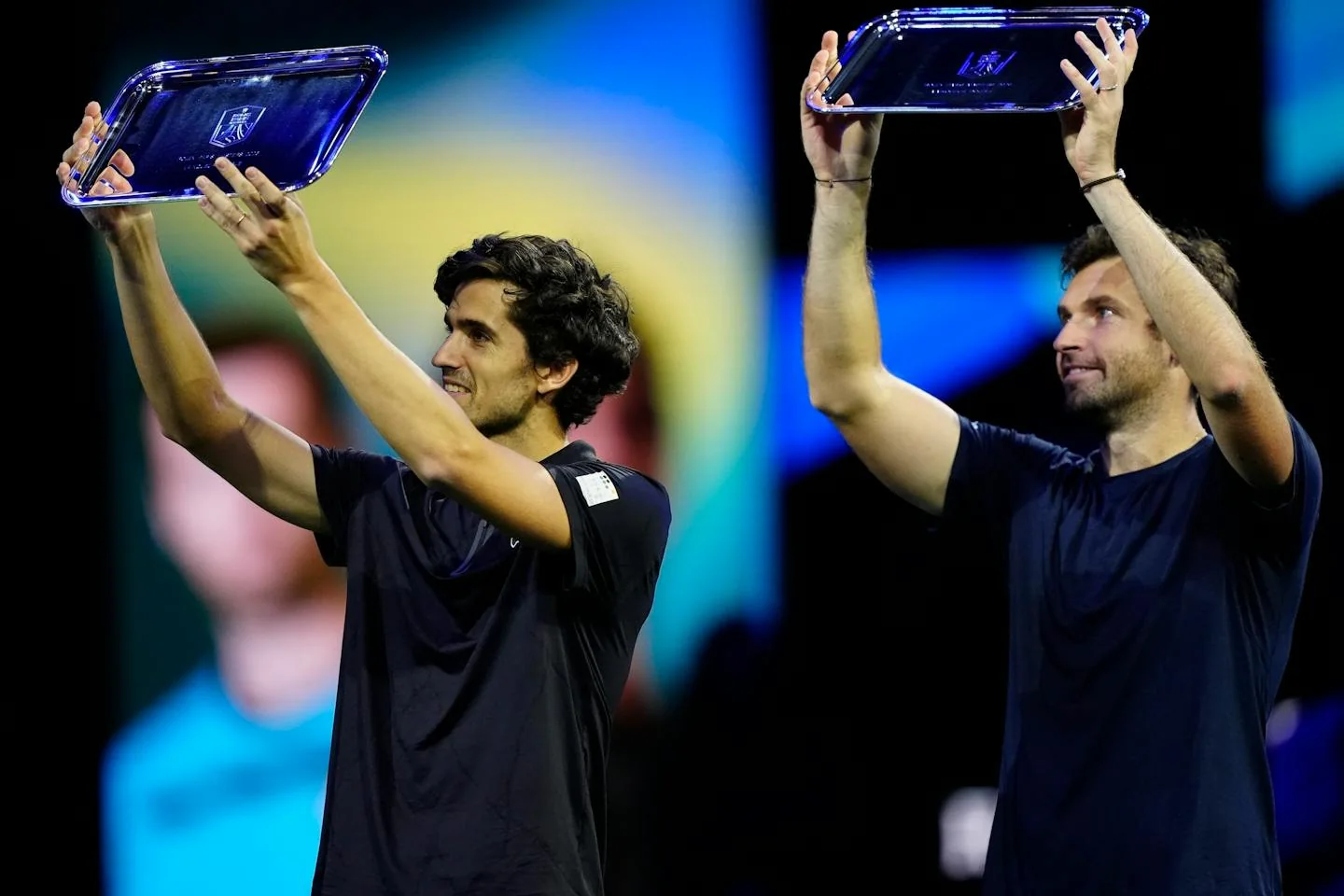
Quentin Halys and Pierre-Hugues Herbert won €298,950 as a team at the 2026 Paris Masters, and the title was worth 1,000 doubles ranking points for each player. Christian Harrison and Neal Skupski earned €162,400 as a team and 600 points each as finalists. The French wild cards won 7–6(3), 6–7(4), 10–8 after two set tiebreaks and a deciding match tiebreak. Each of those tight finishes brought the teams closer to the only result that moved them onto the winners’ line. Official doubles final report.
| Finish | Prize money per team | Standard ATP points per player |
|---|---|---|
| Champions | €298,950 | 1,000 |
| Runners-up | €162,400 | 600 |
| Semifinal loss | €89,210 | 360 |
| Quarterfinal loss | €49,220 | 180 |
| Round of 16 loss | €27,050 | 90 |
| First-round loss (round of 32) | €14,770 | 0 |
Why the cheque is listed per team
€298,950 is the entire amount assigned to the champions’ partnership. An equal division would work out to €149,475 for each player before deductions. That calculation describes the arithmetic of the published prize. The bracket gives a team amount and cannot establish what either player received personally. The same convention applies to every other cash row. For points, read each player’s award in full. The final was worth an extra 400 points to each member of the winning pair and an extra €136,550 to the partnership. Official doubles draw and award table.
This doubles bracket held 28 teams in 32 positions, with four byes. The round-of-16 fixture between Petr Nouza and Michael Venus and fourth seeds Marcelo Arévalo and Mate Pavić shows why the previous column still matters. Arévalo and Pavić had a bye and lost their first match to Nouza and Venus. Under the competition rules, that result carries the €27,050 second-round prize for the pair and the first-round figure of zero ranking points each. A pair that wins a first-round match and loses in the same round of 16 reaches the same prize line with 90 points for each partner. ATP competition rules on byes.
Halys and Herbert played from the first round and beat top seeds Harri Heliovaara and Henry Patten in the semifinals. One reflex volley from Herbert ended the final. As close as that last ball was to the line, the champions’ points follow the round they won, with the same value they would have earned for winning more comfortably.
When Paris points change the rankings and the Turin race
Begin with the player’s result in Paris and the ranking list you want to explain. The tournament publishes a value for each round. A new weekly ranking position also depends on which older results expire, which scores count in the ranking window and how the surrounding players did. The Race to Turin uses a season-based qualification calculation. This is why a Paris points table still matters even when it cannot tell you who will be ranked where on Monday.
Start with the points the draw actually awards
Suppose a player earns 200 points by losing in the Paris quarterfinals and an old 100-point result drops at the same ranking update. If both results count in the same calculation and nothing else changes, the player is up 100 in the weekly total. The whole 200 still belongs to the new tournament line. Another player could have the same Paris finish and a smaller change because a larger result expires for him. Even if both totals rise, their ranking places may hold when the players above them also add points. Use the two dated rankings for the change and the bracket for the award. ATP rankings guide.
Check the ranking window and the Race separately
The weekly list generally follows a 52-week window and has rules about which scores are counted. The Finals qualification standings track the current season. The annual calendar can place one edition a week earlier or later than another, so line up the actual drops and the date of the award when comparing ranking snapshots. Paris was the final Masters 1000 of 2026 and the close of the 2026 Turin Race. A later result could still affect a weekly ranking while belonging to a different qualification period under the ATP’s Finals rules.
Rafael Jodar showed why the distinction mattered in Paris. Casper Ruud had already eliminated him in round two. On Friday, Carlos Alcaraz beat Taylor Fritz in the quarterfinals, and the Finals announced that Jodar had taken the last singles place. Jodar’s own Paris finishing round stayed the same throughout Friday’s play. What changed was what a rival could still achieve. That gives fans a reason to follow other matches after their player is out. Check the live Race and the remaining draw together to see which finish can still alter the field, then use the official qualification announcement to confirm it. Official Finals field announcement and ATP Finals tournament hub.
What the Paris purse measures
The €6,309,095 headline is the 2026 Masters 1000 tournament prize-money figure printed on the Paris draws. The ATP uses a broader label, financial commitment, for on-site prize money plus tournament fee obligations, unless it approves an exception. If two pages use those two labels, check that they describe the same measure before assessing whether they disagree. Published prize money also gives the gross awards. The ATP financial chapter covers notice of applicable tax withholding, and a draw contains no individual player’s payment statement. ATP tournament financial rules.
Check the edition as carefully as the label. The 2025 announcement gave a purse of €6,128,940 and a singles champion’s prize of €946,610. The 2026 draw put the purse €180,155 higher, an increase of about 2.9 percent, and the singles winner’s amount was up €27,760. Both sets of figures describe the same event in different seasons. The date on the bracket is the quickest way to tell which figures belong to the result you are looking at. The 2025 edition ran from October 27 through November 2, while the 2026 ATP main draw ran November 2–8. ATP 2025 prize announcement and 2026 final singles draw.
Paris also staged a wheelchair WC500 tournament at Plenitude Arena from November 6 through November 8. It shared the venue and finals weekend, with its own draws and finals on the event programme. Check the competition label as well as the date when looking up a result from that weekend. An ATP men’s doubles prize row and a wheelchair doubles result describe different draws. The organizer’s wheelchair event programme provides the relevant schedule.
For a result you want to compare across years, line up the edition, draw and finishing round, then check the unit of payment. That keeps a singles player’s cheque, a doubles pair’s cheque and the published event purse in their proper places. The same method works when the ATP season reaches a different Masters stop with early-round values of its own. Use the 2026 ATP Masters 1000 calendar to identify that tournament, then read its own dated bracket and prize schedule.
About the author
ATP Schedule Editorial Team
The ATP Schedule editorial team turns match times, scores, tournament information and verified tennis news into clear answers fans can use quickly.
View all articles by this author →Fan discussion
Comments
Sign in with Google to comment. Keep the discussion helpful and tennis-focused. New comments are reviewed before they appear.
Loading comments…