Australian Open 2026 Prize Money: Men's Singles, Qualifying and Doubles
Confirmed 2026 Australian Open prize-money tables in AUD for men's singles, qualifying and doubles, with per-pair clarification, 2025 comparisons and dated USD context.
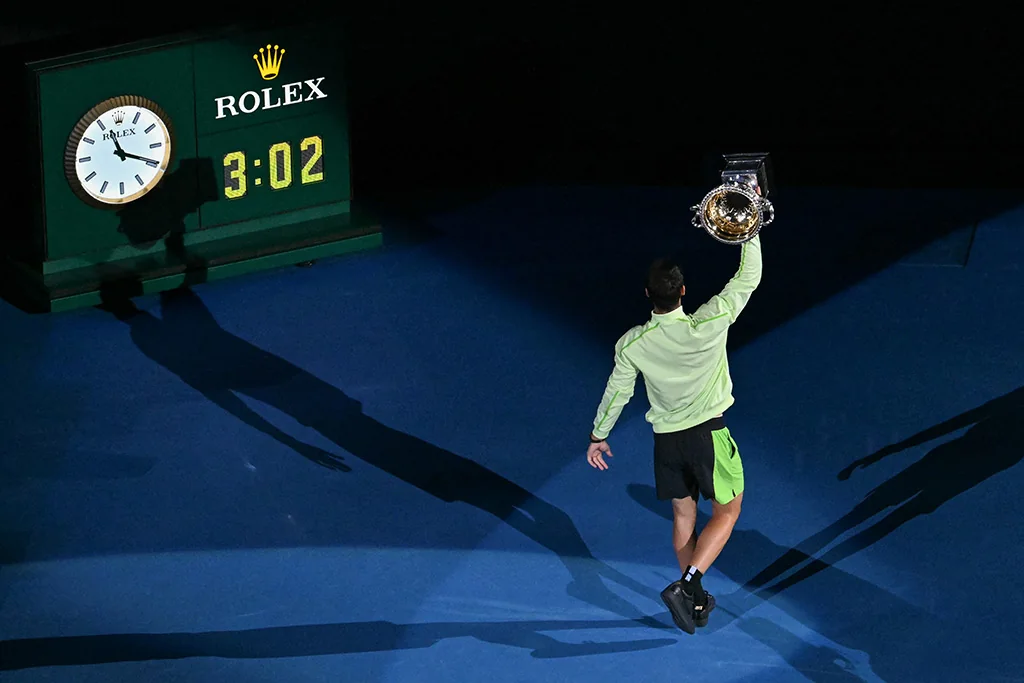
The 2026 Australian Open prize money pool was A$111.5 million, and the men’s singles champion earned A$4.15 million. What each result paid depends on the draw and finishing round. A qualifier, a main-draw player and a doubles partnership cannot all be read from the same line. Below are the confirmed Australian-dollar scales, the meaningful changes from 2025 and a dated US-dollar comparison.
What did each men's singles round pay at the 2026 Australian Open?
The Australian Open paid its 2026 men's singles champion A$4,150,000. The runner-up earned A$2,150,000, and a player who lost his first main-draw match earned A$150,000. Every amount here is in Australian dollars and applies per player. The women's singles draw used the same round-by-round amounts. These prizes sit inside a much larger A$111.5 million Australian Open pool covering the tournament as a whole.
| Finishing stage | Prize | Result description |
|---|---|---|
| Champion | A$4,150,000 | Won the final |
| Runner-up | A$2,150,000 | Lost the final |
| Semifinal | A$1,250,000 | Lost in the last four |
| Quarterfinal | A$750,000 | Lost in the last eight |
| Fourth round (R16) | A$480,000 | Lost in the last 16 |
| Third round (R32) | A$327,750 | Lost in the last 32 |
| Second round (R64) | A$225,000 | Lost in the last 64 |
| First round (R128) | A$150,000 | Lost opening main-draw match |
The organizer's prize announcement and the ITF men's tournament preview agree on all eight rows. The ITF gives a separate A$37.684 million total for the men's singles main draw. That is useful context: neither A$37.684 million nor the whole-event A$111.5 million was the amount handed to one player. A champion's cheque is the winner row; the other totals describe an entire draw or event.
A table labeled “per round” can suggest that a player collects each row on the way through. That is not how to read these published finishing-stage figures. A semifinalist's listed award is A$1.25 million in total for that result, rather than A$1.25 million added to the first four rounds. Similarly, the winner's A$4.15 million is the champion amount, without adding the runner-up or earlier lines. This distinction prevents a drastic overstatement of what one Australian Open run paid.
The differences between neighboring rows still show the stakes of a match. Winning the opener moves the listed outcome from A$150,000 to at least A$225,000, a A$75,000 jump. Winning a quarterfinal moves it from A$750,000 to at least A$1.25 million, a A$500,000 jump. In the completed 2026 final, Carlos Alcaraz became the champion and Novak Djokovic the finalist, so their respective singles rows are the first two in this table. These are gross tournament prize figures; neither source states a player's tax bill or personal expenses.
How much did the 2026 Australian Open qualifying rounds pay?
A men's singles player eliminated in the first round of 2026 Australian Open qualifying was listed for A$40,500. Losing in the second qualifying round paid A$57,000; losing in the third and final qualifying round paid A$83,500. This was a separate pre-main-draw competition. Tennis Australia used the same qualifying prize scale for men and women, and the figures were recorded per player.
The Q1 to Q3 qualifying table
| Elimination stage | 2026 | 2025 comparison |
|---|---|---|
| Q1, first qualifying round | A$40,500 | A$35,000 |
| Q2, second qualifying round | A$57,000 | A$49,000 |
| Q3, final qualifying round | A$83,500 | A$72,000 |
The current amounts are from the AO's official 2026 announcement; the older figures are from its 2025 prize-money document. The increases were A$5,500, A$8,000 and A$11,500 respectively. Organizers described each qualifying round's rise as 16%, a rounded percentage. The gap between a Q1 and Q3 exit in 2026 was A$43,000, an illustration of how making the final qualifying match changed the listed result even before a player entered the main draw.
Q3 is often misread as the third round of the Australian Open itself. It means the third qualifying round, whose losing prize was A$83,500. The main draw's third-round loss paid A$327,750. Those figures belong to two different brackets, so a player result should be matched to the correct draw before a cheque is quoted.
A successful qualifier's main-draw prize
The AO's qualifying entry guide said 128 men entered the qualifying field and a player needed three wins to take one of 16 main-draw qualifier places. Qualifying ran from 12 to 15 January 2026, before the main-draw first round. A qualifier who won through was therefore in the main draw, and his eventual result is read from the main-draw payout table: A$150,000 for losing its first round, A$225,000 for losing its second, and so on.
The published Q1, Q2 and Q3 amounts describe players eliminated at those qualifying stages. It would misread the tables to add all three to a successful qualifier's later main-draw amount as though each match issued another independent finishing prize. That is our interpretation of the organizer's stage-labeled payout schedule, not a statement about a particular player's tax or accounting record. It is also why “played qualifying” and “lost in qualifying” are materially different facts.
For future event planning, our Australian Open dates guide explains the distinction between Opening Week and the main draw. Use the year-specific AO draw for a completed player's path and the year-specific prize sheet for his award. The 2026 Q-stage values answer a 2026 question; they do not predict what qualifying will pay at the next edition.
What did men's doubles teams earn at AO 2026?
The 2026 Australian Open men's doubles champions earned A$900,000 for the team. That is the tournament's pair-level prize, not A$900,000 paid separately to each of the two partners. The finalist team earned A$485,000, while an opening-round loss brought A$44,000 per pair. The women's doubles table used the same listed amounts.
| Finishing stage | Team prize | Equal-split example per player |
|---|---|---|
| Champions | A$900,000 | A$450,000 |
| Runners-up | A$485,000 | A$242,500 |
| Semifinal | A$275,000 | A$137,500 |
| Quarterfinal | A$158,000 | A$79,000 |
| Third round (R16) | A$92,000 | A$46,000 |
| Second round (R32) | A$64,000 | A$32,000 |
| First round (R64) | A$44,000 | A$22,000 |
The first numeric column follows the 2026 doubles breakdown, which explicitly marks the awards per team. The last column is our simple division by two, not another official payout schedule. Tennis Australia's 2025 prize sheet likewise labels the men's and women's doubles draw “per pair,” confirming the unit used in year-to-year comparisons. Like singles, a doubles finishing-stage figure is a total listed award for that outcome; earlier rows are not stacked on top of the champion's cheque.
Why the doubles number is per pair
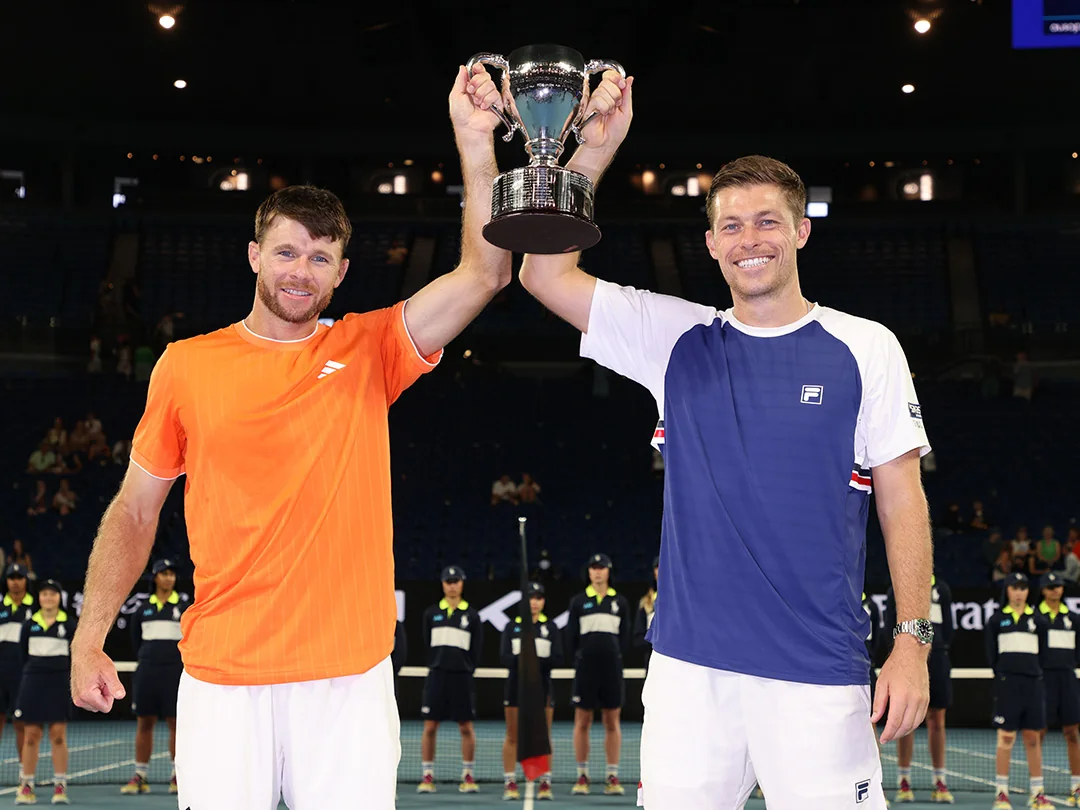
Christian Harrison and Neal Skupski won the completed 2026 men's doubles final, beating Jason Kubler and Marc Polmans 7-6(4), 6-4, according to the Australian Open honour roll. That champion result maps to the A$900,000 team line. If a pair split that amount equally, the arithmetic would be A$450,000 per player before tax or expenses. The tournament's published table does not reveal a team's private financial arrangements, so the calculation must remain labeled as an illustration.
The same principle applies at the other end of the draw. A first-round team prize of A$44,000 would equal A$22,000 each under a 50-50 split. Calling it “A$44,000 per player” would double the nominal tournament award. The distinction is especially important when a men's singles champion is compared with a doubles champion: the A$4.15 million singles amount belongs to one player, whereas A$900,000 belongs to a pair. Comparisons should identify both units, not present them as interchangeable cheques.
The 2025 winning pair's official amount was A$810,000, and its first-round amount was A$40,000. Those rose to A$900,000 and A$44,000 in 2026, respective gains of A$90,000 and A$4,000 for the team. The published figures show real growth in both positions, but they do not indicate how much Harrison, Skupski or another player retained after taxes and professional costs. The table answers a tournament-prize question, not a personal-income question.
Which 2026 payouts rose most from 2025?
At the top of the men's singles draw, the 2026 champion's published prize rose by A$650,000 from the prior year: A$4.15 million compared with A$3.5 million in 2025. Across the tournament, the total announced prize pool rose A$15 million, from A$96.5 million to A$111.5 million. Tennis Australia described the overall gain as 16%. The percentages for individual finishing rounds were different, so applying “16%” to every listed cheque would give a false comparison.
Singles: champion and early-round changes
The difference between the two champion rows is about 18.6% using the printed numbers, which the AO rounded to 19%. The finalist moved from A$1.9 million to A$2.15 million, adding A$250,000, or roughly 13.2%. An opening-round main-draw exit moved from A$132,000 to A$150,000: A$18,000 more, about 13.6%. A player in that early round gained fewer dollars than the champion, but the change was still substantial in relation to the previous listed prize.
| Stage | 2025 | 2026 | Increase |
|---|---|---|---|
| Champion | A$3,500,000 | A$4,150,000 | A$650,000 |
| Runner-up | A$1,900,000 | A$2,150,000 | A$250,000 |
| Quarterfinal | A$665,000 | A$750,000 | A$85,000 |
| Fourth round | A$420,000 | A$480,000 | A$60,000 |
| First round | A$132,000 | A$150,000 | A$18,000 |
The baseline comes from the official AO25 document. The table deliberately keeps the same discipline, currency and prize unit in both years. It shows why a large total-pool percentage is a poor substitute for looking up the precise result. For example, the quarterfinal gain was A$85,000, while the fourth-round gain was A$60,000. Both were below the champion's absolute gain, even though all three rows increased.
Qualifying and doubles changes
Qualifying players also saw higher listed awards. A first-round qualifying loss moved from A$35,000 in 2025 to A$40,500 in 2026, a A$5,500 difference. Q2 rose from A$49,000 to A$57,000, or A$8,000, while Q3 rose from A$72,000 to A$83,500, or A$11,500. The organizer rounded the percentage change for each qualifying round to 16% and said its qualifying prize money was up 55% since 2023. That longer-period claim should not be mistaken for an exact change in every individual row.
For doubles, preserve the pair unit. A winning men's team rose from A$810,000 to A$900,000, a A$90,000 gain for the partnership, or about 11.1%. A pair losing in the opening round rose from A$40,000 to A$44,000, exactly 10%. The final team moved from A$440,000 to A$485,000, a A$45,000 rise. These examples are consistent with the AO's statement that every singles and doubles player would receive an increase of at least 10%, while still differing from the pool's 16% headline.
The AO also reported a 67% increase in player travel assistance and described a A$135 million broader Australian summer tennis investment. Those are related support and event-investment measures, not extra percentages automatically added to a player's prize-money table row. They help explain the event's financial commitment, but the published prize by round remains the right figure to quote for a match result.
What was the 2026 prize money worth in US dollars?
In a January 2026 conversion, the men's singles winner's A$4.15 million was about US$2.8 million. The whole tournament's A$111.5 million pool was about US$75 million. Both US figures were rounded estimates in an Associated Press report published on 6 January 2026. They provide a useful sense of scale for US readers, but the AO's official prize schedule uses Australian dollars, not US dollars.
The short currency labels matter. “A$4.15 million” is the confirmed Australian-dollar champion amount. “US$2.8 million” is what a news outlet estimated it represented at the time, rounded. A headline that drops the A or US prefix can make the two amounts appear contradictory. They are descriptions of the same prize in two currencies and at one approximate conversion date.
The arithmetic is straightforward, though the market conversion rate is time-dependent: multiply the Australian-dollar amount by the number of US dollars per Australian dollar for a stated date. Using AP's two rounded numbers only as a demonstration, US$75 million divided by A$111.5 million gives roughly 0.673 US dollars per Australian dollar. Multiplying the A$4.15 million champion amount by that illustrative ratio gives around US$2.79 million, naturally rounded to US$2.8 million. The 0.673 figure is derived from AP's rounded estimates, not a bank quote or a promise about the rate a player received.
A different outlet may show US$2.79 million, US$2.8 million or another nearby number depending on the date, precision and rate it chose. For a comparison made in September rather than January 2026, the rate could differ. A bank's transaction charges could change what a particular player ultimately converted. None of those uncertainties changes the published A$4.15 million result, so a careful prize-money reference leads with AUD and treats USD as an optional, dated approximation.
Doubles add a second unit problem. The A$900,000 men's doubles champion figure is per pair. Converting A$900,000 into US dollars gives a team estimate, not a per-player award. Dividing it between partners is a separate calculation with its own assumption. Anyone comparing a converted doubles figure with the US-dollar singles champion amount should state both the exchange-rate date and whether the amount describes one player or two. That simple label makes a global tennis prize table much more trustworthy.
How should fans quote a 2026 Australian Open prize figure?
Start with the whole unit of the claim, not just the number. “The 2026 Australian Open men's singles champion earned A$4.15 million per player” is a precise sentence. “The Australian Open winner got $4.15 million” leaves readers to guess the year, competition and currency. For a globally followed event, A$ and US$ are not interchangeable, and the tournament has separate singles, qualifying and doubles prize scales.
A reliable short prize citation should answer six questions:
- Which year? A 2025 row is not the 2026 award. The official 2025 singles winner got A$3.5 million; the 2026 winner row was A$4.15 million.
- Which event? The all-event 2026 A$111.5 million pool covers much more than men's singles. The ITF listed A$37.684 million for the men's singles main draw specifically.
- Which finishing stage? A runner-up is paid the finalist line, not the winner line; a qualifying Q3 loss is not the main-draw third round.
- Which recipient? Singles rows are per player. Doubles figures such as A$900,000 for the champions are per pair.
- Which currency? Put A$ on official values, and date an approximate US$ conversion.
- Which source? Prefer the 2026 AO announcement for its singles and qualifying rows, then identify a table's source for doubles.
Here is a second properly labeled example: “A pair eliminated in the first round of 2026 Australian Open men's doubles earned A$44,000 per team.” The 2026 doubles table gives the team amount. Dividing by two yields A$22,000 per partner only under an equal-split assumption. The AO25 official sheet explicitly calls doubles awards “per pair,” reinforcing why “A$44,000 each” is the wrong reading.
Finally, a published award is not a person's after-tax income. Coaching, travel and other costs do not appear in the simple prize table, and tax rules depend on facts about the player. The table cannot tell us a named player's take-home figure. If the reader wants the identity of the 2026 men's champion, the completed Australian Open winners list supplies it; if the reader wants the next edition's dates, our 2027 schedule guide has that separate answer. This page's verified award rows remain specific to 2026; a new year needs its own official prize announcement.
About the author
ATP Schedule Editorial Team
The ATP Schedule editorial team turns match times, scores, tournament information and verified tennis news into clear answers fans can use quickly.
View all articles by this author →Fan discussion
Comments
Sign in with Google to comment. Keep the discussion helpful and tennis-focused. New comments are reviewed before they appear.
Loading comments…