Who Won the 2026 Australian Open Men's Final? Alcaraz vs Djokovic
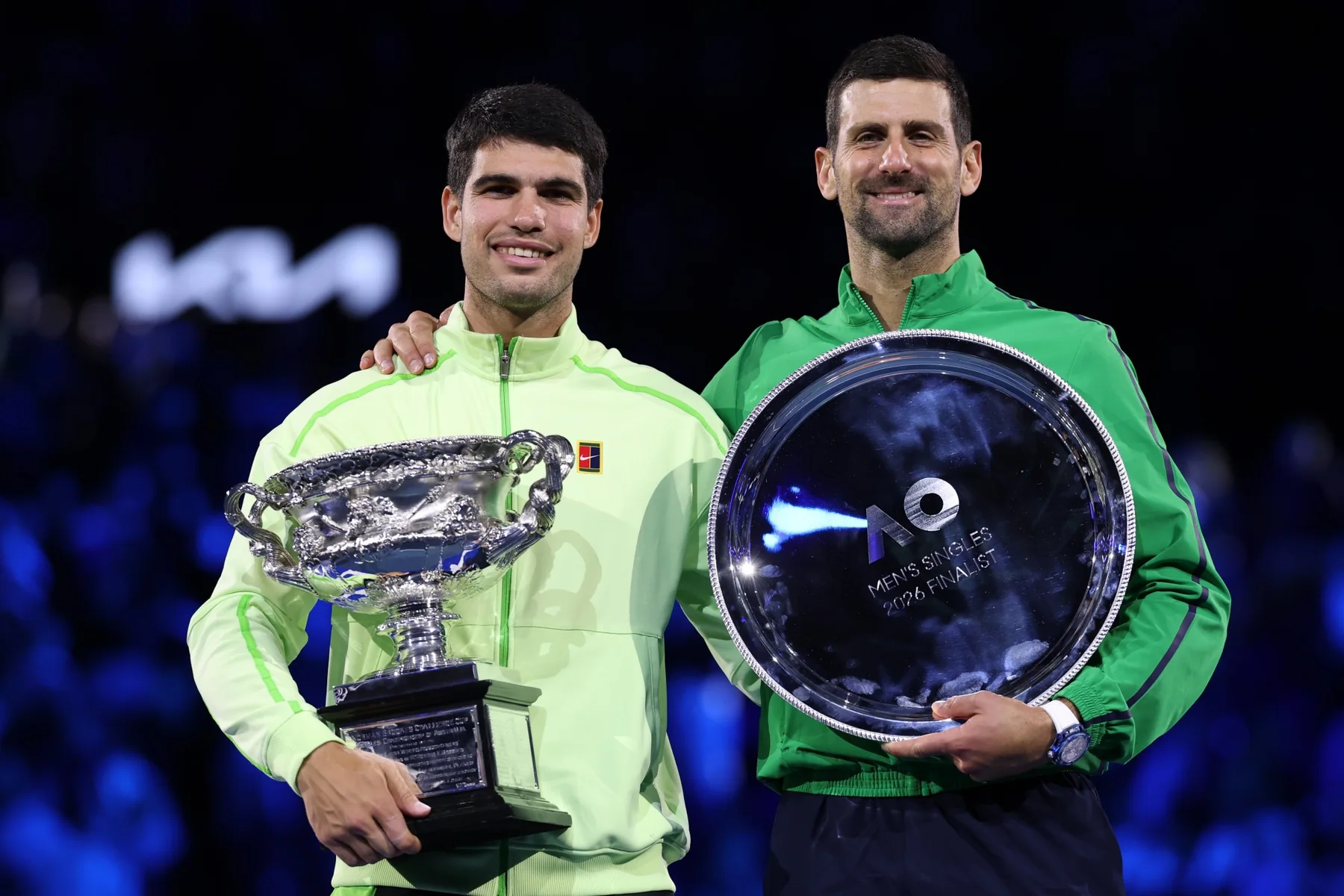
Carlos Alcaraz beat Novak Djokovic in four sets to win the 2026 Australian Open men's final. Read the score, turning points and historic records.
Who won the 2026 Australian Open men's final?
Carlos Alcaraz beat Novak Djokovic 2–6, 6–2, 6–3, 7–5 in the 2026 Australian Open men's singles final on 1 February. The match at Rod Laver Arena lasted three hours and two minutes. Alcaraz lifted the Norman Brookes Challenge Cup for the first time, while Djokovic left a Melbourne final without the title for the first time in his career. This is the completed championship result, rather than a live score or a projection for the next Australian Open.
| Winner | Carlos Alcaraz (Spain) |
|---|---|
| Runner-up | Novak Djokovic (Serbia) |
| Set scores | 2–6, 6–2, 6–3, 7–5 |
| Date and court | 1 February 2026; Rod Laver Arena, Melbourne |
| Duration | 3 hours, 2 minutes |
The unusual shape of that score is the reason the final deserves more than a winner line. Djokovic took the opening set 6–2 and looked capable of extending his perfect record in Australian Open finals. Alcaraz then won three successive sets against the player who had already collected 10 titles in Melbourne. The Australian Open's official match account confirms the score and duration; its later tournament retrospective records five Alcaraz breaks from 16 chances. Those 16 chances show how often he reached the point of threatening Djokovic's serve, even though converting them remained difficult.
For Alcaraz, the title filled the one missing event in his collection of major singles trophies. For Djokovic, the defeat was remarkable because his previous 10 Melbourne final appearances had all ended with the trophy. Neither observation tells us by itself why one man won a particular rally. The next sections trace the actual service games, serve patterns and long exchanges that made the turnaround possible.
Readers following the rest of the fortnight can use the complete Australian Open 2026 results to see how each finalist arrived at this match, including their five-set semifinals. The final score is only the endpoint of two very different paths through the draw.
How did the match turn after Djokovic's opening set?
Alcaraz changed the match by getting into Djokovic's service games early in the second set, then keeping that pressure in place through the third. Yet the fourth was still live deep into the night. The three-set comeback was built from specific holds and breaks, not a sudden moment when Djokovic simply stopped competing.
Djokovic controlled the opening exchanges
Djokovic's first set was a model of taking time away from an opponent. He broke in the fourth game, consolidated to 4–1 and broke once more to finish 6–2 in 33 minutes. Roland-Garros's contemporaneous report records that he won 93% of points behind his first serve in the opener. That figure matters because it left Alcaraz little opportunity to make the set about his own returning and court coverage. The first set was Djokovic dictating the initial shot, getting the ball deep and forcing Alcaraz to react.
For a player with 10 Australian Open titles and no previous loss in a Melbourne final, that start carried more weight than a routine first-set lead. It looked like a familiar Djokovic script: clean serving, early pressure on the other man's second serve and enough return quality to convert the opening he found. The eventual score can obscure how hard Alcaraz had to work to interrupt it.
Alcaraz broke through in sets two and three
The first break of the reversal came in the third game of set two, when Djokovic missed a backhand volley. Alcaraz then faced a break point in the next game, saved it and held for 3–1. That hold was almost as important as the break: an immediate reply would have handed the initiative back. He broke again for 5–2 and levelled the match at a set apiece.
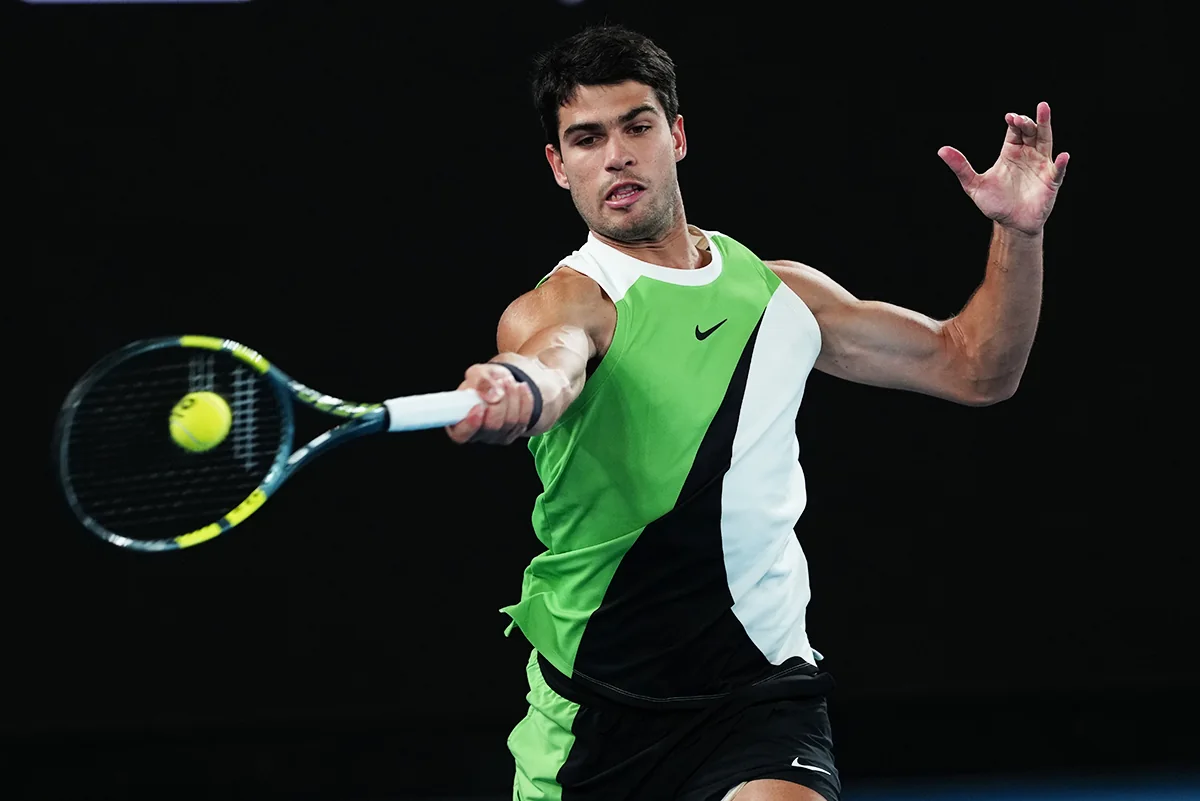
Set three followed a less dramatic but equally decisive path. An early highlight reel retrieval showed Alcaraz's range, but the scoring hinge was Djokovic's service game at 2–2. The Serb's first double fault of the match helped Alcaraz reach a break for 3–2. Djokovic saved four set points when serving at 3–5 before an errant backhand ended the set. The Australian Open match report supplies that sequence. The useful tactical reading is that Alcaraz was repeatedly making Djokovic play an extra pressured service game; the scoreline reflects sustained access to break chances, not only spectacular winners.
The fourth set came down to one late service game
Djokovic refused to allow an easy finish. He escaped six break points in an early fourth-set service game, a reminder that Alcaraz's pressure did not always translate into a break. Then at 4–4 Djokovic had a break point of his own. Alcaraz saved it and held for 5–4, keeping the final on his racquet and denying Djokovic a chance to serve for a fifth set.
At 5–6, Djokovic served to force a tiebreak. A 24-shot exchange swung toward Alcaraz, and two Djokovic errors brought up championship points. The first was enough: a forehand sailed out. Djokovic's own site also highlights the missed chance at 4–4 and the final-game break. The match's last set was therefore closer than 7–5 can sound in isolation; one converted break chance at 4–4 would have produced an entirely different finish. See the individual match result for the score beside the rest of the draw.
How did Alcaraz repair his second serve?
He changed its pace and, more importantly, changed the points that followed it. In the opening set, Alcaraz averaged 170 km/h on his second serve yet won only one of eight points behind it. In set two he reduced that average to 159 km/h and won all six second-serve points. The Australian Open's tactical breakdown supplies those figures and notes that he raised his speed again in the final two sets while winning 62% of second-serve points. That pattern is more useful than the simple claim that he “served better.”
| Phase | Average pace | Second-serve points won |
|---|---|---|
| Set 1 | 170 km/h | 1 of 8 |
| Set 2 | 159 km/h | 6 of 6 |
| Sets 3–4 | Speed increased again | 62% |
Djokovic is one of the sport's most demanding returners. A second serve that merely arrives fast does not automatically deprive him of a useful first reply. The first-set rate—12.5%, rounded to 13% in Roland-Garros's report—shows how little Alcaraz was getting from that delivery when Djokovic controlled the early exchanges. Slowing the average in the next set coincided with a six-for-six return, giving Alcaraz service holds that allowed his new pressure on Djokovic's serve to matter.
The numbers support a careful reading, not a magic-recipe story. Six points are too few to prove a particular serve speed is optimal, and the published set averages do not tell us every placement, amount of spin, return contact point or next-shot choice. Alcaraz may have made several adjustments together. What is observable is that the apparent downgrade in raw speed came with a major improvement in scoreboard protection. After that, he could increase speed without returning to the first-set vulnerability.
For fans watching a final, second-serve points often look like a small subcategory beside aces and first-serve percentage. Here they were central to the match's balance. A player who cannot hold securely after missing a first serve cannot keep applying return pressure for three sets. Alcaraz repaired that part of the contest soon enough to turn Djokovic's early lead into a sustained fight over the Serbian's own service games.
What do the rally and error numbers actually show?
They show that the type of point Djokovic controlled in the first set became harder for him to finish. They do not prove a single physical cause for his defeat. After the opener, Alcaraz's recovery movement kept more balls alive, and Djokovic made more mistakes as the exchanges lengthened. The difference matters because a bare unforced-error total can make a final sound as though one player simply donated it.
Court coverage shifted the long rallies
The Australian Open's tracking-based analysis counted 48 Alcaraz sprints against 22 for Djokovic across the match. In set three alone, the split was 19–6. Those numbers describe a remarkable amount of Alcaraz movement; they do not imply every sprint was a winning shot or that Djokovic stood still. Djokovic's wide serves and follow-up forehands were designed to stretch the Spaniard. Alcaraz often reached the next ball anyway, forcing another shot to be played.
In the opening set, Djokovic won five of six rallies lasting more than eight shots. Over the remaining three sets, Alcaraz won 14 long rallies to Djokovic's nine. That is the clearest numerical reversal in the neutral exchanges. A player who can extend a point after being moved off the court changes the risk calculation for his opponent: a shot that would normally end the rally is returned, and the next attacking ball has to be hit from a less settled position. That explanation is an inference from the tracking and rally counts, not a claim that every long rally followed the same pattern.
Djokovic's late errors need match context
Djokovic made only four unforced errors in the 6–2 first set, then finished with 46. The AO analysis attributes 31 of them to the final two sets. His official player-site report gives the whole-match comparison: 46 Djokovic errors to 27 for Alcaraz, with winners 32 to 36 and total points 106 to 118. The totals show Alcaraz created separation without having to hit vastly more winners. They also show how much of Djokovic's clean opening level disappeared during the chase.
Djokovic controlled five of six extended rallies and made four unforced errors.
Alcaraz won the longer-rally comparison 14–9; Djokovic made 31 errors in the final two sets alone.
It is tempting to turn that progression into a one-word diagnosis such as fatigue. The error category does not tell us whether Djokovic was rushed by Alcaraz's depth, tried a lower-percentage change of direction, felt physical strain, or some combination of those pressures. What can be said with confidence is narrower and more useful: Alcaraz kept the ball in play often enough to make the clean first-set style harder to sustain. Djokovic still found a break point at 4–4 in the fourth, so the late match was contested even as his error count climbed.
Did the five-set semifinals decide the final?
No clear evidence lets us say they decided it. Both finalists had come through punishing five-set matches on Friday, and both had reasons to think about recovery before Sunday's championship match. But the semifinal clock cannot explain every serve choice, long rally or missed chance in a final played two days later. It is part of the context, not a substitute for analysing the final itself.
| Finalist | Opponent and result | Duration |
|---|---|---|
| Carlos Alcaraz | Beat Alexander Zverev 6–4, 7–6(5), 6–7(3), 6–7(4), 7–5 | 5h27 |
| Novak Djokovic | Beat Jannik Sinner 3–6, 6–3, 4–6, 6–4, 6–4 | 4h09 |
Alcaraz's semifinal was the longest in Australian Open history. He had appeared physically troubled from the third set and faced the possibility of defeat when Zverev led 5–3 in the fifth. Instead he won four straight games to reach his first Melbourne final. The Australian Open's semifinal report describes the leg difficulty and records the 5h27 duration. A reader could reasonably wonder whether that effort would leave him short of movement on Sunday. The final's sprint tracking, however, recorded an exceptionally active Alcaraz, including 19 sprints in set three alone.
Djokovic's route presented a different problem. He beat two-time defending champion Sinner in 4h09, saved 16 of 18 break points and finished at 1:32am. As the official Sinner semifinal account makes clear, that was an emotionally and physically demanding escape. Yet the official final account also says Djokovic had spent around four hours less on court over the tournament, thanks in part to a walkover and an opponent's retirement in earlier rounds. One can therefore argue about whether total workload or late Friday finish mattered more, but neither measure is a recovery test.
Djokovic later described a drop in his energy after his excellent first set. That is a relevant player account, but it does not justify declaring the semifinal the sole cause. He still survived six break points early in the fourth set and earned a chance to break at 4–4. Alcaraz, meanwhile, had to improve his second-serve points and win more of the demanding rallies. The fairest conclusion is that the semifinals made both men's performance more impressive and may have shaped their available energy; the observable service games and rally changes explain the final more precisely than a simple “shorter semifinal wins” rule.
Which records changed with the result?
The final added an Australian Open title to Alcaraz's list of major wins and added a first loss to Djokovic's record in Melbourne finals. Those are different kinds of history. Alcaraz completed a collection no younger man had completed; Djokovic still owns the most Australian Open men's singles championships, even though his final record is no longer perfect.
Alcaraz completed the career Grand Slam
Before the 2026 final, Alcaraz had won the other three majors but had never lifted the Norman Brookes Challenge Cup. The Australian Open title gave him at least one singles trophy at each of the Australian Open, Roland-Garros, Wimbledon and the US Open. That is a career Grand Slam, meaning the four championships can be won in different years. It differs from a calendar Grand Slam, which requires winning all four in one season. The distinction matters because the final did not claim Alcaraz swept every 2026 major; it completed the set accumulated since his first US Open win.
At the moment he won in Melbourne, Alcaraz was 22 and had seven major singles titles: two each at Roland-Garros, Wimbledon and the US Open, plus his first Australian Open. The Australian Open's record guide identifies him as the sixth man in the Open Era to complete the career set, joining Rod Laver, Andre Agassi, Roger Federer, Rafael Nadal and Djokovic. It also places his achievement ahead of Don Budge's 1938 age benchmark for men. Those totals describe the night of 1 February 2026; a current career tally can change at later tournaments.
The result is especially striking because Melbourne had been his least productive major before 2026. He had not reached the semifinals there in his four previous appearances. Beating the tournament's most decorated champion to claim the missing trophy made this a genuinely new surface-and-event milestone for him, rather than another title at a Slam he had already solved.
Djokovic's unbeaten Australian Open final run ended
Djokovic entered this match with 10 victories from 10 Australian Open men's singles finals. Alcaraz made it 10 wins and one loss in 11 Melbourne finals. The loss stopped his bid for an 11th Australian Open title and a 25th major singles crown, but it does not diminish the unprecedented count of 10 titles he already held. His presence in the final was itself a record-extending 38th major singles championship match, according to the AO's record review.
The venue tells a more precise story than a vague claim that Djokovic is “unbeatable in Australia.” After his semifinal victory over Sinner, he had 90 wins at Rod Laver Arena; the final was his 100th match on that court and left a 90–10 record there. The AO venue analysis also notes this was his first Australian Open night-match defeat since 2018. That venue record is separate from his tournament-wide match record and from his finals record. Mixing those three denominators would make the achievement less clear, not more impressive.
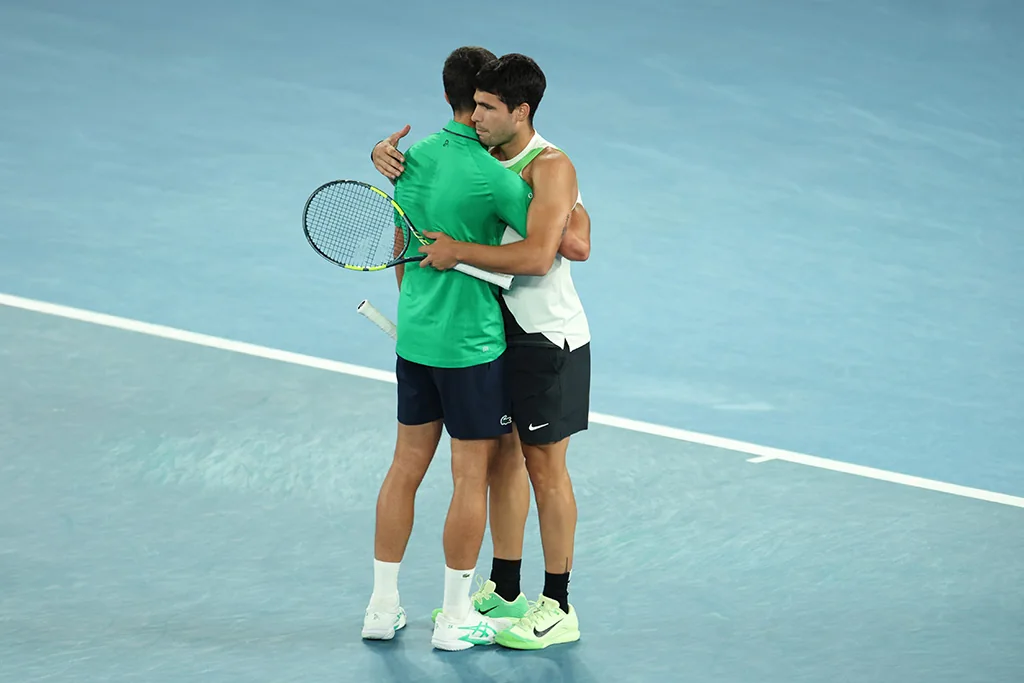
The official final gallery captures that embrace after the last point. It is a fitting closing image for a match in which the younger champion acquired a historic first and the older champion remained the event's benchmark. The next Melbourne meeting, if the draw produces one, would be a new chapter; the record on 1 February 2026 is fixed.
About the author
ATP Schedule Editorial Team
The ATP Schedule editorial team turns match times, scores, tournament information and verified tennis news into clear answers fans can use quickly.
View all articles by this author →Fan discussion
Comments
Sign in with Google to comment. Keep the discussion helpful and tennis-focused. New comments are reviewed before they appear.
Loading comments…