ATP Finals 2026 Groups: Draw Status, Format and Qualification Scenarios
Understand the current 2026 draw status, paired seeding and the score calculations that can send a player through with one win or eliminate him with two.

Have the ATP Finals 2026 groups been announced?
As of 19 October 2026, the official ATP and tournament pages reviewed for this guide had not published the 2026 ATP Finals group assignments. An exact draw-ceremony date and time were also unconfirmed in those announcements. The tournament itself is scheduled for 15-22 November at Inalpi Arena in Turin. Group names, opponents and player-specific semi-final scenarios should be treated as unconfirmed until the official draw is released.
There is useful information before then. The tournament's 18 October Race update marks Alexander Zverev, Carlos Alcaraz and Ben Shelton as qualified. It also states that Jannik Sinner has ended his 2026 season because of injury. Those are qualification and availability facts, rather than a list of the eventual groups.
That distinction is particularly important this year. A player can appear high in the Race and still be unavailable for Turin. Another player may occupy a qualifying position without having mathematically secured entry. Neither circumstance tells you which opponents he will face once the draw is made. An early Race table should therefore never be copied directly into Group A and Group B.
This guide explains the confirmed draw method and the advancement calculations, using explicitly hypothetical examples where the 2026 matches are not yet known. A 2025 group list found in search is historical evidence, not the current draw. The Next Gen ATP Finals is a separate competition and its groups do not apply here either.
There are also two different uses of “qualification.” The Race determines who earns a place at the season finale. Once play starts, the group standings determine who qualifies for the semi-finals. Confusing the two can turn a straightforward headline about reaching Turin into an incorrect claim that a player has already advanced within the tournament.
For the event's broader calendar and viewing context, use our ATP Finals 2026 schedule and TV guide. For the groups, begin with the official draw when it appears, then apply the rules below to the actual results. The older tournament photographs accompanying this guide illustrate the event and its history; they do not depict a 2026 draw ceremony.
How the seeded group draw works
The eight players are not drawn into two unrestricted groups. The top seed is placed in Group A and the second seed in Group B. The remaining players are drawn in three pairs: seeds 3 and 4, seeds 5 and 6, then seeds 7 and 8. One player from each pair goes into each group.
The tournament's official draw explanation supplies that structure. Group A and Group B are useful functional labels; commemorative group names may be announced for a particular edition. Until the 2026 names are confirmed, using names from a previous tournament would create an unnecessary source of confusion.
| Draw step | Group A | Group B |
|---|---|---|
| Leading seeds | Seed 1 | Seed 2 |
| First pair | One of seeds 3-4 | The other of seeds 3-4 |
| Second pair | One of seeds 5-6 | The other of seeds 5-6 |
| Third pair | One of seeds 7-8 | The other of seeds 7-8 |
What the seed pairs can tell you before the draw
The immediate consequences are simple. Seeds 1 and 2 cannot meet in the round robin. Neither can seeds 3 and 4, seeds 5 and 6, or seeds 7 and 8. But seed 1 can meet either player from any of the lower pairs. Qualification order earlier in the season does not assign a player to a permanent group.
As a historical illustration, the initial 2025 draw put seeds 1, 4, 6 and 7 together, with seeds 2, 3, 5 and 8 in the other group. That arrangement followed the paired method. It does not predict which numerical combination will be drawn in 2026, and subsequent withdrawals can change the names attached to a draw.
Seeding also cannot guarantee equal difficulty in tennis terms. A lower seed with a strong first serve may be an awkward opponent indoors, while a higher seed may arrive after a demanding run of matches. Once the actual names are known, assess return pressure, second-serve vulnerability and recovery alongside the numbers. Calling a group easy solely because of the seed sum overlooks the matchup that must actually be played.
What it takes to reach the semi-finals
The top two finishers in each four-player group reach the semi-finals. Group winners cross over to face the other group's runner-up, so finishing first affects the next opponent. The group phase rewards wins first, but there is no universal rule that “two wins equals qualification.” The combination of results matters.
For a normal group in which everyone completes three matches, a 3-0 record guarantees first place. A 2-1 record can advance or be eliminated. Even 1-2 can be enough for second place. The ATP Finals format guide gives the wider tournament context; the crucial detail here is how ties in the standings are resolved.
A two-player tie goes to head-to-head
After comparing wins and matches played, a tie involving exactly two players is decided by their match against each other in this tournament. It is not their career head-to-head record. A player who has lost ten earlier meetings can still win this deciding comparison by winning the one relevant group match.
This is why a scoreboard's sets column should not be used to overrule a straightforward two-player tie. Set percentage becomes relevant in the three-player procedure. First identify how many players remain tied and which earlier conditions have already separated the standings.
Why two wins do not always guarantee qualification
If three players finish 2-1 and the fourth goes 0-3, one two-win player must miss out. The three contenders have beaten the same fourth player and divided their matches against one another. Their overall match records alone cannot choose two semi-finalists.
Alexander Zverev provides a real example from 2023. He beat Carlos Alcaraz and Andrey Rublev but lost in straight sets to Daniil Medvedev, and did not advance. The ATP's report of his final group match explains the costly distinction between winning twice and securing a place.
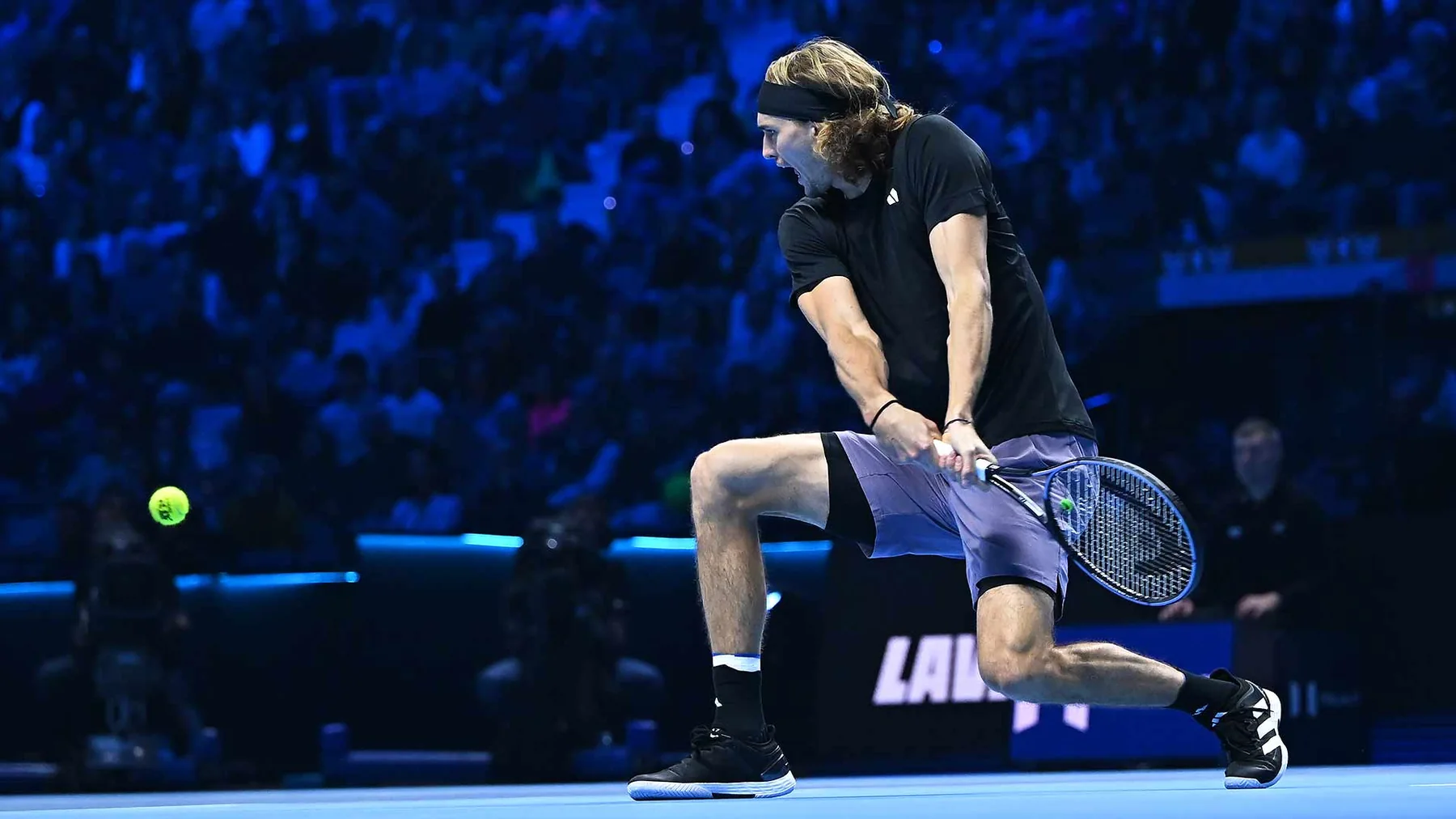
For fans, the practical lesson is to keep the entire group in view. A victory can greatly improve a player's chances without mathematically clinching them. Likewise, losing the opening match does not end a campaign. The sets won and lost in those matches may still have a decisive role after the third round.
A three-way tie worked through from the scores
In a three-player tie with equal wins and matches played, calculate each player's percentage of sets won across his group matches. Use sets won divided by total sets played, not sets won minus sets lost. The following is a hypothetical teaching example, with fictional players A, B, C and D. It is not a 2026 draw or a prediction.
| Match | Hypothetical result |
|---|---|
| A vs B | A wins 6-4, 6-4 |
| B vs C | B wins 6-3, 6-3 |
| C vs A | C wins 6-4, 3-6, 6-4 |
| A vs D | A wins 6-2, 6-2 |
| B vs D | B wins 6-4, 6-4 |
| C vs D | C wins 7-6(4), 6-4 |
A, B and C each have two wins. Each beat D, and their matches against one another form a circle: A beat B, B beat C, C beat A. There is no player who wins a simple head-to-head comparison against both of the others. D finishes 0-3.
| Player | Match record | Sets won-lost | Sets won percentage | Finish |
|---|---|---|---|---|
| A | 2-1 | 5-2 | 5/7 = 71.43% | First |
| B | 2-1 | 4-2 | 4/6 = 66.67% | Second |
| C | 2-1 | 4-3 | 4/7 = 57.14% | Third |
| D | 0-3 | 0-6 | 0% | Fourth |
A advances first and B second. C's win against A does not overturn the three-way calculation. The rule is resolving a tie among three players, not an isolated dispute between A and C. Notice also that the sets against D count: it is the overall group record, rather than a new mini-league that discards the fourth player's matches.
The example shows why rescuing a set in defeat can matter. A lost to C in three sets, so A still added one set to his numerator. B's defeat to A was in two sets. Both ultimately qualified here, but the difference helps explain their order. A comfortable win and a narrow win are worth the same match victory; their set records may carry different value later.
If set percentages cannot finish the comparison, the procedure can move to game percentages and ultimately the specified ranking fallback. There is one further essential step: once a criterion separates one superior or inferior player and leaves exactly two tied, their direct meeting decides the remaining order. Do not mechanically keep moving down the percentage columns after the comparison has become a two-player tie.
For an actual final round, calculate the possible outcomes from all six matches and identify which condition resolves each tie. “Must win in straight sets” should be a conclusion from that arithmetic, never a phrase attached to every player who has lost a match.
Why one win can be enough and every set can matter
A player can reach the semi-finals with a 1-2 record when one opponent dominates the group and the remaining three players divide their other matches. The group winner finishes 3-0. The others can each finish 1-2, leaving the tie-break procedure to decide who joins him. This is a legitimate result of the format, rather than a special exemption.
How a 1-2 player can advance
Alex de Minaur demonstrated the route in 2025. After losing his first two group matches, he beat Taylor Fritz 7-6(3), 6-3. That straight-sets victory gave him a chance, but he still needed Carlos Alcaraz to beat Lorenzo Musetti in the later match. Winning his own match and clinching qualification were separate events.
Alcaraz then defeated Musetti 6-4, 6-1 to complete a 3-0 group record. De Minaur advanced in second place at 1-2. The ATP's account of the final group match confirms that outcome. It is a useful historical answer to the claim that two opening defeats automatically eliminate every player.

There is a tactical consequence. Returning at 4-5 in a set may carry importance beyond the immediate match. Recovering that set could improve a player's eventual percentage, even if he later loses in three. A player who has already lost the match's opening set still has a reason to fight for the second; the group table can preserve value that an ordinary knockout draw would not.
That does not mean a player should aim for an acceptable defeat. Winning remains the first criterion and supplies the strongest route. It means spectators should resist calling the remaining tennis meaningless until the calculations actually show it. The distinction between a straight-sets loss and a three-set loss can decide which player stays in the tournament.
When checking the latest results, record the sets as well as the winner, then wait for the other relevant match before treating an open scenario as settled. A 1-2 finish can qualify; it cannot promise qualification in every group. De Minaur's example shows both the possibility and the dependence on the full set of results.
Withdrawals, alternates and the doubles draw
A withdrawal can leave a group with more than four names and unequal numbers of matches played. In that situation, begin with each individual's results. Equal numbers of wins are followed by a comparison of matches played before the ordinary head-to-head step. Under the published procedure, 2-1 ranks above 2-0, and 1-2 above 1-0.
An alternate does not inherit another player's wins
An alternate joins the available place in the schedule, but does not take ownership of the withdrawn player's earlier victories. Combining two different people's results into a single row can therefore produce a false impression of who is eligible to advance. Check the name, the matches actually played and the tournament's official standings.
In 2023, Hubert Hurkacz replaced Stefanos Tsitsipas after the Greek's withdrawal. Hurkacz then played Novak Djokovic, who beat him 7-6(1), 4-6, 6-1. The ATP's match report identifies him as the alternate. It is a concrete example of a new participant entering an existing group, rather than the original player returning under another name.
Retiring during a match and withdrawing from the rest of the tournament also require different treatment. The rules contain specific provisions for incomplete matches and eligibility. A fan calculation based on ordinary completed sets should not be applied blindly after a retirement; use the official scenario announcement once those exceptional results have been accounted for.
Doubles uses a different match scoring format
Doubles has its own eight-team field and separate group draw. The first two sets use no-ad scoring, and at one set all a match tie-break replaces a full third set. The LTA's format explanation distinguishes that structure from singles, where the deciding set is a normal tie-break set.
For set-percentage purposes, winning the doubles match tie-break counts as winning one set. Its individual points are not ten ordinary service games. That distinction matters when reading a score such as 6-4, 3-6, [10-7]: the bracketed number describes the deciding tie-break, not a long final set.
The tennis assessment changes too. Return positions, the first volley and control of the net can make a doubles pairing difficult to face even when one individual has a modest singles ranking. Judge the actual partnership and its recent team results. A singles draw preview cannot simply be reused with two names inserted into every place.
How to read the actual 2026 groups when they are released
When the draw is published, start with the confirmed eight-player field and the seed beside each name. Then examine the three individual opponents, their recent results and the daily order of play. A draw reveals who can meet; it does not by itself assign every match to a guaranteed start time.
The official 2026 schedule separates round-robin sessions on 15-20 November from semi-finals on 21 November and finals on 22 November. Its session times should not be mistaken for the start of a particular singles match. Doubles can precede singles, and the final order of play identifies the match and any “not before” condition.
There is a recent reason to avoid assuming that each group always follows a neat alternating-day pattern. In 2025, the opening two days split the groups because Lorenzo Musetti had played the Athens final on the preceding Saturday. The ATP then announced the realigned schedule. That historical adjustment does not forecast a 2026 change; it shows why the published daily programme matters more than a remembered pattern.
For a useful draw assessment, focus on a few questions:
- Which opponents can consistently pressure a second serve, and which rely heavily on protecting their own service games?
- Who has arrived after a demanding sequence of matches, and what recovery time does the order of play allow?
- Does a recent head-to-head meeting involve similar conditions, or would a surface change make that result less informative?
- After each round, which outcomes are already guaranteed and which still depend on another match or a particular set score?
Those questions support analysis without inventing precise court-speed figures or treating career reputation as current form. A favourable past record can inform an expectation, but it cannot replace the evidence of how a player is serving, returning and moving during the week.
Use today's ATP schedule for the matches as they are assigned and our watch guide for regional coverage. Keep the official group table beside the results, especially when an alternate enters or three players can still finish level. The 2026 names will make the scenarios specific; the draw method and the arithmetic explain how to read them accurately.
About the author
ATP Schedule Editorial Team
The ATP Schedule editorial team turns match times, scores, tournament information and verified tennis news into clear answers fans can use quickly.
View all articles by this author →Fan discussion
Comments
Sign in with Google to comment. Keep the discussion helpful and tennis-focused. New comments are reviewed before they appear.
Loading comments…