What Is the ATP Finals? Format, Qualification, Points & Schedule
A current guide to the ATP Finals format, 2026 Turin dates, qualification, group tiebreaks, ranking points, schedules and Next Gen differences.
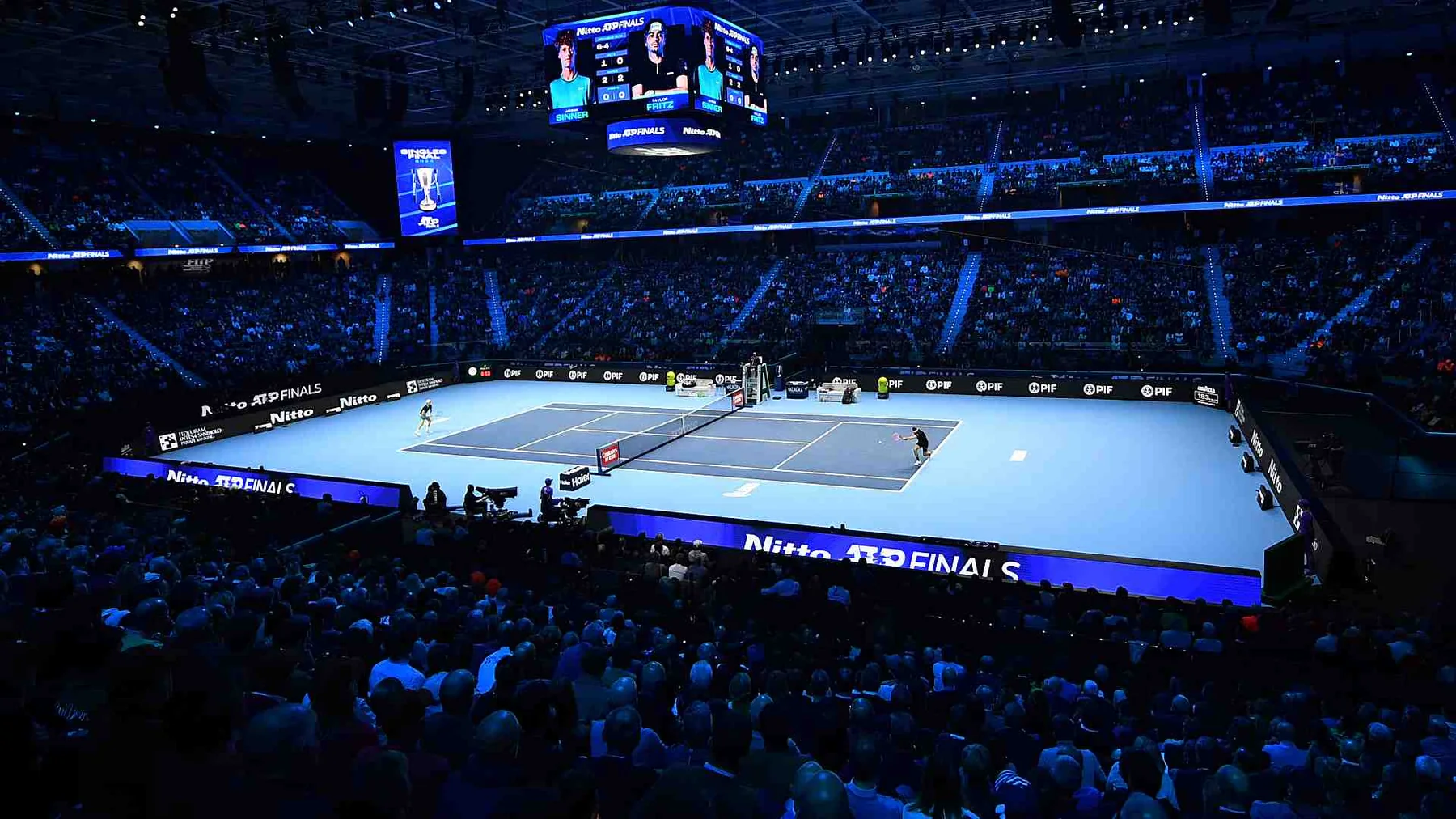
The ATP Finals is the men’s tour’s season-ending championship for eight qualified singles players and eight qualified doubles teams. Unlike a normal knockout tournament, it begins with two round-robin groups; the top two in each group move into the semifinals. That gives an entrant room to survive a defeat—and gives fans more standings arithmetic to follow.
The 2026 edition is confirmed for 15–22 November at Inalpi Arena in Turin. The dates, venue and session framework are published, but the complete fields, groups and daily match assignments develop as the Race concludes and the draw is made. This guide separates those moving parts from the stable rules: who qualifies, how a three-way tie is broken, how an undefeated champion reaches 1,500 points, and which schedule or results page to check at each stage.
What the ATP Finals Is—and What Makes It Different
The ATP Finals is the elite season-ending championship on the men’s tour. It brings together eight qualified singles players and eight qualified doubles teams, then divides each field into two groups of four. Every entrant plays three round-robin matches. The best two records in each group advance to the semifinals, where the group winners cross over to play the runners-up from the opposite group.
That opening phase is what separates the Finals from almost every event fans encounter on the ATP tournament calendar. In a conventional draw, one defeat ends a player’s tournament. In Turin, a player can lose once and still qualify at 2-1—and, in some combinations of results, can even remain in contention at 1-2. The other side of that second chance is dependency: a player may need a later match between two group rivals to produce a particular outcome.
Most ATP tournaments
The draw is single elimination. Win and move on; lose and the run is over. The bracket alone tells the fan who remains alive.
ATP Finals
Three guaranteed group matches are scheduled for each original entrant, subject to withdrawal or replacement. Wins, matches played and—when records are tied—deeper tiebreak criteria determine who reaches the knockout weekend.
The competition therefore has two distinct moods. From Sunday through Friday, fans follow a mini-league: the scoreline can matter beyond the identity of the winner because sets and games may later break a three-way tie. On the final weekend, all that arithmetic disappears. The two semifinals and the final are straight knockout matches.
The phrase “season finale” also describes the quality of the field, not just its place in November. Qualification is earned through the year’s Race, so nearly every group match resembles a late-round meeting at a major event. Yet reputation does not carry an entrant through the group. Three matches in the same indoor environment test recovery, tactical adjustment and consistency against elite opposition. For a first-time viewer, the essential rule is simple: do not declare anyone out after one loss, and do not assume two wins settle first place until the full group table is checked.
2026 ATP Finals Dates, Venue and Daily Schedule
The 2026 ATP Finals is confirmed for 15–22 November at Inalpi Arena in Turin, Italy. The published ticket schedule lays out 15 sessions across eight days: 12 round-robin sessions from Sunday through Friday, two semifinal sessions on Saturday and one finals session on Sunday. Times below are Turin local time.
| Dates | Phase | Published session starts | Matches per session |
|---|---|---|---|
| Sun 15–Fri 20 Nov | Round robin | 11:30 day; 18:00 night | 1 doubles, then 1 singles |
| Sat 21 Nov | Semifinals | 12:00 day; 18:00 night | 1 doubles, then 1 singles |
| Sun 22 Nov | Finals | 15:00 | Doubles final, then singles final |
The crucial word is session. An 11:30 or 18:00 listing is the start of that ticketed block, not a promise that the singles match begins at that moment. Doubles is listed first, so the singles start depends on how long the opening match and the changeover take. Named players and teams are assigned after the fields and groups become clear, then refined through the daily order of play.
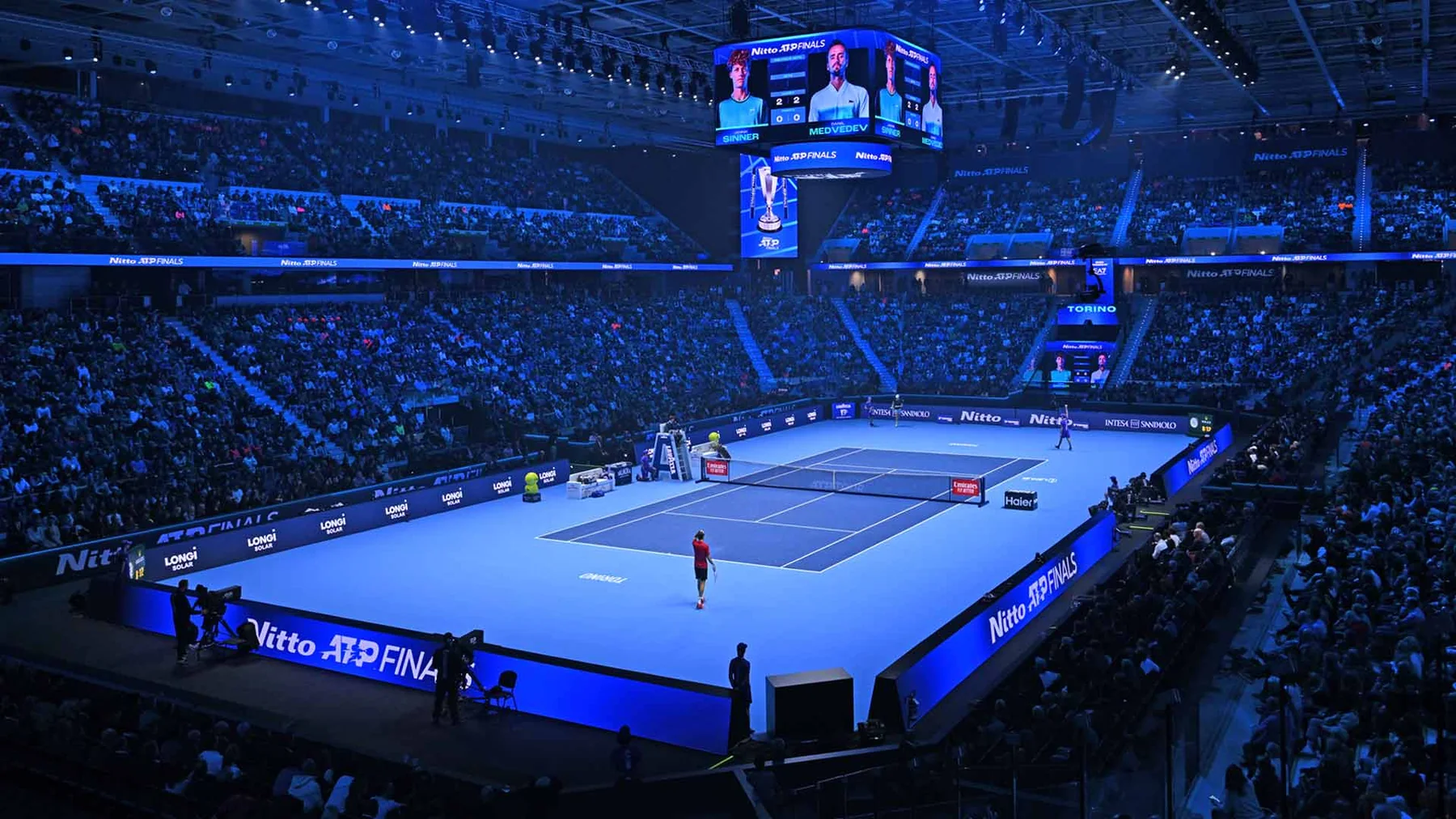
Inalpi Arena is an indoor multi-purpose venue. The official venue guide gives a potential capacity of 15,000 and says the Finals configuration can hold up to 12,000 spectators. For ticket holders, the practical detail is that day and night are separate admissions: the arena is cleared after the afternoon session, including for someone who also has a night ticket.
How Singles Players and Doubles Teams Qualify
Qualification follows a selection list, not simply a screenshot of the top eight. Fans normally track the PIF ATP Live Race To Turin because it shows points earned toward the current season’s finish. The formal 2026 Rulebook, however, sets the selection order on the Monday after the Paris Masters and adds a provision for current-year Grand Slam champions.
Singles selection order
- The top seven players at the specified post-Paris cutoff lead the list.
- Next come up to two singles champions from that year’s four Grand Slams who are positioned from No. 8 through No. 20, ordered by their position.
- Then come the remaining players from No. 8 downward.
The first eight names on that constructed list are direct acceptances. In the most common case—no eligible major champion from No. 8 to No. 20—the player eighth in the Race takes the final place. If one eligible champion is in that band, he moves ahead for the eighth berth. If two are eligible, the higher-positioned champion receives the final direct place and the lower-positioned champion is next in the alternate logic described by ATP’s rankings FAQ.
This is why the eighth line on a live leaderboard should be read as a bubble position, not an unconditional ticket. Another 2026 detail matters at the cutoff: results from ATP Tour events held in the week after Paris count toward the following year’s Finals acceptance. They do not provide a last-minute route into the current Turin field.
Doubles is a team race
Doubles uses the same broad priority—top seven, eligible current-year Grand Slam-winning teams from No. 8 to No. 20, then the next teams—but applies it to the PIF ATP Doubles Team Rankings. That is different from either partner’s individual doubles ranking. A partnership accumulates its own season results, and that team is the qualifying unit.
The distinction becomes especially important when a player has strong results with multiple partners. The 2026 rules say a player who directly qualifies on more than one team may choose which team to represent. The partner on the unchosen team does not keep that acceptance automatically unless he also qualifies with another partner. When checking contenders in the ATP player directory, therefore, pair identity matters as much as either name.
ATP had officially confirmed Jannik Sinner as the first 2026 singles qualifier on 10 July and Harri Heliovaara/Henry Patten as the first doubles team on 11 July. Those are dated confirmations, not a projection of November’s complete fields; the Race and official qualified indicators remain the proper sources as the season develops.
Round-Robin Format, Semifinals and Group Tiebreaks
Each field starts as two four-entry groups, but only the top two in each group reach the semifinals. The draw keeps seeds No. 1 and No. 2 apart. Seeds 3/4, 5/6 and 7/8 are then handled as pairs, with one member of each pair drawn into each group. That method balances the two groups without making every position automatic.
From groups to the semifinals
Every singles player or doubles team faces the other three entries in the group. The Group A winner then plays the Group B runner-up, while the Group B winner plays the Group A runner-up. From that point, the semifinals and final are single elimination.
The phase structure is shared, but the match formats are not. Singles uses best-of-three tie-break sets all week, including the final. Doubles uses two no-ad tie-break sets; at one set all, a Match Tie-break to 10 points, win by two, replaces a full third set. That shorter decider raises the value of return positioning and first-strike net play because a small run can settle the match.
The group-tiebreak order
- Most match wins.
- Most matches played. A 2-1 record ranks above 2-0; 1-2 ranks above 1-0.
- Head-to-head when exactly two entries are tied.
- For a three-way tie: percentage of sets won, then percentage of games won, then the relevant ATP ranking at the rules’ cutoff.
- If a percentage step identifies one superior or one inferior entry and leaves two tied, those two revert to head-to-head.
Worked three-way example: suppose three teams all finish 2-1. Their set records are 5-2, 4-3 and 4-3. The first team has won 71.43% of its sets and wins the group. The other two are both at 57.14%, so their direct meeting decides which one advances as runner-up.
This is why “Player X beat Player Y” does not by itself settle every three-way tie. Head-to-head returns only after the multi-entry calculation has reduced the tie to two.
The practical fan lesson is to keep the full score. A straight-sets loss and a three-set loss are both one defeat in the W/L column, but they produce different set percentages. If that still does not separate three entries, every game enters the calculation. The complete ATP results are therefore more useful than a winners-only recap when the final group round approaches.
Official scenario sheets demonstrate the dependency. In 2025, ATP published separate outcome paths after the second round for singles and doubles because the last matches could decide another entrant’s fate. Until all 2026 groups and scores exist, any equivalent scenario would be speculation; use the decision order above, then follow the official calculation.
ATP Finals Ranking Points: How 1,500 Is Built
An undefeated ATP Finals champion earns 1,500 ranking points, but 1,500 is a maximum—not a flat award for lifting the trophy. Points accumulate with each win in both the singles and doubles events.
| Win | Points | Maximum running total |
|---|---|---|
| Round robin, match 1 | 200 | 200 |
| Round robin, match 2 | 200 | 400 |
| Round robin, match 3 | 200 | 600 |
| Semifinal | 400 | 1,000 |
| Final | 500 | 1,500 |
The undefeated calculation is therefore 600 + 400 + 500 = 1,500. A champion who loses one group match but advances at 2-1 receives 400 for the group stage, then 400 for winning the semifinal and 500 for winning the final: 1,300 in total. The title is the same; the points haul is not.
The wording “for a win” is also important. Reaching the semifinals does not automatically add 400. An undefeated group winner who loses there keeps the 600 earned from three group victories. Likewise, a player who wins one group match but is eliminated keeps 200. A round-robin loss does not deduct points already banked.
This match-by-match system makes the event unusual. At a normal knockout tournament, points are primarily associated with the furthest round reached. In Turin, two players eliminated at the same stage can leave with different totals because their group records differ. Use the match-by-match results to count wins rather than assuming a finishing label tells the whole points story.
How to Follow the Schedule, Draw and Results
The safest way to follow the ATP Finals is to use a different source at each stage of the event. A season-long Race, a ticket session timetable, a group draw and a daily order of play all answer different questions. Calling all four “the schedule” creates avoidable confusion.
- Before the field is complete: follow the Race. The official Nitto site displays separate singles and doubles leaderboards, including qualification indicators. Treat the points order as the live picture, then look for an official qualified mark or announcement before calling a place certain.
- After qualification: read the draw and groups. The draw shows the three round-robin opponents and the possible cross-over semifinal path. It still does not tell you every match’s exact day and time. The published session grid identifies the available blocks, while the daily order of play assigns names.
- During tournament week: switch to order of play, live score and results. ATP says daily orders are typically released in the afternoon or evening for the following day. Later matches may be marked “not before” because the first match has no fixed finishing time.
For a simple routine, open the ATP schedule this week when Finals week begins, then use today’s ATP matches for the current card. The official order of play remains the final check for court sequence and local start guidance. Turin uses local Italian time, so convert from that listed time—not from an old article’s television window.
A live score answers what is happening now. The completed ATP results answer what happened, with the set-by-set record needed to interpret group standings. After each round, recheck the table rather than assuming the winner of one head-to-head automatically leads a three-way tie.
Viewing is a separate layer. Rights and platforms differ by country and can change, so use the current ATP watch guide near the event instead of relying on a broadcaster named months earlier. The same last-check rule applies to on-site plans: the 2026 organiser labels times and programme as indicative. Confirm the order of play before leaving for Inalpi Arena, especially if your ticket is tied to a day or night session.
ATP Finals vs Next Gen ATP Finals
The ATP Finals and Next Gen ATP Finals are separate season-ending events. They share an eight-player, two-group structure in singles, but they serve different populations and use different scoring. The Nitto ATP Finals is the tour-wide elite finale and also stages doubles; Next Gen is an age-restricted singles showcase.
| Question | Nitto ATP Finals | Next Gen ATP Finals |
|---|---|---|
| Who is eligible? | Elite qualifiers from the tour-wide singles Race and doubles team ranking; no age ceiling | Players who remain 20 or younger throughout 2026 |
| Field | 8 singles players and 8 doubles teams | 8 singles players; no doubles event in the 2026 rule |
| Selection | Post-Paris selection lists, including the current-year major-champion provision | Top 7 in the Next Gen Race plus 1 age-eligible ATP wildcard |
| Singles scoring | Best of 3 standard tie-break sets | Best of 5 short sets; first to 4 games, tie-break at 3-3, no-ad games |
| Core purpose | Crown the champion among the season’s established elite | Showcase emerging players and provide a controlled setting for format innovation |
“Best of five” is the easiest phrase to misread. At Next Gen, it does not mean five full Grand Slam-style sets. Each set is a sprint to four games, a 3-3 score triggers a tie-break and no-ad scoring removes repeated deuces. The structure demands fast starts and makes a brief dip more expensive than it would be across a conventional six-game set.
The latest complete event-specific innovation list published by ATP was for 2025. It included presentation and timing experiments in addition to short-set scoring. Those details should not automatically be projected onto the 2026 edition. The April 2026 Rulebook does confirm the age rule, Race-plus-wildcard selection and first-to-four/no-ad match format.
The cleanest distinction is competitive status: a Next Gen title is a major development marker, but it is not the same achievement as winning the tour-wide Finals against the season’s open-age elite. Use the ATP tournament directory to keep the event pages separate, and recheck the official Next Gen page for its 2026 city, dates and edition-specific innovations when those details are displayed.
The short version: Turin rewards both season-long qualification and week-long adaptability. Follow the Race before November, the draw once the fields are set, and the daily order of play and full results during the event. One defeat is survivable; one set or game can still decide a group; and only five wins produce the maximum 1,500-point finish.
About the author
ATP Schedule Editorial Team
The ATP Schedule editorial team turns match times, scores, tournament information and verified tennis news into clear answers fans can use quickly.
View all articles by this author →Fan discussion
Comments
Sign in with Google to comment. Keep the discussion helpful and tennis-focused. New comments are reviewed before they appear.
Loading comments…