Is ATP Cutting Doubles in 2028? The Proposal and Why Fans Are Worried
ATP says doubles will remain on the Tour, while reviewing draw sizes and compensation. Here is what that could mean for specialists, singles qualifying and fans.
Is ATP abolishing doubles in 2028?
No. ATP has not announced the abolition of doubles. In its October 15, 2026 OneVision Q&A, the Tour explicitly says doubles will remain a core part of its competition. What it is reviewing is the discipline's long-term structure, including possible changes to draw sizes and the distribution of player compensation.
That reassurance has a limit. Continuing to offer doubles does not necessarily mean preserving every current entry place, payout or event arrangement. Specialists can therefore have a legitimate concern about the review without a claim that the Tour has already decided to eliminate their sport.
The proposals are still subject to consultation and approval. The stated goal is to bring a final package for consideration at the year-end meetings in Turin. As of October 19, there is no final 2028 draw-size table or confirmed doubles cut amount in the statements discussed here.

The distinction matters for anyone planning to follow a pair through a season. An announcement about policy development is not a published tournament draw. Existing events still need to be followed through their own entry lists, schedules and results, while the proposed future framework receives scrutiny on its actual terms.
The ATP Finals guide explains how singles and doubles share the season-ending event. Doubles has its own teams, qualification contest and championship. The question raised by the 2028 review is how to maintain a viable competitive circuit around that identity, and which players would bear the cost of any restructuring.
What doubles changes are actually under review?
The explicit areas are potential changes to doubles draw sizes and player compensation distribution. These sit inside a wider review of competition structure. They are related decisions, but they answer different questions and should not be collapsed into one prediction about what tennis will look like in 2028.
Draw size is about who gets to enter
A draw size describes the number of teams in an event. Entry rules decide how those places are allocated. A smaller field could mean fewer opportunities even if the matches themselves retained exactly the same scoring system. Conversely, a revised entry method could change which teams get in without changing the total field.
That is why specialists will need more than a headline number to assess a proposal. They would need to know which tournament categories are affected, how places are awarded and what happens to teams near the cutoff. No published list of new 2028 doubles fields has answered those questions yet.
Match format is about how a contest is played
Match format concerns the scoring and structure of an individual contest: games, sets and any deciding tie-break. A reference to competition formats is not evidence that a particular new scoring system has been approved. Nor does an ATP review automatically rewrite the doubles rules of Grand Slam tournaments.
| Policy question | What it affects | Current position |
|---|---|---|
| Draw sizes | Number of competing pairs | Potential adjustments under review |
| Compensation distribution | Where player money is allocated | Potential redistribution described |
| Specific new scoring rules | How each match is played | No final 2028 system announced here |
Contemporary reporting by Tennis Majors likewise notes the absence of published draw sizes, formats and financial figures. For fans checking an event now, the tournament directory remains the place to begin. A future policy debate should not replace the actual conditions of a tournament already taking place.
Why would smaller draws matter to doubles specialists?
Entry is the first opportunity to earn anything from a tournament. A team outside the field cannot win its matches, build points from that event or become part of its on-court story. A debate centered only on the prize available to eventual champions misses the effect on the pairs who may never get to start.
Doubles also means two careers depend on each team place. A partnership has to coordinate a schedule, travel and preparation. If access becomes less predictable, it becomes harder to decide which weeks justify that commitment. This is an economic consequence to examine, not a claim that a particular pair has already lost a 2028 place.
A simple example of lost opportunities
Consider a purely hypothetical reduction from 32 pairs to 24. That would remove eight team places, affecting 16 players before the first ball was struck. These are illustrative numbers, not an announced ATP proposal. Raising the payout for teams still admitted would not automatically replace the competitive opportunity of those excluded.
The longer-term question is how new successful teams emerge. Orlando Luz and Rafael Matos won their first Masters 1000 title in Montreal in August 2026 after also winning in Buenos Aires and Santiago that season. Their ATP title report provides a concrete example of a team building a season across different levels before a major breakthrough.
That does not prove every existing draw must remain untouched. It does show why the pathway needs to be discussed alongside the quality of the final field. A sport that wants compelling future champions needs opportunities for teams to become competitive together, rather than evaluating the circuit only through the names already leading it.
Our ATP rankings explainer helps separate individual doubles rankings from the season's team race. Both perspectives matter here. A pair's status in one list is not the whole story of its access, development or potential. Any final reform should make clear which teams face a narrower route and what opportunities remain available to them.
Where could money reallocated from doubles go?
The stated destination is player compensation, with reinvestment expected in singles qualifying and early-round prize money. Andrea Gaudenzi's October 15 open letter makes that direction explicit. It describes what would happen to any money reallocated, without publishing an amount to be removed from doubles.
That matters because two very different claims can otherwise become mixed together: whether money would leave player compensation altogether, and whether it would move away from doubles players. The statement addresses the first concern. It does not remove the second.
Qualifying and early-round singles players have a clear competitive reason to want stronger support: their opportunity to earn from a tournament may end before the most visible rounds begin. Directing more money toward that stage would distribute rewards differently from concentrating additional funds on the eventual finalists.
A bigger total does not guarantee every player earns more
The wider package projects annual ATP player compensation of $350 million from 2028, excluding Grand Slams. As Reuters reported, that total includes prize money, profit-sharing and central support. It is not simply the doubles prize fund, nor a promise of an equal increase for every player.
An aggregate can rise while a particular group receives less. For specialists, the relevant questions are what their own discipline receives, how many pairs can compete and what a realistic season would cost. A larger Tour-wide figure cannot answer those questions on its own.
Fans interested in the broader development ladder can use our Challenger Tour guide. The announced expected destination here is singles qualifying and early rounds; that should not be rewritten as a confirmed transfer to a named Challenger program.
Our editorial test for a final package is distributional clarity. Show the existing and proposed amounts, the affected rounds and the number of players eligible to receive them. That would let supporters evaluate the intended benefit to one group alongside the competitive opportunity and income potentially lost by another.
What would fans lose if doubles became harder to sustain?
Doubles supplies a different tactical contest and a different kind of sporting relationship. Its value is not adequately described as more tennis after singles finishes. A team must coordinate first-strike patterns, net coverage and decisions under pressure, with two opponents trying to disrupt that coordination.
Watch the returner and the player at the net together
A useful way to watch is to track what a return allows the returner's partner to do next. A low ball can make the first volley difficult; a high return can expose the partner. The server's placement, the opposing net player's movement and the available passing angle all belong to the same short sequence.
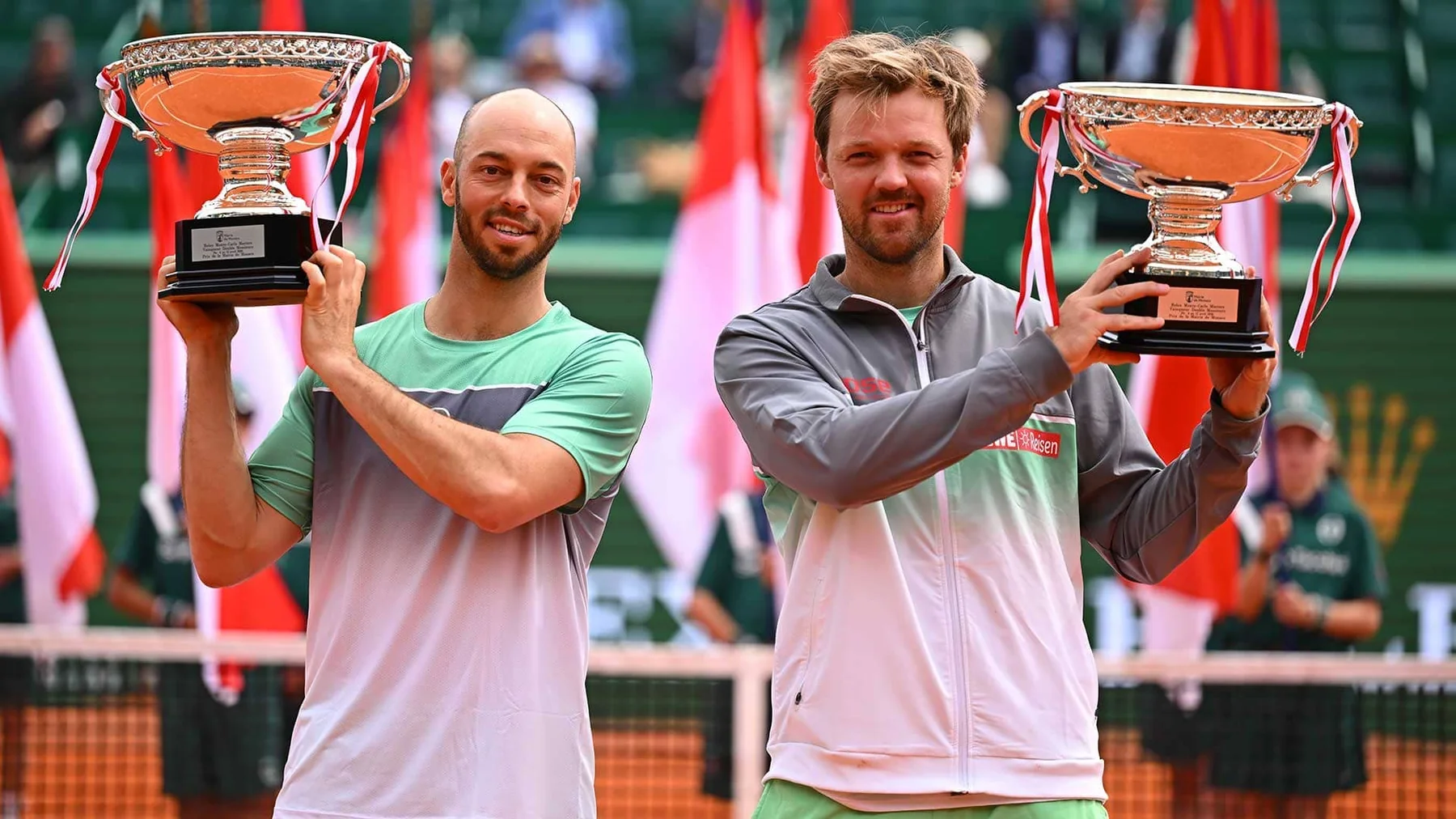
That is viewing advice, rather than an unsourced description of every rally in a particular final. There is a concrete 2026 example of the return's importance: Kevin Krawietz struck a return winner on championship point as he and Tim Puetz beat Marcelo Arevalo and Mate Pavic 4-6, 6-2, 10-8 in Monte-Carlo, according to the official final report.
The current ATP format uses no-ad games and a deciding 10-point Match Tie-break at one set all. The 10-8 in that Monte-Carlo score is therefore a deciding tie-break, not a third set of 18 games. Those pressure points offer an immediate way into the discipline for a viewer accustomed to singles.
Partnerships create a different season-long story
At Queen's Club, Arevalo and Pavic beat Harri Heliovaara and Henry Patten 6-2, 6-4 for their eighth title together. ATP's June report notes that their partnership began in 2024. Following how a pair solves problems over time adds something that an isolated entry list cannot show.

Our view is that any sustainability plan should explain how it will preserve that depth and help spectators discover it. Better presentation, sensible scheduling and clear storytelling deserve evaluation alongside the number of places available. Fans using the results pages should be able to follow a developing pair across surfaces and tournament levels, rather than encounter doubles only when singles stars briefly enter it.
Are the concerns about doubles and the player pathway compatible?
Yes. Fans can support better opportunities for qualifying and early-round singles players while also wanting a viable doubles circuit. The difficult question is how to achieve both aims, and whether the specific trade-offs in a final package would be justified.
In one contemporary r/tennis discussion, contributors questioned whether a Tour concentrated more heavily around its biggest events would leave enough room for players developing below the top tier. Doubles prompted a related concern: a broad promise of growth may feel different to the group being asked to give up opportunities.
Those comments illustrate the argument, rather than measure the opinion of all tennis fans. Another discussion of the 2028 plans showed how quickly uncertainty about the review could turn into a claim that doubles was being removed. The official assurance that doubles remains part of the Tour is therefore useful, while still leaving the financial question open.
Our view is that the debate improves when it uses explicit criteria. If an event needs a more manageable schedule, explain the scheduling problem. If the concern is commercial demand, show relevant audience and attendance evidence. If the aim is a stronger player pathway, explain who can progress through it and how. No verified comparison of those measures in the statements discussed here settles the entire issue.
It is also reasonable to ask whether other approaches were considered before reducing entry opportunities: different presentation, clearer match windows or ways to make teams easier for spectators to follow. These are options to examine, not claims that any one solution would certainly pay for itself.
The strongest policy would address the discipline as a continuing competition with current players and future entrants. The weakest argument on either side would reduce the question to whether singles or doubles players deserve sympathy. Both groups are pursuing professional careers; the rules and resources determine what opportunities those careers actually contain.
What should the next ATP announcement tell fans?
The next meaningful step is an approved, specific package that lets people assess actual consequences. ATP says it will continue developing the proposals with the Player Advisory Council, Tournament Advisory Council and ATP Board while consulting the wider membership. Its goal is consideration at the year-end meetings in Turin, rather than an announcement that approval has already happened.
For doubles, a useful final explanation should answer several connected questions:
- Which tournament categories and individual events would change their fields, and from what date?
- How many pairs could enter, and how would the entry method allocate those places?
- What would prize money look like round by round, with team amounts clearly distinguished from individual amounts?
- Which qualifying and early-round singles payments would receive any redistributed money?
- Would there be transition arrangements or a published review of the effects?
These are editorial questions to judge the eventual plan, not a claim that every item has been promised in a future announcement. They would make it possible to compare the stated aim of sustainability with the practical experience of players and spectators.
There is a timing question as well. A target date of 2028 and beyond does not mean that every part of a broad restructuring must happen at once. Fans should look for an implementation schedule attached to each approved change, rather than read a general strategic date as the start of every possible rule.
Meanwhile, the existing competition remains worth following. Open this week's ATP tournaments, find the doubles draw and follow the teams through the event. That is also the clearest way to see what the debate concerns: specific partnerships, entry opportunities and matches with their own tactical identity.
As of October 19, the answer remains precise: ATP is reviewing doubles structure and compensation; it says the discipline will continue. The potential redistribution deserves scrutiny, and the impact should be assessed when concrete terms are published. No final draw sizes, exact cuts or cancellation of doubles should be inferred from the current proposal.
About the author
ATP Schedule Editorial Team
The ATP Schedule editorial team turns match times, scores, tournament information and verified tennis news into clear answers fans can use quickly.
View all articles by this author →Fan discussion
Comments
Sign in with Google to comment. Keep the discussion helpful and tennis-focused. New comments are reviewed before they appear.
Loading comments…