Djokovic's Australian Open Record: Titles, Finals and 2026 Result
Novak Djokovic has 10 Australian Open titles in 11 finals through 2026. Explore every title year, his 104–11 match record and the Alcaraz final loss.
How many Australian Open titles and finals does Djokovic have?
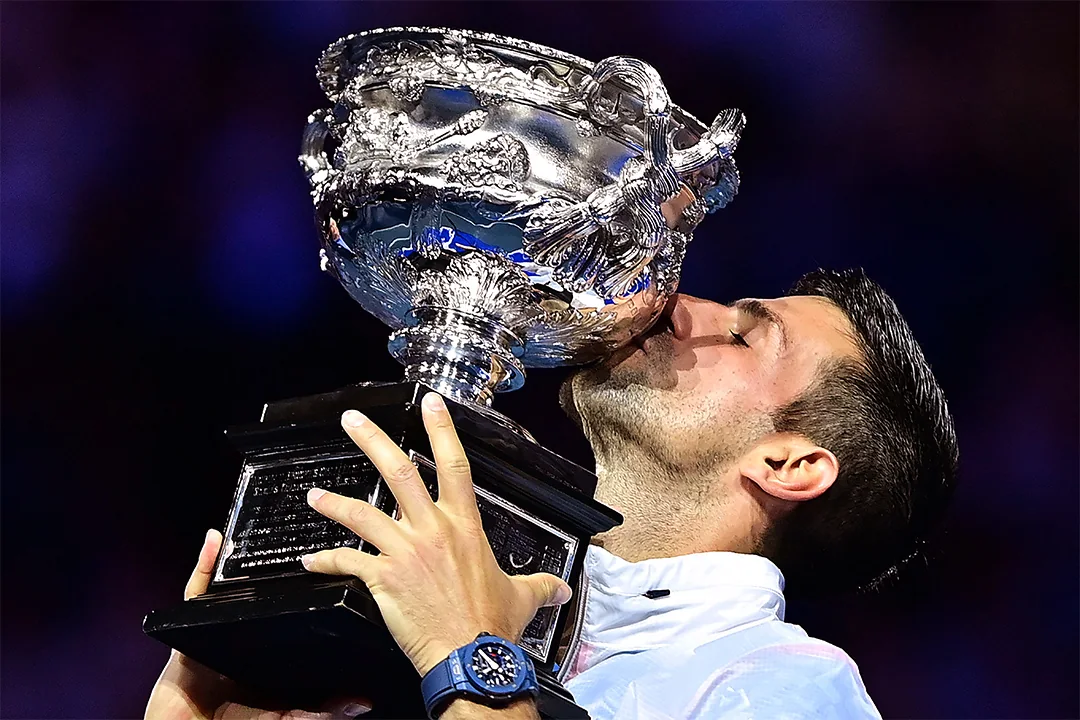
Novak Djokovic has won 10 Australian Open men's singles titles and reached 11 finals through the 2026 tournament. His finals record stands at 10 wins and one loss after Carlos Alcaraz beat him in February 2026. Across all Australian Open singles main-draw matches, his career record is 104 wins and 11 losses. Those are three related but different measures: trophies, championship matches and every match he has played in the draw.
Men's singles titles
Finals record in 11 appearances
Career AO singles match record
The Australian Open's men's singles honour roll identifies Djokovic as the event's record holder with 10 titles. Its current player profile lists the championship years from 2008 through 2023 and 21 appearances at the event. The tournament's records are the best starting point for title and finalist counts. A separate year-by-year results ledger gives the 104–11 match aggregate, while the ATP Tour's 2026 final report independently confirms the 104 wins and first loss in 11 finals.
Why does the final loss need a date stamp? Before the 2026 championship match, “10 finals, 10 titles” was accurate and often repeated. It stopped being current when Alcaraz won 2–6, 6–2, 6–3, 7–5. Djokovic's all-time lead in Australian Open titles did not disappear; the perfect final record did. This is the most useful correction for anyone reading an older preview or social-media graphic.
One more distinction prevents confusion later in the article. Rod Laver Arena is a court inside Melbourne Park, and Djokovic's record there is 90–10 after the 2026 final. That is not the same as his 104–11 record across the Australian Open tournament, because he has played on other courts as well. If you want the complete 2026 draw rather than a career summary, the site's Australian Open results show his semifinal and final alongside every round.
Which years did Djokovic win the Australian Open?
Djokovic won in 2008, 2011, 2012, 2013, 2015, 2016, 2019, 2020, 2021 and 2023. The spread matters as much as the total: his first and tenth titles were 15 years apart. The official Australian Open honour roll supplies the champion, runner-up and set scores for every year below.
The 2008 breakthrough and 2011–13 three-peat
Melbourne gave Djokovic his first major singles trophy in 2008. Against Jo-Wilfried Tsonga, he lost the opening set before winning in four, becoming a champion at 20. The 2011 title over Andy Murray began a different phase: three consecutive Australian Open championships. Murray returned as the losing finalist in 2013, but 2012 was the year that most vividly explains why Djokovic's Melbourne record became more than a trophy count. He beat Rafael Nadal 5–7, 6–4, 6–2, 6–7(5), 7–5 in five hours and 53 minutes. The AO's historical account identifies it as the longest Grand Slam final. A three-peat containing that particular endurance test says more about his ability to solve different finals than three identical wins would.
The 2015–16 repeat and 2019–21 run
Djokovic beat Murray again in 2015 and 2016; their four Australian Open finals together account for four of his ten titles. The 2016 win was his sixth at the tournament, matching Roy Emerson's then all-time mark. He later moved beyond that mark in a second long run: Nadal in 2019, Dominic Thiem in 2020, and Daniil Medvedev in 2021. Those finals were not copies of one another. The 2019 Nadal match ended in three sets, while Thiem led by two sets to one in 2020 before Djokovic recovered. The AO's finals retrospective highlights the 2020 comeback as a defining five-set title match. It is useful context whenever a simple “ten titles” line makes the decade look effortless.
The 2023 return and the full finals ledger
Stefanos Tsitsipas was the opponent for title number ten in 2023. Djokovic took it in straight sets, though two were decided in tiebreaks. In 2026 he returned to the final but lost to Carlos Alcaraz, so that year belongs in the finals ledger as a runner-up finish, not the title list.
| Year | Opponent | Result for Djokovic | Set score |
|---|---|---|---|
| 2008 | Jo-Wilfried Tsonga | Won | 4–6, 6–4, 6–3, 7–6(2) |
| 2011 | Andy Murray | Won | 6–4, 6–2, 6–3 |
| 2012 | Rafael Nadal | Won | 5–7, 6–4, 6–2, 6–7(5), 7–5 |
| 2013 | Andy Murray | Won | 6–7(2), 7–6(3), 6–3, 6–2 |
| 2015 | Andy Murray | Won | 7–6(5), 6–7(4), 6–3, 6–0 |
| 2016 | Andy Murray | Won | 6–1, 7–5, 7–6(3) |
| 2019 | Rafael Nadal | Won | 6–3, 6–2, 6–3 |
| 2020 | Dominic Thiem | Won | 6–4, 4–6, 2–6, 6–3, 6–4 |
| 2021 | Daniil Medvedev | Won | 7–5, 6–2, 6–2 |
| 2023 | Stefanos Tsitsipas | Won | 6–3, 7–6(4), 7–6(5) |
| 2026 | Carlos Alcaraz | Lost | 6–2, 2–6, 3–6, 5–7 |
Read each score from Djokovic's side of the net. This keeps the final row comparable to his ten wins: Alcaraz's own score is 2–6, 6–2, 6–3, 7–5. It also makes the 10–1 finals record transparent rather than asking fans to infer it from a title list that stops in 2023.
What is Djokovic's Australian Open match record?
His Australian Open men's singles main-draw record is 104 wins and 11 losses through the 2026 event. That is the whole-tournament figure, not the 10–1 record in finals. It includes wins in early rounds, quarterfinals and semifinals as well as championship matches. The count reached 104 when Djokovic beat Jannik Sinner in the 2026 semifinal, then the loss to Carlos Alcaraz made the loss side 11.
His 100th Melbourne win came in 2026
Djokovic entered the 2026 main draw on 99 Australian Open singles wins. A 6–3, 6–2, 6–2 opening victory over Pedro Martinez became win 100. The Australian Open's milestone report notes that he had already crossed 100 main-draw wins at Wimbledon and Roland-Garros, making him the first player to achieve that century at three different majors. That is a broader Grand Slam record, but the Australian component began with Martinez.
His next completed match, against qualifier Francesco Maestrelli, made 101. The third-round win over Botic van de Zandschulp made 102, level with Roger Federer's Australian Open career total, as the event's round-three account recorded at the time. Djokovic then advanced past Jakub Mensik without playing their fourth-round match. A walkover moves a player through the bracket; it does not add a played match to a match-win ledger. This is why the number did not jump to 103 until the quarterfinal.
Finals, match wins and losses count different things
Lorenzo Musetti led that quarterfinal by two sets to love before retiring in the third. Unlike a walkover, a retirement ends a match that started, so the result counted as Djokovic's 103rd Australian Open win. The five-set semifinal over Sinner made 104, corroborated by the ATP Tour's final report. He therefore finished 2026 with five match wins and one match loss, while his draw also includes one unplayed walkover advancement.
104–11 describes all Australian Open main-draw matches through 2026. The 10–1 figure describes only his 11 final appearances. A 90–10 figure sometimes seen in articles is for Rod Laver Arena specifically; it is a court subset, not the whole tournament.
Those distinctions make the achievement easier to appreciate. Ten titles alone show repeated peaks. More than 100 match wins show the depth of successful campaigns between those peaks. The first final loss in 2026 changed one row of the ledger without undoing either the title lead or the fact that he had reached an eleventh championship match.
How did Djokovic reach the 2026 final?
He began with three straight-set wins, advanced through an unplayed fourth-round match, survived when a quarterfinal opponent retired, and then produced a five-set upset of defending champion Jannik Sinner. Carlos Alcaraz ended the run in the championship match. The path was not a seven-match winning streak: one round was a walkover, and the final was a loss.
Early rounds included a walkover and a retirement
Djokovic opened by beating Pedro Martinez and qualifier Francesco Maestrelli by identical 6–3, 6–2, 6–2 scores. He then beat Botic van de Zandschulp 6–3, 6–4, 7–6(4). Those were three played wins, and the third brought him level with Roger Federer on 102 Australian Open singles match victories. His scheduled round-of-16 opponent, Jakub Mensik, withdrew before they played. The official AO match list marks that round as a walkover with no match duration.
The quarterfinal against Lorenzo Musetti was a different kind of abrupt finish. Musetti won the first two sets 6–4, 6–3; Djokovic led 3–1 in the third when the Italian retired. The Australian Open account records both the score and Djokovic's 103rd tournament win. It would be misleading to describe that as Djokovic completing a comeback from two sets down, because the match stopped before either man could finish it. The retirement is a recorded match win; the Mensik walkover is bracket advancement without a played match.
He beat Sinner in a five-set semifinal
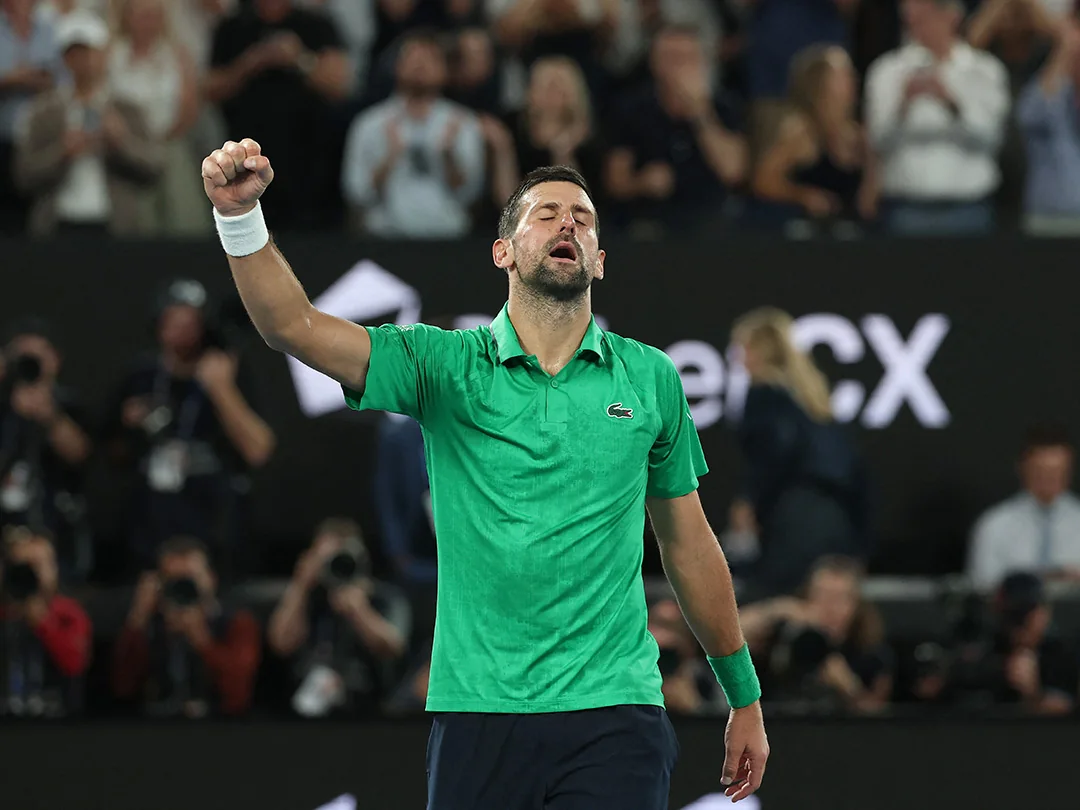
Djokovic's most demanding victory came next. Sinner arrived as the two-time defending Australian Open champion and took a two-sets-to-one lead. Djokovic answered with the fourth and fifth to win 3–6, 6–3, 4–6, 6–4, 6–4 in four hours and nine minutes. He saved 16 of 18 break points, according to the official semifinal report. That figure is a much more meaningful sign of his resistance than the mere fact that the match went five sets: Sinner repeatedly created chances, but Djokovic preserved enough service games to reach another final.
Alcaraz stopped his unbeaten finals streak
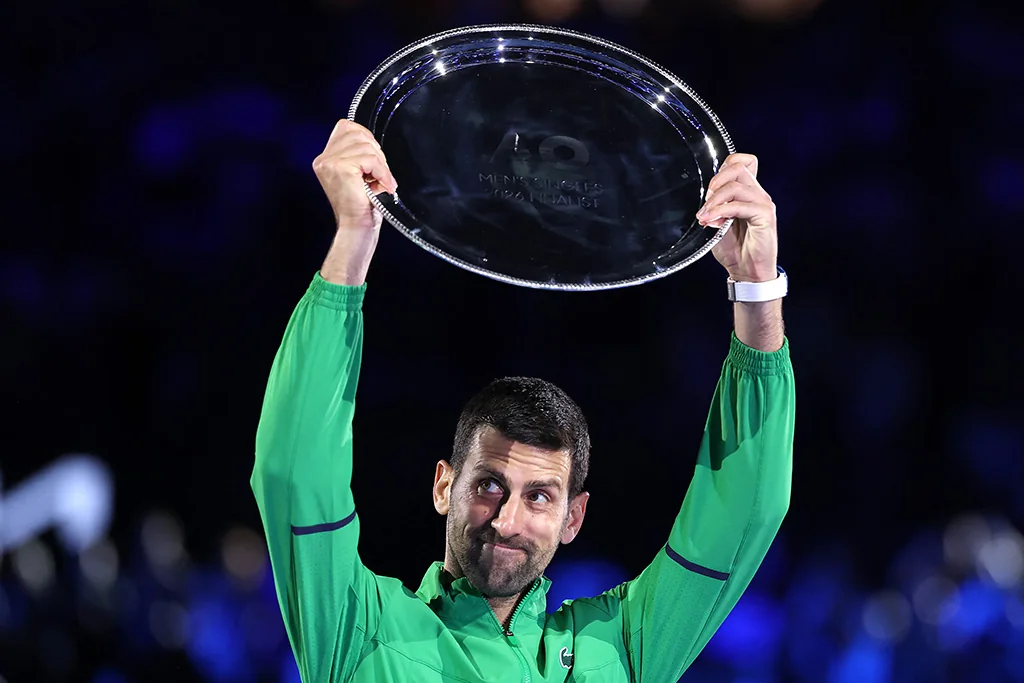
Djokovic took the first set of the final 6–2, then Alcaraz won 6–2, 6–3, 7–5. The AO final report gives the score and three-hour, two-minute duration. Djokovic came close to extending the match in the fourth set, saving six break points in an early service game and creating a chance at 4–4. He could not convert it, and Alcaraz broke at 5–6. The defeat changed the perfect 10–0 finals line to 10–1, while leaving Djokovic's ten titles untouched. For the detailed service-game and rally explanation, see our 2026 men's final recap.
How strong is Djokovic's record at Rod Laver Arena?
Through the completed 2026 Australian Open, Djokovic had won 90 of his 100 matches at Rod Laver Arena. His 90–10 record there is a precise 90 percent winning rate on Melbourne Park's main show court. He reached the 90-win mark by defeating Jannik Sinner in the 2026 semifinal, then made his 100th arena appearance against Carlos Alcaraz in the final. The loss counted in that venue ledger; it also ended his unbeaten record in Australian Open finals.
That court total should not be confused with the 104–11 Australian Open match record discussed above. The event record covers Djokovic's played men's singles matches wherever they were staged; the Rod Laver Arena record counts only matches on that court. Subtracting one total from the other is not a useful way to infer how many matches he won on any particular outside court, because the denominators track different sets of matches and rounds.
The Australian Open's arena record review puts those 90 wins in perspective. Roger Federer still led the venue's all-time wins table with 93, achieved in 107 appearances. Djokovic had three fewer arena wins but a higher winning rate: 90.00 percent compared with Federer's 86.92 percent. He and Federer were the only players in that review to have played at least 100 matches on the court. The comparison says something specific about sustained success at the main stadium; it does not change either player's Grand Slam title count.
Djokovic also owns the venue's longest listed winning streak: 33 consecutive Rod Laver Arena matches from the first round in 2019 until the 2024 semifinal. Those victories spanned the Australian Open titles he won in 2019, 2020, 2021 and 2023. Sinner ended the streak in that 2024 semifinal, then lost to Djokovic on the same court in the 2026 semifinal. The sequence makes the 2026 result more interesting than a simple revenge label: it added a 90th arena win, but Alcaraz prevented a new title two days later. AO also notes that the final defeat was Djokovic's first in an Australian Open night match since 2018; that narrower night-session fact should not be read as an unbeaten overall arena record.
What did the 2026 runner-up finish change?
It gave Djokovic a first Australian Open final defeat while extending several appearance records. As of the end of the 2026 tournament, he was a 10-time champion in 11 Melbourne finals, a 24-time major singles champion, and the owner of 104 Australian Open singles match wins. Those figures tell different stories: the final loss altered a perfect title-match record, but the semifinal victory over Sinner still added a tournament match win and another final appearance.
The 25th-major bid continued beyond Melbourne
Djokovic arrived in the championship match one victory from a 25th major singles title. Alcaraz's four-set win meant that the milestone had not arrived by the end of the 2026 Australian Open. The official Australian Open records review states that Djokovic's appearance was his record-extending 38th Grand Slam singles final. At 38, he was also the oldest men's singles finalist in the Australian Open's Open era, moving past the age mark associated with Ken Rosewall's 1972 final.
That is more precise than saying the tournament was only a missed chance. A player cannot pursue a 25th major in a final without first winning the matches needed to get there. Djokovic's five-set semifinal win over the two-time defending champion is part of the 2026 record, even though he lost two days later. The title bid remained unresolved at Melbourne; what he might achieve at later majors is a separate question and should not be inserted into a final-day record card.
A first final loss does not erase a decade of titles
Before facing Alcaraz, Djokovic had won every Australian Open men's singles final he had played. His 2026 defeat changed that line from 10–0 to 10–1. It did not take away the ten titles listed in the year-by-year table, his 33-match Rod Laver Arena winning streak, or his extraordinary success against different generations of finalists. The 2026 final belongs in the ledger as a runner-up finish, not as an eleventh title and not as evidence that earlier wins count for less.
Djokovic's own post-final comments also argue against easy predictions. In the Australian Open's account of his response, he credited Alcaraz's tactical adjustment and praised his opponent's level. He thanked the crowd for its support and acknowledged uncertainty about what the coming months would bring. The report records no retirement announcement or commitment to a particular future Australian Open. As with any active player's career record, the honest snapshot is dated: these Melbourne figures stand through the 2026 event and should be updated if he plays more matches in later editions.
About the author
ATP Schedule Editorial Team
The ATP Schedule editorial team turns match times, scores, tournament information and verified tennis news into clear answers fans can use quickly.
View all articles by this author →Fan discussion
Comments
Sign in with Google to comment. Keep the discussion helpful and tennis-focused. New comments are reviewed before they appear.
Loading comments…