Novak Djokovic ATP Ranking History: Year-End Rankings, No. 1 Records and Ranking Changes
A season-by-season account of Djokovic's ranking history, the records that define it and the results behind his biggest rises and falls.
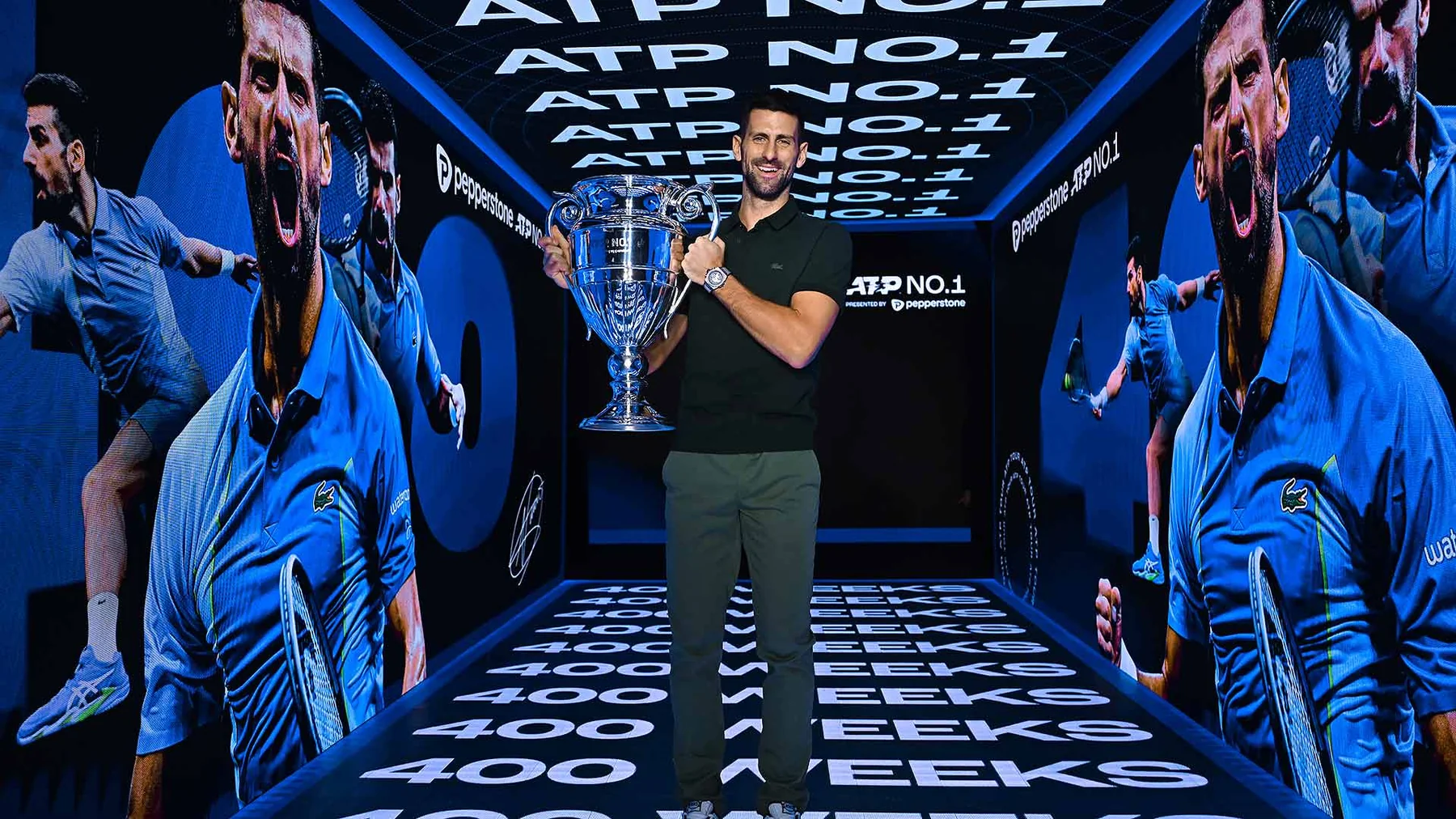
Djokovic's ranking records at a glance
Novak Djokovic's ATP ranking history is led by 428 weeks at world No. 1 and eight year-end No. 1 finishes. His career-high singles ranking is No. 1, first reached on 4 July 2011. Those are historical achievements; they should not be read as a claim that he occupies the top position today. This guide covers completed year-end rankings through 2025, with historical records checked on 19 October 2026.
The ATP's official former No. 1 table makes the comparison clear. Djokovic leads the men's cumulative weeks and year-end columns. Roger Federer has the longer uninterrupted reign. Pete Sampras finished six seasons on top, while Rafael Nadal finished five. Each comparison answers a slightly different question about a career.
| Player | Total weeks at No. 1 | Longest consecutive run | Year-end No. 1 finishes |
|---|---|---|---|
| Novak Djokovic | 428 | 122 | 8 |
| Roger Federer | 310 | 237 | 5 |
| Pete Sampras | 286 | 102 | 6 |
| Rafael Nadal | 209 | 56 | 5 |
Total weeks, consecutive weeks and year-end No. 1 are different
Total weeks add together separate spells at the summit. Consecutive weeks measure one unbroken spell. Year-end No. 1 counts the seasons a player closes in first place. Djokovic's eight winning seasons were 2011, 2012, 2014, 2015, 2018, 2020, 2021 and 2023. A player can reach No. 1 during a season and still lose the year-end race.
This distinction makes the history more interesting than a single league table. Djokovic repeatedly regained the lead after rivals had taken it, so recovery is central to his cumulative record. Federer's consecutive figure describes a different kind of control: holding off every challenger without interruption. Neither number tells you who served best in a particular final or who was healthiest in a given month.
For reading individual changes, the useful companion is our ATP rankings explanation. Ranking points reward results within the applicable counting rules; they do not award permanent credit for reputation. That is why the career record can remain extraordinary while a player's current position changes sharply.
Novak Djokovic's year-end ATP rankings, 2003-2025
Djokovic finished 2025 at No. 4, following No. 7 in 2024 and No. 1 in 2023. The table below records completed seasons, rather than the highest ranking reached within each year. The early-career figures and the results through 2024 come from the ATP's official player media guide; the final row follows its 2025 year-end release.
| Season | Year-end singles ranking | Season | Year-end singles ranking |
|---|---|---|---|
| 2003 | 676 | 2015 | 1 |
| 2004 | 187 | 2016 | 2 |
| 2005 | 83 | 2017 | 12 |
| 2006 | 16 | 2018 | 1 |
| 2007 | 3 | 2019 | 2 |
| 2008 | 3 | 2020 | 1 |
| 2009 | 3 | 2021 | 1 |
| 2010 | 3 | 2022 | 5 |
| 2011 | 1 | 2023 | 1 |
| 2012 | 1 | 2024 | 7 |
| 2013 | 2 | 2025 | 4 |
| 2014 | 1 | 2026 | Season not complete at this article's check date |
These are the ATP media guide's season-end records. In the earliest seasons, they differ from some dated December weekly entries in the ATP archive; they are not presented as his ranking on 31 December or the final Monday of each calendar year. Compare historical tables using the same source and date convention.
The first phase is a straightforward climb: outside the top 600 in 2003, inside the top 100 in 2005 and No. 16 by the end of 2006. Then the pattern changes. Four successive No. 3 finishes from 2007 to 2010 show that Djokovic had established himself near the summit well before his first No. 1 season. The breakthrough did not arrive from nowhere.
The middle of the table reveals how rarely his best years were isolated peaks. From 2011 through 2021, he finished outside the top two only once, in the injury-affected 2017 season. That sequence is more useful evidence of durable competitiveness than taking one tournament victory as proof of an entire year's level. It covers different opponents, surfaces and phases of his career.
There is also a reason to keep the label “year-end” visible. A No. 2 finish does not mean Djokovic was second for every week that year. The same applies to No. 12 in 2017: it describes where the season ended, not his highest position before his layoff. Comparing a year-end table with a season-high chart without checking those labels creates false contradictions.
Through 2025, the ATP credits him with 18 year-end top-ten finishes and 17 inside the top five. The unfinished 2026 season has no entry in those completed-season totals here. Its final placing will belong in this history only when the year's official ranking is settled.
How Djokovic first reached world No. 1 in 2011
Djokovic first appeared at No. 1 on 4 July 2011, the Monday after winning Wimbledon. He had already guaranteed the ranking by beating Jo-Wilfried Tsonga in the semi-finals. Defeating Nadal in the final completed the sporting occasion; reaching the final had settled the immediate ranking calculation. The ATP's anniversary account explicitly separates those two moments.
That distinction is useful whenever a broadcast says a player “will become No. 1.” The decisive result may have happened, but the official weekly list has yet to be issued. Djokovic's first published week was 4 July, rather than the day he won his semi-final or the Sunday of his championship victory.
Winning enough points to break the Federer-Nadal barrier
The foundation was a run across the main surfaces. Djokovic won the Australian Open, then Indian Wells and Miami on hard courts, followed by Madrid and Rome on clay. He opened the 2011 season with 41 consecutive wins before Federer stopped him in the Roland Garros semi-finals. The often-cited 43-match streak includes two Davis Cup victories from the end of 2010; it is not a different count of his 2011 start.
At Wimbledon he defeated Nadal 6-4, 6-1, 1-6, 6-3. The third-set reversal matters when interpreting the result. This was not simply an opponent fading away: Djokovic had to restore his control after Nadal had taken a set decisively. Finishing the job against the defending champion gave the new ranking a memorable match to accompany it.
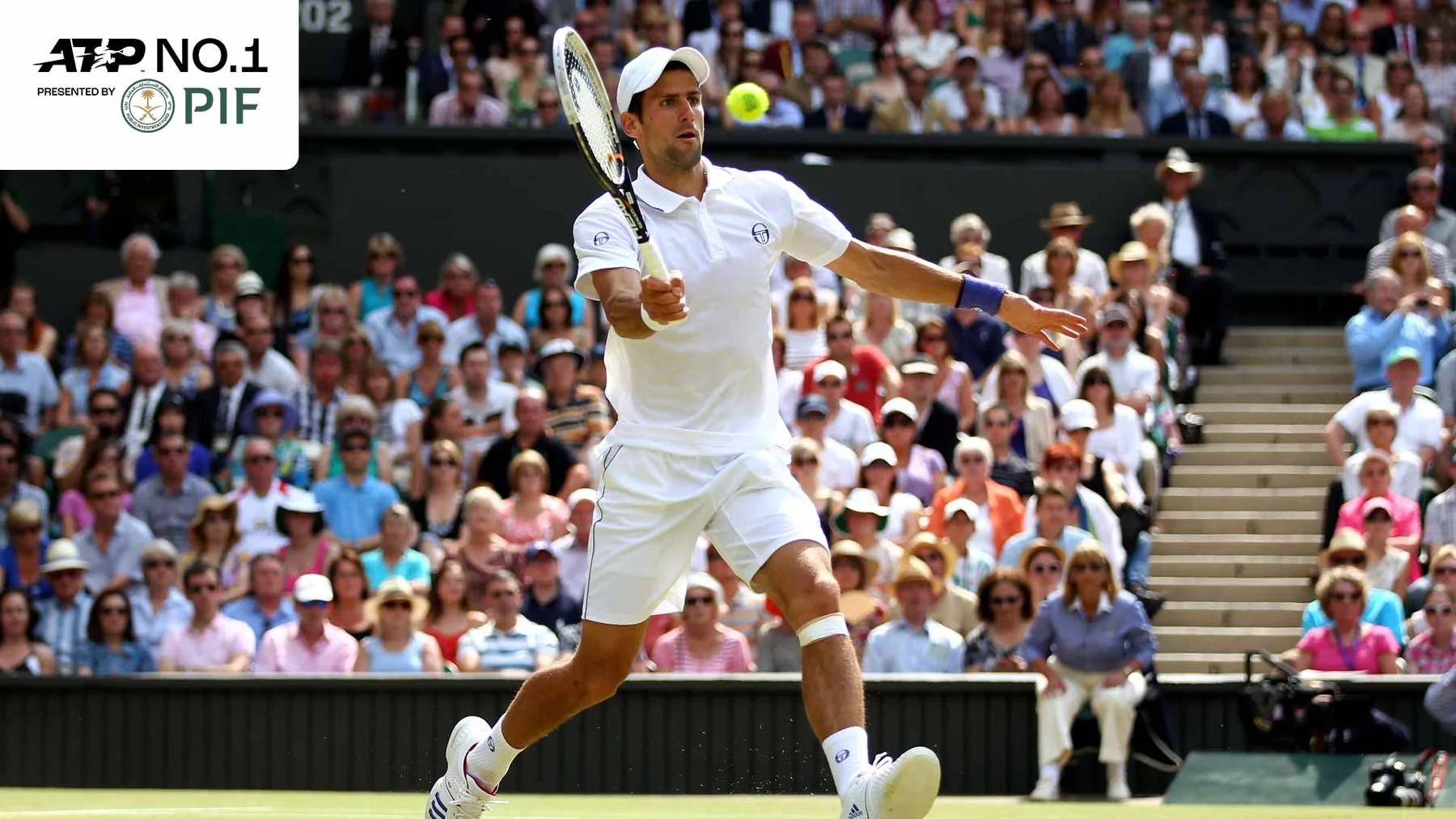
From a tennis perspective, the significance was repeatability. A return game that applies pressure from the first neutral ball, plus reliable depth from both wings, can travel from one event to another. That is an editorial explanation for why his game suited the ranking contest, rather than a claim that one technical adjustment alone produced the breakthrough.
His first reign lasted 53 weeks. Becoming No. 1 was therefore followed by more than a year of staying there. The story is a sustained accumulation of important results, crowned at Wimbledon, rather than a single upset that briefly overturned the established order.
The long reign and the 2018 ranking comeback
Two stretches explain much of Djokovic's ranking identity: the 122-week reign between 2014 and 2016, and the recovery from No. 22 to year-end No. 1 in 2018. One shows how long he could protect a lead. The other shows that losing position, even dramatically, did not prevent him from rebuilding a season around major titles.
The 122-week run from 2014 to 2016
His longest uninterrupted spell began on 7 July 2014 and ended on 6 November 2016. Across that period, the ranking stayed stable while the tournaments kept changing. Winning points was only half of the job; he also had to replace the value of earlier results as those results moved outside the counting window.
Andy Murray replaced him at the top on 7 November 2016. The year-end contest was still alive, however, and the two met in the season-ending final in London. Murray won 6-3, 6-4 to secure both that tournament and year-end No. 1. It is an especially clear example of why “losing No. 1” and “losing the year-end race” can refer to different matches.
Djokovic's No. 2 finish in 2016 therefore sits beside a much larger story than the annual table alone conveys. He had spent most of that year first. The late change reflects a rival's exceptional finish as well as Djokovic's own results; ranking movement is always relational.
From No. 22 back to the top in 2018
An elbow problem interrupted the following phase. Djokovic finished 2017 at No. 12 and underwent elbow surgery after the 2018 Australian Open. By mid-2018 he had fallen to No. 22. The ATP's 2018 awards account records his return from that low point to the top, alongside his player-voted Comeback Player of the Year award.
Wimbledon supplied the first major confirmation. He survived Nadal 10-8 in the fifth set of their semi-final, then beat Kevin Anderson for the title. Cincinnati followed, with a 6-4, 6-4 win over Federer completing his collection of all nine Masters 1000 tournaments. Winning the US Open and Shanghai added further weight to a recovery that already extended beyond one inspired fortnight.
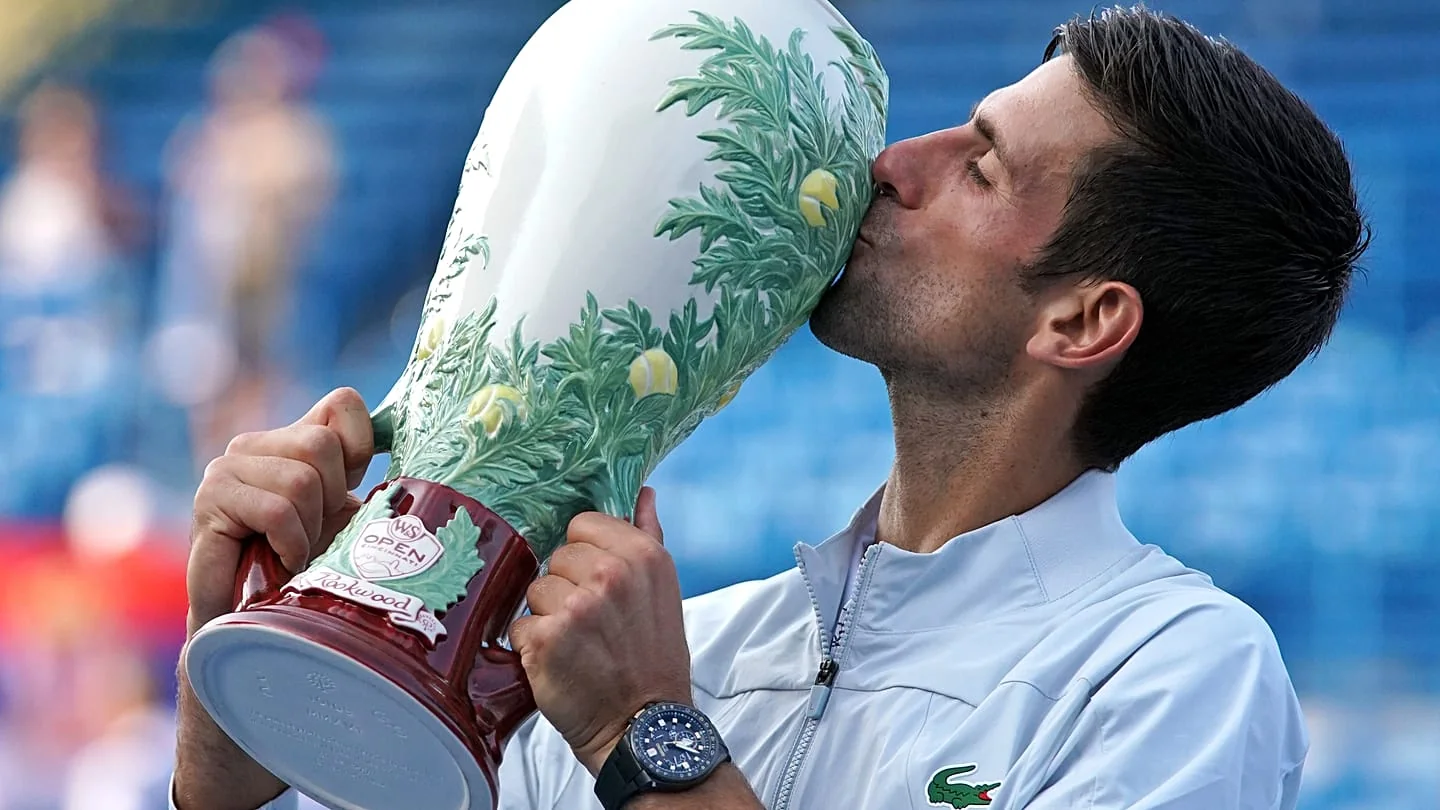
The analytical lesson is about evidence. A familiar player looking sharper for one match is encouraging; winning across grass and hard courts, then carrying that level into another major and another Masters event, is stronger evidence of recovery. The ranking eventually reflected that sequence. For following a similar rebuilding phase today, successive match results tell you more than one isolated highlight.
Why Djokovic's ranking can fall despite elite results
A ranking can decline even when a player remains capable of beating the best. The key questions are which results count, which older results leave the calculation, and how many points rivals collect. Career achievements establish historical stature; the current table measures a defined set of eligible results.
Consider an ordinary title defence. If an earlier championship result leaves the counting window and is replaced by a shorter run, a player's total can fall despite winning several matches that week. “Points lost” usually describes that comparison. It does not necessarily mean points were deducted as a punishment, or that an additional defeat was added to the player's record.
Djokovic's 2022 Wimbledon victory offers a different example. The ATP removed ranking points from that edition following Wimbledon's exclusion of Russian and Belarusian players. The tournament still produced a champion and a Grand Slam title, but Djokovic received none of the normal ATP championship points. The ATP's original statement explains the event-wide decision. A trophy list and a points total therefore describe different things.
In June 2024, another combination of circumstances ended a reign. Djokovic withdrew from his Roland Garros quarter-final because of a right-knee injury. He had won consecutive five-set matches against Lorenzo Musetti and Francisco Cerundolo, but could not continue. Jannik Sinner was then guaranteed to replace him at No. 1 on 10 June.
The withdrawal settled that week's calculation, yet it was not the whole explanation for Sinner's rise. The Italian's accumulated results had already created the possibility. Before the event, ATP calculations showed that a Sinner final would guarantee the change even if Djokovic won the tournament. That is an important corrective to describing every ranking switch as one player simply “giving away” a position.
For assessing Djokovic's form, separate the arithmetic from the tennis. His movement, recovery between matches and ability to sustain pressure on return inform what he might do next. The ranking gives a useful measure of recent results, but it does not tell you whether a particular matchup suits him. Both perspectives are needed when reading a late-career dip or predicting a comeback.
What the 2023-2025 finishes say about his later career
Djokovic's later ranking history is not a simple downward slope. He finished first in 2023, seventh in 2024 and fourth in 2025. Those changes reflect different seasons and counting results, while his established records remain part of the historical picture. The useful question is what each finish reveals, rather than whether every season matched his most dominant one.
The eighth year-end No. 1 in 2023
He secured his eighth year-end No. 1 by beating Holger Rune 7-6(4), 6-7(1), 6-3 in his opening match at the 2023 ATP Finals. At 36, he extended his own record as the oldest man to finish a season on top. That result settled the ranking award before the tournament champion had been decided.
The year's foundation was exceptional major-tournament consistency: titles at the Australian Open, Roland Garros and US Open, plus a Wimbledon final. Those deep runs supplied repeated evidence against the strongest fields over five sets. His success was not confined to one surface or one favourable section of a draw.
He subsequently won the ATP Finals as well, reaching seven titles at that event. Seven tournament trophies and eight year-end No. 1 finishes are separate records. Our ATP Finals guide explains the event; the ranking award recognises the season's position in the points table.
No. 7 in 2024 and No. 4 in 2025
Finishing seventh in 2024 did not make the year empty. Djokovic won Olympic singles gold in Paris and reached another Wimbledon final. Those achievements matter greatly to a career assessment. They do not make the published No. 7 incorrect, because an annual ranking and a personal list of career priorities answer different questions.
In 2025 he moved back to a No. 4 finish. The official year-end release counted it as his 17th season ending inside the top five, a men's record at that point. He also won his 100th tour-level title in Geneva and added his 101st in Athens. These are concrete signs of continued competitiveness, even though the year-end lead belonged to Carlos Alcaraz.
The editorial conclusion is about the balance between peak level and repetition. A veteran can still produce a superb final while finding it harder to reproduce the same workload across months. Conversely, a lower position does not prevent a strong finish from lifting him again. Djokovic's history contains enough reversals to make sweeping conclusions from a single ranking change particularly unhelpful.
How to follow Djokovic's next ranking change
To find Djokovic's current ATP ranking, begin with a dated official weekly list. Then use his official points breakdown to understand the results behind it. A career-high badge, an old tournament seed and a live ranking projection can all display different numbers without any of them describing the same moment.
The ATP's live-ranking explanation is especially useful during a tournament. Live totals account for points leaving the calculation and for newly earned points as play develops. They can therefore differ from the most recently published weekly ranking before Djokovic has played his first match of the week. A change on the screen is not necessarily a new result.
Check these questions in order when interpreting a movement:
- What is the ranking date? A weekly position and a historical season-end finish need separate labels.
- Is the table official or live? Live shows the developing position; a projected future round still has to be reached.
- Which score is leaving? Compare it with the score actually replacing it, including any eligible result that was previously outside the counting total.
- What are rivals doing? A player's points and ordinal position do not move in isolation.
For example, the ATP illustrates a 90-point score leaving and a previously non-counting 20-point result taking its place: the net fall is 70, rather than 90. The principle matters more than memorising an imagined Djokovic total. His actual calculation depends on the results and rules applicable on the date being examined.
For the tennis around that calculation, check today's matches and the tournament schedule. Entry, seeding, withdrawal and a completed match are separate pieces of information. A tournament on the calendar does not by itself confirm that Djokovic will play it.
Read this history as a record of what he has achieved, then use dated rankings and match evidence to assess the next change. His 428 weeks and eight year-end No. 1 finishes explain the scale of the career. The next week's position will be decided by eligible points and results, just as his previous returns to the summit were.
About the author
ATP Schedule Editorial Team
The ATP Schedule editorial team turns match times, scores, tournament information and verified tennis news into clear answers fans can use quickly.
View all articles by this author →Fan discussion
Comments
Sign in with Google to comment. Keep the discussion helpful and tennis-focused. New comments are reviewed before they appear.
Loading comments…