ATP Calendar 2026 PDF: Official Download and Printable Guide
Get the official 2026 ATP calendar PDF and a practical guide to its dates, tournament levels, surface codes, print settings and revision limits.
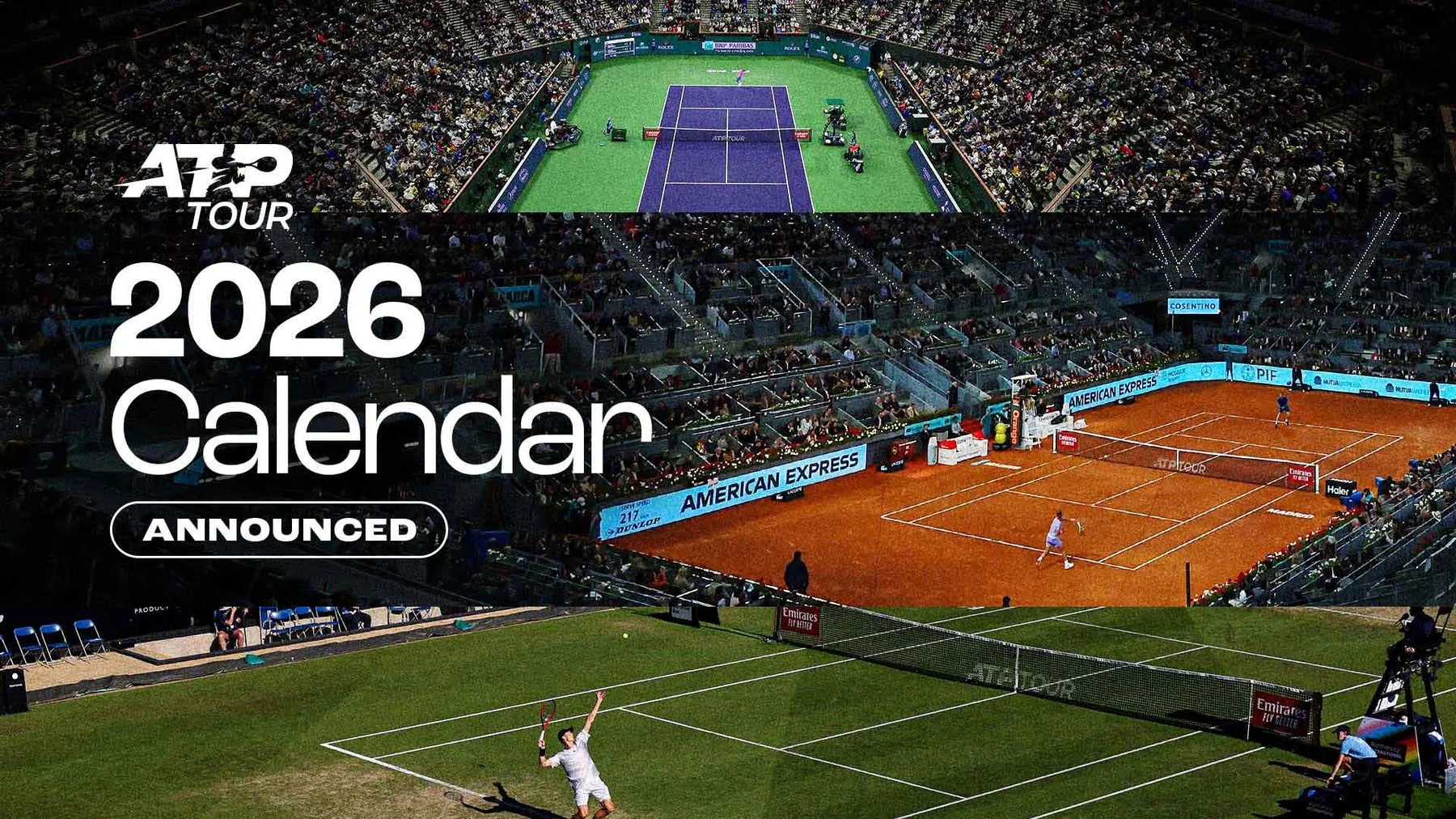
Looking for an ATP calendar 2026 PDF you can trust and print? Start with ATP's own download, check the revision date inside the file, and use it as a season map rather than a live order of play. As of August 19, 2026, the PDF linked from ATP's tournament calendar was the revised August 3 edition, a combined 11-page file whose first two pages cover the 2026 ATP Tour.
This guide shows which official file to choose, how to decode its compact fields, which parts of the season deserve special attention, and how to turn the PDF into a useful paper or digital planner. It also explains when to switch to the site's dynamic ATP tournament calendar, today's match page, or calendar-file download. That distinction matters: a PDF is excellent for seeing the entire year, but dates, event names and operational schedules can still change after publication.
Download the official ATP calendar 2026 PDF
The safest download is the PDF linked from the ATP Tour’s official tournament calendar. When checked on August 19, 2026, that button opened the 2026-27 ATP calendar published August 3, 2026. Save that file if you want the newest first-party printable available through ATP’s live calendar page.
Quick download check: open the official ATP tournaments page, select the ATP Tour view, and follow its calendar PDF link. Then look for the publication stamp inside the file. ATP may replace the linked edition after this guide is updated.
Which ATP PDF should you save?
The August document runs to 11 pages. Its first two pages give the compact 2026 ATP Tour overview, followed by a 2027 overview and detailed Challenger Tour pages. That broader file is useful if you follow players moving between the main tour and Challengers, but it is more than many fans need for a refrigerator-door season planner.
Search results also surface a two-page 2026 ATP Tour PDF dated December 2025. It is genuinely official and easier to print, but it is an older snapshot. Treat it as a compact reference, not proof that every tournament name, start date or late-season detail is still current.
Why the edition date matters
ATP first announced the season in February 2025, later published a full calendar table in November 2025, and has continued issuing revised PDF files. A search engine can retain every one of those versions. The word “official” therefore identifies the publisher; it does not automatically identify the newest revision.
Our practical rule is simple: keep the PDF for the season-wide picture, but verify dates in a live calendar before making a commitment. After downloading, open the 2026 ATP tournament calendar to filter current events and follow each tournament’s latest schedule. That pairing gives you a clean printable map without asking a static file to behave like a live service.
How to read the ATP PDF: dates, levels, surfaces and draws
Read each tournament from left to right, then check any small number printed after its city against the Other Information key. The overview is dense because it compresses a year into two pages; its codes are useful once you stop treating every number as a date.
The seven fields that matter
| Field | What it tells you | How to use it |
|---|---|---|
| Week / Date | Tour week and published start date | Follow both rows when an event spans two weeks. |
| City / Tournament | Host and event identity | Resolve a city’s superscript in the legend. |
| Category | Masters 1000, ATP 500, ATP 250 or another event type | Use the ATP levels guide for the hierarchy. |
| Surface | H, IH, CL or G | Read as hard, indoor hard, clay or grass. |
| Draws | Main field size in the overview | Do not mistake it for matches scheduled that day. |
The August PDF, for example, lists Indian Wells with a 96-player draw, Monte-Carlo with 56 and Wimbledon with 128. Many ATP 250s show 28, while the ATP Finals show eight. United Cup and Laver Cup are team events, so their figures are teams rather than singles players. For a broader explanation of the court codes, open our ATP surface directory.
Surface and schedule shorthand
The 2026 ATP Rulebook confirms the underlying classifications: outdoor courts are hard, clay or grass; indoor courts are classed as indoor hard unless ATP approves another surface. That is why Dallas appears as IH, Monte-Carlo as CL and Wimbledon as G.
The numbered notes explain non-standard start or final days. In the official key, 1 means Sunday start, 4 Wednesday start, 5 Thursday start, 8 Saturday final and 12 Thursday final. Indian Wells carries 4; Cincinnati carries 5; Montreal carries 1 and 12. The key also includes Tuesday, Friday and Saturday starts plus Monday, Tuesday and Wednesday finals. It skips the number 3, so never guess the meaning from sequence alone.
Finally, a repeated name is often intentional. Indian Wells, Madrid, Rome and Wimbledon each occupy two Tour weeks because their events cross the weekly boundary. The PDF maps the season; it does not replace the qualifying draw, doubles draw or daily order of play.
The 2026 ATP calendar at a glance
The 2026 men's season is best understood as a chain of anchor windows, not one flat list. ATP announced 59 tournaments across 29 countries in addition to the four Grand Slams. Within the Tour mix are nine Masters 1000s, 16 ATP 500s and 29 ATP 250s, plus the year-end and team events shown on the calendar.
Those category figures should not be added and labelled as one count of ATP-owned events: the ATP announcement explicitly reports its 59 tournaments in addition to the four majors. The PDF also carries United Cup, Davis Cup and Laver Cup because a fan planning the men's season needs those dates even though the events do not all sit in the same category.

Confirmed event mix
Seven Masters 1000s use the expanded 12-day format. That matters when reading the PDF: Indian Wells, Madrid, Rome and other long Masters occupy parts of two Tour weeks. Use the Masters 1000 calendar to isolate those premium stops, or the full ATP tournament calendar to compare levels.
The season's anchor windows
United Cup opens January 2, with Brisbane and Hong Kong beginning January 5. The majors then divide the year: Australian Open from January 18 to February 1; Roland Garros from May 24 to June 7; Wimbledon from June 29 to July 12; and US Open from August 31 to September 13.
The closing run is equally clear on the current file: Shanghai from October 7-18, Paris from November 2-8 and the Nitto ATP Finals from November 15-22. Davis Cup Finals follow in late November. The Next Gen ATP Finals remain listed as December TBC in the current official calendar, so do not build travel around an older location or date until ATP confirms it.
Follow the surface changes, not just the months
Color-code the PDF by surface if you want to see the competitive shape of the season. The 2026 calendar moves from outdoor and indoor hard courts into a concentrated clay block, a short grass swing, another hard-court run, and finally a largely indoor finish. Those transitions change what fans should watch for even when the tournament level stays the same.
Hard courts to clay and grass
- January-March: Australian hard courts lead to Indian Wells and Miami.
- March 30-June 7: ATP lists 11 clay events, ending at Roland Garros.
- June 8-July 12: seven grass events run from Stuttgart and ’s-Hertogenbosch through Wimbledon.
- After Wimbledon: resume reading the H and IH codes separately; outdoor and indoor hard courts are not the same calendar condition.
The official clay calendar counts one major, three Masters 1000s, three ATP 500s and four ATP 250s between March 30 and June 7. The grass calendar then starts on June 8: two ATP 250s open the swing the day after Roland Garros' published end date.

Why the transitions matter
ATP's own tour explainer describes hard courts as generally more neutral, clay as slower and higher-bouncing, and grass as lower-bouncing and faster. That usually shifts attention from patient baseline construction and movement on clay toward reaction time, return position and first-strike execution on grass. It is context, not a universal rule: ATP also notes that speed varies from tournament to tournament within the same surface family.
The Paris-to-grass turn is the sharpest planning signal. ATP's Halle and London preview showed Roland Garros champion Alexander Zverev entered in Halle the next week, while other deep Paris performers also changed surface. For fans, that means recent form needs interpretation rather than simple carry-over.
Use the ATP surface directory to isolate each block, then check this week's ATP schedule before watching. A printed “G” or “CL” tells you the court family; tournament-specific conditions, court preparation and the live order of play still shape the event you actually see.
PDF, live schedule or calendar file: choose the right tool
Use the PDF for the season map, not for today's order of play. The live schedule and downloadable calendar file solve different jobs. Choosing by task is safer than trying to make one format carry dates, local match times, court assignments and later revisions.
| Tool | Best use | What it cannot promise |
|---|---|---|
| Official ATP PDF | Print the season's weeks, levels, surfaces and draw sizes | Current court, player or local start time |
| Live tournament calendar | Filter current event dates, levels and surfaces | A final daily order of play months ahead |
| Matches today | Check match status and displayed local times | That weather will not cause a later move |
| This week's schedule | Plan the next run of singles and doubles matches | Unreleased court assignments |
| 2026 ICS download | Import all-day tournament windows and locations | Automatic updates or match-level start times |
What the PDF does well
Two printable pages reveal relationships that are easy to miss one event at a time: consecutive Masters, surface blocks, parallel ATP 250s and tournaments spanning two Tour weeks. It is also stable. Your notes do not disappear because a web filter changes. That makes it ideal for marking travel possibilities, priority viewing weeks and the events you want to follow.
When the PDF is not enough
The ATP Rulebook says the daily order of play should be released by 10 p.m. local time and can be changed with Supervisor approval. Washington supplied a real 2026 example: forecast weather led to a revised Sunday order, with the men's singles final moved to not before 2:30 p.m. A year-level PDF could never carry that decision.
The ICS button is a download, not a live subscription. It imports each tournament as an all-day date range with a location. Google Calendar's own help warns that imported events do not stay in sync. Re-download after important schedule revisions, and still use the live match pages near play.
This hierarchy keeps the task simple: PDF for the year, live tournament page for the event, and order of play for the day.
How to print the ATP calendar and build a personal planner
For a clean 2026 ATP Tour printout, select pages 1-2, use landscape or automatic orientation, and fit each page to the printable area. The current ATP-linked file has 11 pages because it also includes a 2027 overview and Challenger detail. Printing the entire file is unnecessary if your target is only the 2026 main-tour map.
Best print settings
- 1. Save the PDF locally. Add its edition date to the filename or write “ATP file checked August 19, 2026” on the printout.
- 2. Choose pages 1-2. These contain the 2026 Tour overview in the August 3 file. Pages 3-4 move to 2027; later pages cover Challengers.
- 3. Use Landscape or Auto Portrait/Landscape. Check the preview rather than relying on the printer's default orientation.
- 4. Select Fit or Shrink oversized pages. Adobe explains that Fit uses the printable area, while Actual size can crop content that is larger than the paper.
- 5. Inspect the smallest text. If A4 or Letter makes the footnotes unreadable, use one calendar page per sheet or move to larger paper instead of squeezing both PDF pages onto one side.
Acrobat Reader and Microsoft Edge both support page ranges, orientation, scale and preview. The labels can vary by device or printer driver, but the aim is constant: every month, surface code and numbered footnote must remain legible.
Turn the calendar into a travel and viewing plan
Do not fill every empty space. Circle the events you genuinely expect to follow, use one mark for possible trips and another for television priorities, and leave daily match times off the annual sheet. Those times often do not exist until the order of play is released.
A useful annotation has four parts
- Event and city
- Surface and level
- Your home timezone
- Recheck date before travel or viewing
For the next layer, open the ATP venues directory before planning a trip and the where-to-watch guide closer to play. Return to the live tournament calendar whenever a booking, leave request or long journey depends on the date. Your paper calendar should be the index to those checks, not their replacement.
Recheck these 2026 dates before you book or tune in
As verified on 19 August 2026, keep two late-season entries provisional: ATP's current season table shows a second ATP 250 on 8-14 November as TBD, and it lists the Next Gen ATP Finals for December with both the exact dates and host location still unconfirmed. Those are clear signals not to build a non-refundable trip around an older PDF. For the rest of the future calendar, the newest revised file is a strong starting point, but it should still be compared with the live tournament listing when a decision becomes costly or time-sensitive.
A release date tells you which version you are reading
The original 2026 ATP announcement said Marseille would move from February to October. The current official season table now lists Almaty, Brussels and Lyon for 19-25 October. Both pages remain useful when read as dated records: the announcement explains the launch plan, while the later table reflects the schedule now being presented to fans.
Check the calendar at three decision points
- When building the planner: record the tournament's week, city, level and surface from the newest PDF. Write the file's revision date beside the entry so you can immediately identify a stale printout later.
- Before spending money: compare the entry with ATP's live calendar and the tournament's official site. Confirm the venue and session date before purchasing a flight, hotel or ticket that cannot be changed. If only the sponsored title looks different, compare the city, week, category and surface before deciding that the event itself changed.
- During tournament week: switch to the event page and daily order of play for courts and start times, then consult the ATP viewing guide for market-specific television and streaming help. Player commitments and broadcast assignments do not belong on a year-level PDF.
Estoril provides a useful model. The official season calendar placed the clay-court ATP 250 on 20-26 July. ATP's event-week guide then added the draw time, qualifying and main-draw hours, final times, official tournament link and viewing links. The sources were not competing; they worked at different levels of detail. Apply the same handoff to every remaining event: use the PDF to reserve the week, the current calendar to confirm the route, and the event source to plan the day.
A printable ATP calendar is therefore reliable as a clearly dated snapshot, not as a promise that every operational detail will remain frozen. Keep it visible for the season-wide picture, and refresh the live evidence before travel, ticketing or a broadcast window depends on it.
Your simplest workflow: save the latest official ATP PDF, print pages 1-2 at a readable scale, mark your priority tournaments, and note the edition date. Then recheck the live calendar before booking and the event page during tournament week. That gives you the clarity of a printable 2026 overview without mistaking a static snapshot for a real-time schedule.
About the author
ATP Schedule Editorial Team
The ATP Schedule editorial team turns match times, scores, tournament information and verified tennis news into clear answers fans can use quickly.
View all articles by this author →Fan discussion
Comments
Sign in with Google to comment. Keep the discussion helpful and tennis-focused. New comments are reviewed before they appear.
Loading comments…